Skip to content
Windup & Wonder

Guides · Guides

Best STEM toys under $50

Under $25, the science aisle sells you a consumable: a tray, a booklet and three things you already own. Between $25 and $50 it starts selling instruments instead — a microscope, a telescope, a circuit grid. That is the whole reason this page exists separately.

By Stephen V.Updated How we pick
#ad

We earn a commission if you buy through our links. It does not change the price you pay and it does not decide our picks — our method is published in full, including the part where we say we have not played with these toys. How this works.

Top pick

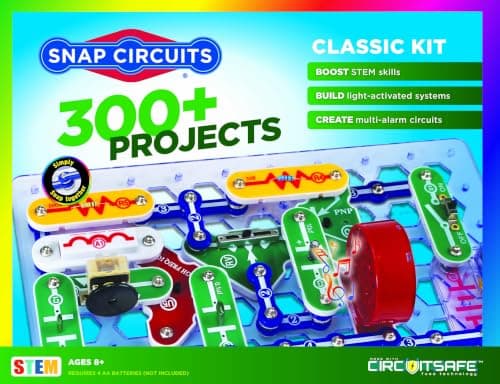
Snap Circuits Snap Circuits Classic SC-300 Electronics Kit

Snap Circuits Classic SC-300 Electronics Kit

Best overall under $50, graded 8+, and the biggest project count here · Snap Circuits grades it 8+.

Budget pick

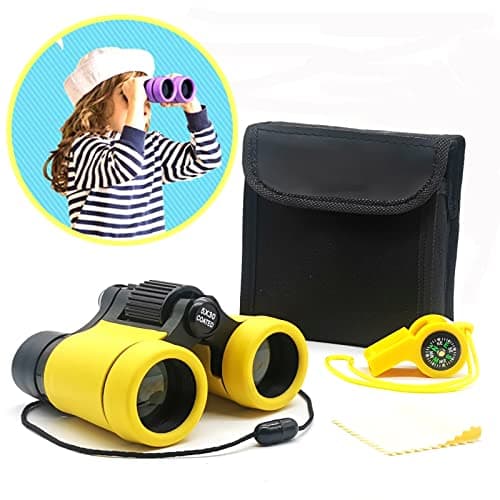
ARTOMIDE Kids Binoculars with Compass

Budget pick — the cheapest real instrument here, graded 3 to 12 · ARTOMIDE grades it 3–12.

#ad · we may earn a commission · prices come live from Amazon and were last checked November 25, 2026. Where we have no verified live price we show none.

The short answer

The picks, at a glance

#ToyBest forAge gradeNoisePrice
01Best overall under $50, graded 8+, and the biggest project count here8+Some noise$42.99Amazon
02Best for the youngest, graded 4+, and the only screen-free coding toy here4+Quiet$39.99Amazon
03Best microscope under $50, graded 5 to 125–12Silent$29.87Amazon
04Best telescope under $50, graded 8 to 128–12Silent$35.99Amazon
05Best long project, graded 8+, and the one that sits at the very top of the band8+Loud$48.99Amazon
06Best value on the page, graded 8 to 13, and nothing ever runs out8–13Quiet$14.22Amazon
07Best logic buy, graded 8+, and there is nothing to consume at all8+Quiet$24.99Amazon
08Best experiment kit, graded 8+, for a child who wants reactions8+Quiet$16.99Amazon
09Best build-and-learn kit, graded 8+8+Quiet$21.95Amazon
10Budget pick — the cheapest real instrument here, graded 3 to 123–12Silent$9.99Amazon

#ad · Prices come live from Amazon’s API and were last checked November 25, 2026. Where we have no verified live price we show none — we would rather leave a gap than print a number that has gone stale. Age grades are the manufacturer’s own; noise is our reading, not a measurement.

The verdict: the best STEM toy under $50 is Snap Circuits Classic, published for ages 8 and up with over 300 projects — two or three years of Saturdays with no soldering and no adult bottleneck. The budget pick is the Artomide kids’ binoculars, graded 3 to 12: the cheapest real optical instrument on the page and the only pick that does not need a table.

Every age grade is the manufacturer’s own published wording, and every price comes live from the price layer with the date it was checked printed beside it — which matters more on a page with a number in the title than anywhere else on this site. If a pick has moved above the line since we published, the price you see will say so. Our method is published in full.

What the extra $25 actually buys

We publish a STEM shelf under $25, and it is a genuinely good shelf. But the two bands are not the same product category with different margins — the thing you are buying changes at roughly $25, and it changes in one specific way.

Below $25, most of the science aisle is consumable. You are buying a set of reactions, a bag of grit, a sheet of chemicals: the kit works beautifully and then it is used up, and what remains is a plastic tray. There is nothing wrong with that — a good consumable kit is a great afternoon and sometimes a great month — but it is a finite purchase and should be bought knowing that.

Between $25 and $50, the shelf starts selling instruments. A microscope with a real objective lens. A telescope on a mount that holds still. A circuit grid with three hundred projects on it. A tumbler with a motor. These do not run out, which means the cost per month of use is frequently lower in the upper band than the lower one, even though the sticker is higher.

The practical rule: if the child has asked for a subject — astronomy, electronics, chemistry, geology — buy the instrument in this band. If they have asked for a science kit as a general idea, the cheaper shelf is the better test of whether the interest is real.

How to choose, in the order that matters

  • Start with the published age grade, not the skill. Every grade on this page is the manufacturer’s own wording, and on this shelf it usually reflects small parts, chemicals or a motor rather than difficulty. Buying under the grade is not ambition. The whole argument is on age grades explained.
  • Then ask what it consumes. Grit, chemicals, batteries, printer-paper refills. We state this on every pick above, because it is the single most common unpleasant surprise in this category and almost nobody prints it. The full version is on battery reality.
  • Then ask whether it needs an adult. The electronics grid, the logic puzzles, the solar kit and the binoculars all work with a child alone after the first build. The chemistry kit and the telescope do not. A STEM toy that requires a free parent gets used on the days a parent is free, which is fewer days than anyone plans for.
  • Then ask whether it has a second week. Project count is the honest proxy: 300 projects, forty puzzle challenges and twelve solar builds all have one. Six builds and a booklet is a weekend, which is fine if a weekend is what you are buying.
  • Only then look at the price. Within this band the spread is small enough that it should be the last tiebreak, not the first filter.

By age, since the band skews old

Be aware of one thing before you buy from this page: the $25-to-$50 STEM shelf is mostly graded 8 and up. That is not an accident — instruments have small parts, motors and chemicals, and the makers grade accordingly. If the child is younger, the honest options narrow quickly.

  • Three to five: the binoculars, graded 3 to 12, or the coding mouse, graded 4+. Those are the only two picks on this page a four-year-old can use, and the wider shelf for that age is on STEM toys for 4-year-olds and STEM toys for 5-year-olds.
  • Five to seven: the microscope, graded 5 to 12, with prepared slides so the first look happens immediately.
  • Eight to ten: this is the band’s home ground — electronics, telescope, tumbler, logic puzzles, solar kit, all graded 8+.
  • Ten to twelve: the crystal kit at 10+, and the electronics grid, which is the one pick here that is still interesting at twelve. The rest of that shelf is on STEM toys for 10 to 12.

What we would not buy in this band

A telescope with a shaky mount, at any price. It is the most common failure in sub-$50 astronomy and it is total: a wobbling image at 40x is worse than no telescope, because the child concludes that telescopes do not work. Mount quality matters more than aperture in this band, which is the reverse of the advice you get at every higher price.

A microscope with no slides included. The child has to find, prepare and mount a specimen before seeing anything at all, and that is where most of them stop. Prepared slides are worth more than extra magnification on a first instrument.

A kit whose project count is its only claim. “150 experiments” on a box that weighs almost nothing means 150 variations on three reactions. Read what the parts are, not how many activities the box claims to contain.

And a tablet-dependent STEM toy. If the kit needs an app, the app is the toy and the plastic is a controller — which is a different purchase from the one most people think they are making. The screen-free argument in full is on tech toys without screens, and the cheaper shelf is on STEM toys under $25.
In detail

Every pick, in full

01
Snap Circuits Snap Circuits Classic SC-300 Electronics Kit

Best overall under $50, graded 8+, and the biggest project count here

Snap Circuits Classic SC-300 Electronics Kit

Snap Circuits

Snap Circuits publishes the Classic SC-300 for ages 8 and up with over 300 projects, and at the price it is currently listed at it has only just cleared this band — it has not usually been a sub-$50 kit. The reason it beats the smaller Jr. set is the runway rather than the component count: 300-plus projects with a real difficulty curve is a multi-year kit rather than a Christmas afternoon, and the AM radio build near the top of the list is the project children actually remember. Nothing is soldered and nothing is stripped, so there is no adult bottleneck after the first build, and the parts are backwards compatible with the Jr. kit if the house already owns one. Honest limits: batteries are required and are not supplied; the first fifty projects overlap with the Jr. set, so if this is the household's first electronics kit the cheaper Jr. box is genuinely the better place to start.

Age grade:
8+
Batteries:
manufacturer does not publish a battery requirement
Noise:
Some noise
Mess:
Contained
Assembly:
manufacturer does not publish an assembly time
Price:
$42.99 as of November 25, 2026

Age grade, battery and assembly wording are quoted from Snap Circuits’s own product listing, read on September 7, 2026. The manufacturer’s exact words: “Ages 8+”. Noise and mess are our reading, not a measurement — we have not played with this.

What it gets right

  • Three hundred-plus projects is a genuine multi-year kit rather than a Christmas afternoon
  • Backwards compatible with the Jr. parts, so the earlier kit is not wasted
  • Includes an AM radio build, which is the project children remember

What it doesn’t

  • Roughly double the price of the Jr. kit, and the first fifty projects overlap
  • Batteries again required and again not supplied

How loud

The project list includes sirens, alarms and an AM radio, so some builds make noise on purpose. No published sound level.

How much mess

More parts than the Jr. kit but the same tray-based storage.

Skip this if…

…you are buying the child's first electronics kit. Start with the Jr. set — if they finish it, this upgrade is earned and welcome.

$42.99See it on Amazon

$88.4951% off

Price checked November 25, 2026. Toy prices move constantly, especially in December — Amazon’s price at checkout is the one that counts.

#ad · we may earn a commission from this link to Snap Circuits Classic SC-300 Electronics Kit

02
Learning Resources Code & Go Robot Mouse, Rechargeable

Best for the youngest, graded 4+, and the only screen-free coding toy here

Code & Go Robot Mouse, Rechargeable

Learning Resources

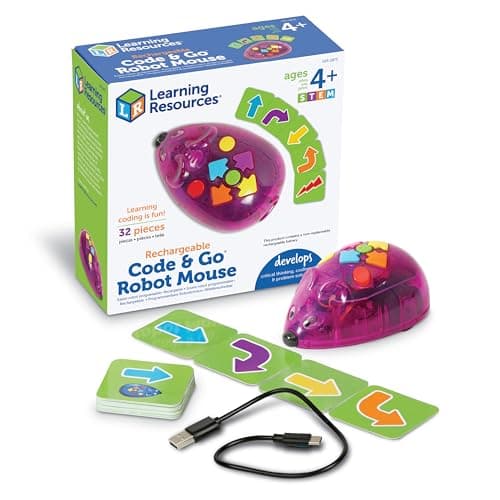
Learning Resources publishes the rechargeable Code & Go Robot Mouse for ages 4 and up, and it is the lowest published grade on this page by four years. It is also the only pick here whose maker prints "no screens required" on the listing itself — the claim is theirs, not ours. The child builds a sequence by pressing direction buttons on the mouse's back, sets it down, and watches the sequence either work or fail, which is the entire debug loop of programming run by a child who cannot yet read. Thirty double-sided coding cards and an activity guide are in the box, and that is what turns button-pressing into planning. It charges over a USB cord, so this is a powered toy with no batteries to buy, ever. Honest limits: there are no maze walls, tunnels or cheese wedge — the maker sells this version as an add-on or replacement for its activity sets, so buy a full set if you want the maze; and at four, planning a route before running it means an adult is on the floor too.

Age grade:
4+
Batteries:
manufacturer does not publish a battery requirement
Noise:
Quiet
Mess:
Contained
Assembly:
manufacturer does not publish an assembly time
Price:
$39.99 as of November 25, 2026

Age grade, battery and assembly wording are quoted from Learning Resources’s own product listing, read on September 7, 2026. The manufacturer’s exact words: “Ages 4+”. Noise and mess are our reading, not a measurement — we have not played with this.

What it gets right

  • Rechargeable over a USB cord, so this is a powered toy with no AA batteries to buy, ever
  • Learning Resources states “screen-free coding fundamentals” and “no screens required” on the listing — the claim is the maker's, not ours
  • Thirty double-sided coding cards and an activity guide are in the box, which is what turns button-pressing into sequencing

What it doesn’t

  • No maze walls, tunnels or cheese wedge — the maker lists this version as a replacement or add-on for the Code & Go activity sets
  • Graded 4+, but planning a route before running it is the entire activity, so at four an adult is on the floor too

How loud

Learning Resources advertises no sound feature on this listing at all — what it advertises is screen-free coding. The noise is a small motor on a hard floor.

How much mess

One mouse, a charging cord and thirty cards. The cards are the only thing that goes missing.

Skip this if…

…you want the maze. This is the rechargeable mouse plus cards, which Learning Resources sells as an add-on or replacement for the activity sets — buy an activity set if you want walls and tunnels in the box.

$39.99See it on Amazon

Price checked November 25, 2026. Toy prices move constantly, especially in December — Amazon’s price at checkout is the one that counts.

#ad · we may earn a commission from this link to Code & Go Robot Mouse, Rechargeable

03
Uarzt 58-Piece Kids Microscope Kit

Best microscope under $50, graded 5 to 12

58-Piece Kids Microscope Kit

Uarzt

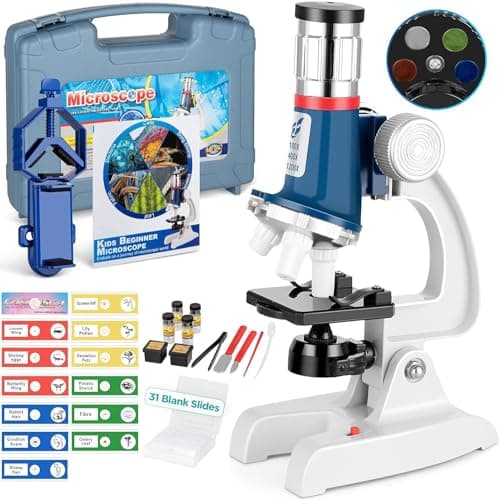
This 58-piece kit is published for ages 5 to 12, with a metal body, LED illumination, 100x to 1200x magnification and prepared slides in a carrying case. Two details decide whether a child's microscope gets used twice or fifty times, and this one has both. The first is the metal body: plastic microscopes at the same price lose focus the moment the stage is nudged, and a child who cannot hold an image gives up. The second is the prepared slides — a microscope with none is a homework assignment, because the child has to find, prepare and mount something before seeing anything at all, and most five-year-olds stop at that step. With slides in the box the first look happens in the first minute, and that is what gets a child collecting pond water the following week. Honest limits: it needs two AA batteries for the LED and the maker does not include them; and the slides are glass in a kit graded from five, so the youngest end of that range needs an adult alongside.

Age grade:
5–12
Batteries:
Requires 2 AA batteries (not included)
Noise:
Silent
Mess:
Contained
Assembly:
manufacturer does not publish an assembly time
Price:
$29.87 as of November 25, 2026

Age grade, battery and assembly wording are quoted from Uarzt’s own product listing, read on September 7, 2026. The manufacturer’s exact words: “Ages 5-12”. Noise and mess are our reading, not a measurement — we have not played with this.

What it gets right

  • Metal body rather than the plastic toy microscopes at the same price, so focus actually holds
  • Prepared slides included, so there is something to look at immediately
  • Published 5 to 12 range makes it a genuinely long-lived purchase

What it doesn’t

  • Requires 2 AA batteries, not included, for the LED
  • Glass slides in a kit graded from five needs an adult present the first few times

How loud

Nothing but an LED.

How much mess

Slides and small tools in a case. The slides are glass, which is the thing to supervise.

Skip this if…

…the child is at the young end and unsupervised. Focusing a microscope is fiddly and glass slides break — five-year-olds need company for this one.

$29.87See it on Amazon

$39.9925% off

Price checked November 25, 2026. Toy prices move constantly, especially in December — Amazon’s price at checkout is the one that counts.

#ad · we may earn a commission from this link to 58-Piece Kids Microscope Kit

04
Blue Marble NASA Lunar Telescope for Kids

Best telescope under $50, graded 8 to 12

NASA Lunar Telescope for Kids

Blue Marble

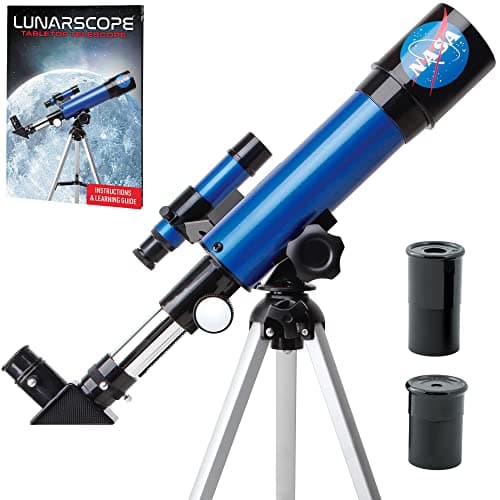
Blue Marble publishes this NASA Lunar Telescope for ages 8 to 12, with a tripod and a finder scope, and it is on this page because of what its own name is honest about: it is a Moon telescope. At this aperture the Moon is genuinely astonishing — craters, the lunar seas, the shadow line running down the terminator — and the Moon is the one object in the sky that never disappoints through a small instrument. The tripod and finder scope are the reason it is the right buy rather than the cheap buy: the cheapest telescopes omit both and are then unusable, because a wobbling image at any magnification is worse than no telescope at all. Honest limits, and you should say them out loud before the first night: the planets are dots at this aperture and deep-sky objects are invisible, so a child expecting nebulae will be let down; and it needs a clear, reasonably dark night, which is a lot of conditions to attach to a gift.

Age grade:
8–12
Batteries:
manufacturer does not publish a battery requirement
Noise:
Silent
Mess:
No mess
Assembly:
manufacturer does not publish an assembly time
Price:
$35.99 as of November 25, 2026

Age grade, battery and assembly wording are quoted from Blue Marble’s own product listing, read on September 7, 2026. The manufacturer’s exact words: “Ages 8-12”. Noise and mess are our reading, not a measurement — we have not played with this.

What it gets right

  • The Moon through even a small telescope is genuinely astonishing, and this one does that job properly
  • Tripod and finder scope included, which the cheapest telescopes omit and then become unusable
  • Published 8 to 12 grade matches the patience needed to actually aim it

What it doesn’t

  • Planets are dots and deep-sky objects are invisible at this aperture — set expectations before the first night
  • Needs a clear night and a dark-ish garden, which is a lot of conditions for a gift

How loud

Nothing.

How much mess

One instrument on a tripod. There is nothing to lose but the eyepieces.

Skip this if…

…you live somewhere with permanent cloud or heavy light pollution. A telescope that never gets a good night becomes a reproach in the corner of a bedroom.

$35.99See it on Amazon

$44.9920% off

Price checked November 25, 2026. Toy prices move constantly, especially in December — Amazon’s price at checkout is the one that counts.

#ad · we may earn a commission from this link to NASA Lunar Telescope for Kids

05
Blue Marble National Geographic Hobby Rock Tumbler Kit

Best long project, graded 8+, and the one that sits at the very top of the band

National Geographic Hobby Rock Tumbler Kit

Blue Marble

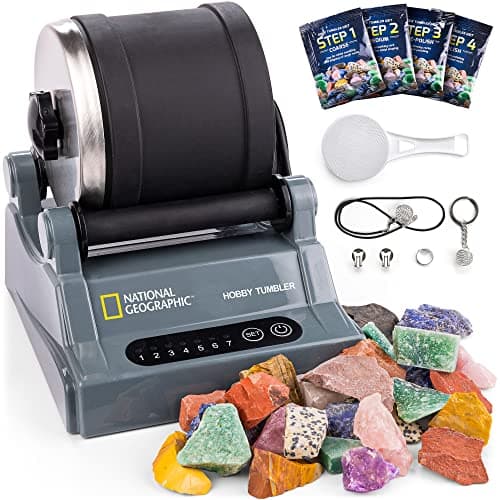
National Geographic publishes this rock tumbler kit for ages 8 and up, and it is the only pick here whose output takes weeks rather than minutes. The tumbler runs for days at a time in four stages, with coarser and finer grit, and at the end the child has polished stones they made rather than a finished kit they assembled. That delay is the pedagogy: it is the clearest demonstration of mechanical weathering a household can own, and it teaches patience in a way nothing else on this shelf does. Honest limits, and they are substantial: the barrel runs a small motor continuously for several days, which is a constant low hum somewhere in the house; the grit is consumable and refills are an ongoing cost; and it sits at the very top of this price band, so a modest price rise puts it over the line. Check the live price before committing to it.

Age grade:
8+
Batteries:
manufacturer does not publish a battery requirement
Noise:
Loud
Mess:
Contained
Assembly:
manufacturer does not publish an assembly time
Price:
$48.99 as of November 25, 2026

Age grade, battery and assembly wording are quoted from Blue Marble’s own product listing, read on September 7, 2026. The manufacturer’s exact words: “Ages 8+”. Noise and mess are our reading, not a measurement — we have not played with this.

What it gets right

  • The result is genuinely impressive — polished stones a child made themselves
  • Teaches patience in a way very few toys manage, because the machine enforces it
  • Published 8+ grade and the process is safe once the barrel is sealed

What it doesn’t

  • Runs for days and hums the entire time; it cannot live in a bedroom
  • Grit is consumable and a full four-stage batch uses a lot of it

How loud

The barrel runs continuously for days per stage. It is a constant low rumble, not a burst. No decibel figure is published, and the usual advice is a garage or a basement.

How much mess

Grit and slurry at each stage change. Messy for ten minutes, four times per batch.

Skip this if…

…you live in an apartment with thin walls or the child's room is the only place for it. The noise is continuous and the run time is measured in weeks.

$48.99See it on Amazon

$58.0016% off

Price checked November 25, 2026. Toy prices move constantly, especially in December — Amazon’s price at checkout is the one that counts.

#ad · we may earn a commission from this link to National Geographic Hobby Rock Tumbler Kit

06
Sillbird 12-in-1 Solar Robot Building Kit

Best value on the page, graded 8 to 13, and nothing ever runs out

12-in-1 Solar Robot Building Kit

Sillbird

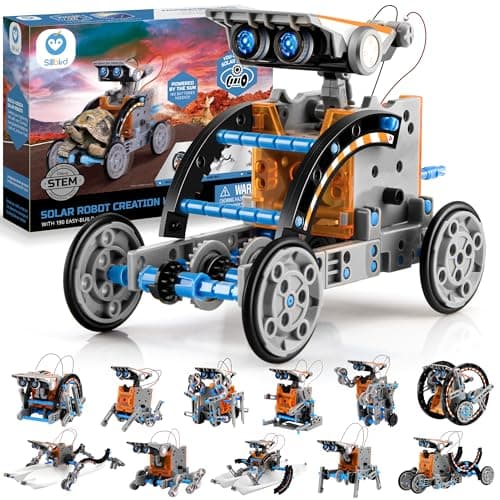
Sillbird publishes this 12-in-1 solar robot building kit for ages 8 to 13, the widest published grade here, and it is the value answer on this page for one structural reason: it is not a consumable. Twelve machines come out of one parts bin and every one of them is driven by a solar cell, so there is no battery, no charging, no cable and nothing to replace — which is unusual in a category where most of the shelf is designed to be used up. It is also a better physics lesson than its price suggests, because the robot stops in shade and restarts in sun and the child works out why without being told. Honest limits: it needs direct sun or a genuinely bright bulb, so a dark winter week kills it completely; and the small plastic tabs are easy to over-tighten and snap, usually on the first build.

Age grade:
8–13
Batteries:
manufacturer does not publish a battery requirement
Noise:
Quiet
Mess:
Contained
Assembly:
manufacturer does not publish an assembly time
Price:
$14.22 as of November 25, 2026

Age grade, battery and assembly wording are quoted from Sillbird’s own product listing, read on September 7, 2026. The manufacturer’s exact words: “Ages 8-13”. Noise and mess are our reading, not a measurement — we have not played with this.

What it gets right

  • Solar-powered, so there is no battery cost and nothing to run out on Christmas afternoon
  • Twelve published builds from one parts set, which is real rebuild value
  • Published 8 to 13 grade with genuine assembly difficulty at the top end

What it doesn’t

  • Needs actual direct sunlight; on an overcast January day it does nothing at all
  • Small plastic parts that snap off if a build is forced

How loud

Small motor whirring. There is no speaker and no sound feature.

How much mess

Many small plastic parts during assembly. They belong in the box and the box has compartments.

Skip this if…

…you are giving it in midwinter in a dark climate. A solar robot that will not move is a bad first impression that the toy may never recover from.

$14.22See it on Amazon

$24.9943% off

Price checked November 25, 2026. Toy prices move constantly, especially in December — Amazon’s price at checkout is the one that counts.

#ad · we may earn a commission from this link to 12-in-1 Solar Robot Building Kit

07
ThinkFun ThinkFun Gravity Maze Slide Marble Logic Game

Best logic buy, graded 8+, and there is nothing to consume at all

ThinkFun Gravity Maze Slide Marble Logic Game

ThinkFun

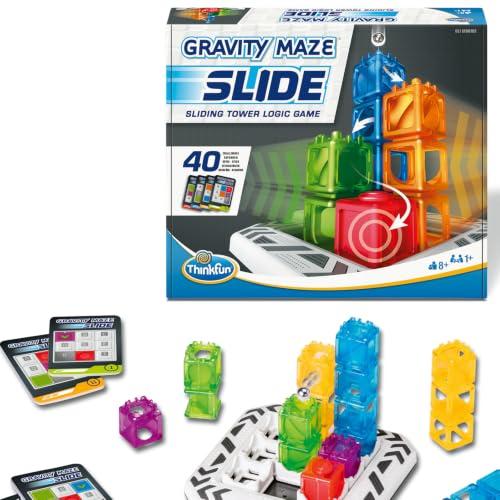
ThinkFun publishes Gravity Maze Slide for ages 8 and up — a marble run that is also a logic puzzle, with forty challenges from beginner to expert. The child is given a start, a target and a fixed set of towers that slide into position on a grid, and has to work out the arrangement that gets the marble from one to the other. It is the purest value in the category: no batteries, no refills, no consumables, no app, and a solution that proves itself, because the marble either arrives or it does not. It also plays solo, which is the thing a household needs more of — a puzzle that does not require a second person to be free gets picked up on a wet Tuesday. Honest limits: the challenge set is the product, so a lost booklet takes most of the value with it, and a determined child finishes all forty with no expansions widely available; and there are three loose marbles, which is three too many if there is a baby crawling.

Age grade:
8+
Batteries:
manufacturer does not publish a battery requirement
Noise:
Quiet
Mess:
Contained
Assembly:
manufacturer does not publish an assembly time
Price:
$24.99 as of November 25, 2026

Age grade, battery and assembly wording are quoted from ThinkFun’s own product listing, read on September 7, 2026. The manufacturer’s exact words: “Ages 8+”. Noise and mess are our reading, not a measurement — we have not played with this.

What it gets right

  • Forty graded challenges with verifiable solutions — the marble arriving is the proof
  • Plays solo, so it fills the same gap Rush Hour does with a completely different mechanic
  • Published 8 and up with no upper bound, and the maker's own framing is kids and adults alike — the expert end earns that

What it doesn’t

  • Marbles, in a household that may have a toddler in it
  • Forty challenges and no expansions widely available — a determined child finishes the set

How loud

One marble falling through a short tower. Considerably quieter than an actual marble run.

How much mess

Towers, a grid and marbles. Only three marbles, which is a far smaller loose-marble problem than a marble run.

Skip this if…

…there is a baby crawling. Three marbles is fewer than a marble run but three is not zero.

$24.99See it on Amazon

Price checked November 25, 2026. Toy prices move constantly, especially in December — Amazon’s price at checkout is the one that counts.

#ad · we may earn a commission from this link to ThinkFun Gravity Maze Slide Marble Logic Game

08
Doctor Jupiter Ultimate Science Experiments Kit

Best experiment kit, graded 8+, for a child who wants reactions

Ultimate Science Experiments Kit

Doctor Jupiter

Doctor Jupiter publishes this experiments kit for ages 8 and up, and the single reason to buy it is that the consumables are in the box. Kits in this category live or die on that: a science kit that sends you to the supermarket for vinegar and baking soda before anything happens is a shopping list with a lid, and it gets done once. This one works on day one. It is also structured as many short experiments rather than one long one, which matches how long an eight-year-old actually sits at a table, and the results are visible and immediate — fizzing, color change, a precipitate appearing — which is what a child means when they ask for a science kit. Honest limits, and they weigh more here than on anything else on this page: the consumables run out and refills are not sold separately, so this is the one genuinely finite purchase on the list; and it needs an adult nearby and a surface you can wipe, so it is not an independent activity.

Age grade:
8+
Batteries:
manufacturer does not publish a battery requirement
Noise:
Quiet
Mess:
Spreads
Assembly:
manufacturer does not publish an assembly time
Price:
$16.99 as of November 25, 2026

Age grade, battery and assembly wording are quoted from Doctor Jupiter’s own product listing, read on September 7, 2026. The manufacturer’s exact words: “Ages 8+”. Noise and mess are our reading, not a measurement — we have not played with this.

What it gets right

  • Consumables included, so the kit works on day one without a shopping trip
  • Multiple short experiments rather than one long one, which suits an eight-year-old's session length
  • Published 8+ grade and the chemistry is genuinely age-appropriate

What it doesn’t

  • Consumables run out and refills are not sold separately — after that it is a box of empty tubes
  • Needs an adult nearby, so it is not an independent activity

How loud

Nothing electronic in the box.

How much mess

Powders, liquids and colored reactions on a kitchen table. Cover the surface first; most of it wipes off, some of it stains.

Skip this if…

…nobody has an hour to supervise. A science kit done alone by an unsupervised eight-year-old is either boring or a problem, and neither is what you paid for.

$16.99See it on Amazon

$19.9915% off

Price checked November 25, 2026. Toy prices move constantly, especially in December — Amazon’s price at checkout is the one that counts.

#ad · we may earn a commission from this link to Ultimate Science Experiments Kit

09
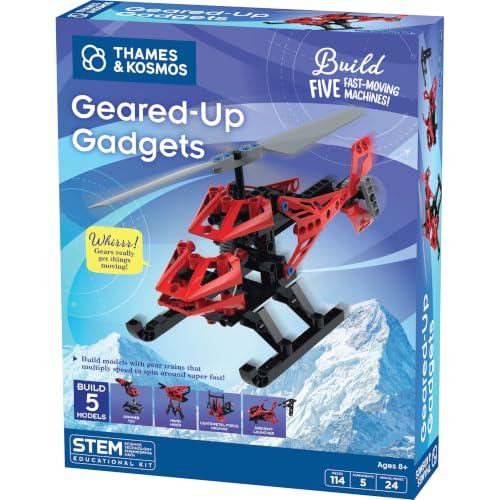
Thames & Kosmos Geared-Up Gadgets 5-in-1 Engineering Set

Best build-and-learn kit, graded 8+

Geared-Up Gadgets 5-in-1 Engineering Set

Thames & Kosmos

Thames & Kosmos publishes this Geared-Up Gadgets set for Ages 8+, and the manual is as much of it as the parts: five working models out of one parts set — a rescue copter, an aircraft launcher, a hand mixer, a spinner toy and a centripetal force machine — with 24 pages explaining the gears and transmissions while they turn. The format is the reason it ranks here rather than the parts count. Most mechanism kits supply steps; this one supplies the idea, so a child finishes understanding why a small gear driving a large one trades speed for turning force — a real piece of physics they will meet again in a classroom. The maker states no batteries required, so there is nothing to charge and nothing to replace. Honest limits: five builds is a finite sequence, and once they are done it is a parts bag; and half the value is on the page, so a child who will not read the explanation has bought a short afternoon of plastic.

Age grade:
8+
Batteries:
No batteries required
Noise:
Quiet
Mess:
Contained
Assembly:
manufacturer does not publish an assembly time
Price:
$21.95 as of November 25, 2026

Age grade, battery and assembly wording are quoted from Thames & Kosmos’s own product listing, read on September 7, 2026. The manufacturer’s exact words: “Ages 8+”. Noise and mess are our reading, not a measurement — we have not played with this.

What it gets right

  • Gears and transmissions are what the manual teaches, not just what the models happen to contain
  • Five models from the same parts set, so finishing the first build does not finish the kit
  • The maker publishes no batteries required, which is unusual for a kit whose models move

What it doesn’t

  • Five builds is a finite sequence, and the parts are Thames & Kosmos’s own — nothing on the listing claims LEGO compatibility — so they do not fold into a brick collection afterwards
  • The maker grades it Ages 8+ in the listing title and “ages 6 and up” in a feature bullet on the same listing; we publish the higher number, but the inconsistency is theirs

How loud

Gears and a hand crank. The maker states no batteries required, so nothing in the box makes a sound on its own.

How much mess

Plastic parts that live in the box they came in. It is published as a 5-in-1, so it is one model at a time out of the same parts — they come apart again rather than accumulating.

Skip this if…

…the household already owns a lot of LEGO Technic. The listing claims no LEGO compatibility, so a Technic bin buys more mechanism per dollar than starting a second, separate parts system does.

$21.95See it on Amazon

Price checked November 25, 2026. Toy prices move constantly, especially in December — Amazon’s price at checkout is the one that counts.

#ad · we may earn a commission from this link to Geared-Up Gadgets 5-in-1 Engineering Set

10
ARTOMIDE ARTOMIDE Kids Binoculars with Compass

Budget pick — the cheapest real instrument here, graded 3 to 12

ARTOMIDE Kids Binoculars with Compass

ARTOMIDE

ARTOMIDE publishes these kids' binoculars for ages 3 to 12, 5x30, with a rubber-armored housing, soft rubber eyecups, a compass and a whistle. That is the lowest grade and the widest range on this page, and it is the budget pick by a long way. They earn the slot rather than merely undercutting everything for two reasons. The barrels fold in to match a small child's eye spacing, which is the usual reason children's binoculars get handed back after a minute. And they are built around being dropped, which no other optic here is. They are also the only pick on this page that does not need a table — the thing being looked at is outside, in daylight, in the hundreds of hours a telescope cannot work. Honest limits: 5x is modest and the maker states a usable range of roughly 328 to 492 feet in good conditions; the view is clear in the center and soft at the edges; and it will not show a single crater on the Moon, which is exactly what a child asking for a telescope wants.

Age grade:
3–12
Batteries:
manufacturer does not publish a battery requirement
Noise:
Silent
Mess:
No mess
Assembly:
manufacturer does not publish an assembly time
Price:
$9.99 as of November 25, 2026

Age grade, battery and assembly wording are quoted from ARTOMIDE’s own product listing, read on September 7, 2026. The manufacturer’s exact words: “Ages 3-12”. Noise and mess are our reading, not a measurement — we have not played with this.

What it gets right

  • Published from 3 years, which is five years earlier than any telescope here, and the lowest-priced thing in this registry by some distance
  • Rubber armor and a stated drop-resistant housing — this is the rare optic designed around being dropped
  • Folding barrels adjust to a small child's eye spacing, which is the usual reason kids' binoculars do not work
  • Usable in daylight, so it gets used in the hundreds of hours a telescope cannot

What it doesn’t

  • 5x magnification is modest, and the maker states a furthest usable range of roughly 328 to 492 feet in good conditions
  • A toy-grade optic: the view is clear in the center and soft at the edges
  • Will not show a single crater on the Moon, which is what a child asking for a telescope is actually asking for

How loud

Optics and a plastic whistle. The whistle is the only thing in the box that makes a sound, and it is the first thing to confiscate.

How much mess

One object on a neck strap.

Skip this if…

…the child specifically asked to look at space. Binoculars are the better optic for a six-year-old in almost every way except the one they care about, and a substitute gift that misses the point lands badly.

$9.99See it on Amazon

Price checked November 25, 2026. Toy prices move constantly, especially in December — Amazon’s price at checkout is the one that counts.

#ad · we may earn a commission from this link to ARTOMIDE Kids Binoculars with Compass

The toys

The toys this guide is about

Every one of these carries its manufacturer’s published age grade and a live Amazon price, read November 25, 2026. Full rankings live in the roundups linked above.

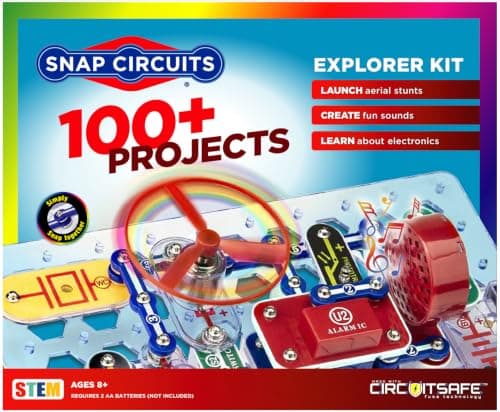
  • Snap Circuits Snap Circuits Jr. SC-100 Electronics Kit

    If the budget is tighter and 100 projects is enough

    Snap Circuits Jr. SC-100 Electronics Kit

    Age grade 8+

    Snap Circuits publishes the Jr. SC-100 for ages 8 and up with over 100 projects. Same snap-on grid, same no-soldering design, substantially less money, and for most eight-year-olds the first hundred projects are already more than a year of activity.

  • Sobrzy Sobrzy 50mm Beginner Telescope for Kids

    If the telescope has to be carried to a campsite

    Sobrzy 50mm Beginner Telescope for Kids

    Age grade 8–12

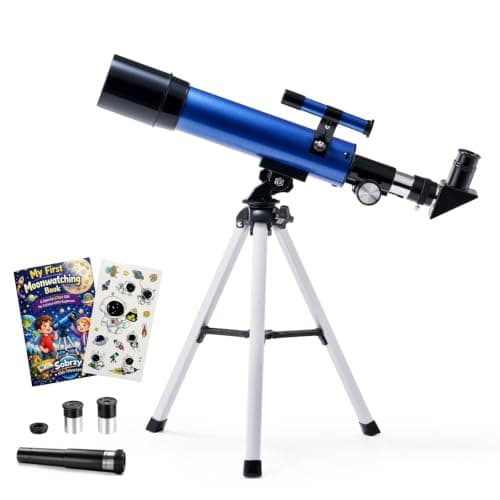
    Sobrzy publishes this 50mm beginner telescope for ages 8 to 12, 20x to 100x, with a tripod, two eyepieces and a finder scope. It is light enough that a nine-year-old carries the whole thing outside in one trip, which is what actually decides how often a telescope gets used. The compromise is the tripod: it is lightweight, and at 100x a wobble is the difference between a crater and a smear.

  • ThinkFun ThinkFun Rush Hour Traffic Jam Logic Game

    If you want logic in a box that fits in a coat pocket

    ThinkFun Rush Hour Traffic Jam Logic Game

    Age grade 8+

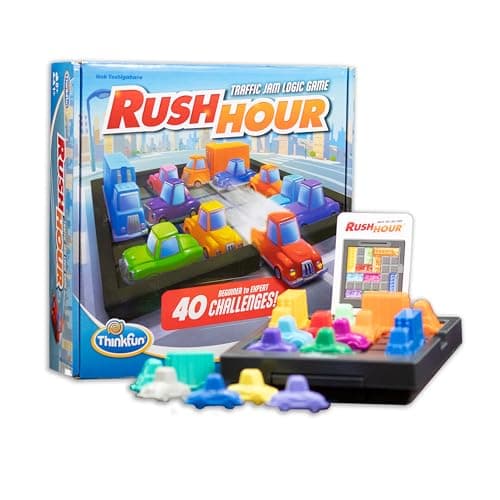
    ThinkFun publishes Rush Hour for kids age 8 and up — a sliding-block traffic puzzle with forty graded challenges whose last few defeat adults. Genuinely single player, no batteries, nothing to consume, and the whole thing packs into its own board for travel.

  • 4M 4M Crystal Growing Science Kit

    If the child wants chemistry that leaves something behind

    4M Crystal Growing Science Kit

    Age grade 10+

    4M recommends this crystal growing kit for ages 10 and up, with seven separate growths and display cases so the results get kept. It is a multi-day project like the rock tumbler but silent, and the output is a specimen rather than a polished stone. It needs boiling water and an adult at the critical step, which is why the grade is 10+.

#ad · As an Amazon Associate we earn from qualifying purchases. How this works.

How we picked

Toys we claim to have played with: 0

Every toy site tells you they tested forty toys with a focus group of real children. We have not played with any of these, and we say so. Here is what we do instead: we read the manufacturer’s own listing and print its published age grade word for word, we record the battery requirement and the assembly note where the maker publishes one and say plainly when it does not, we pull the price live from Amazon so it is never a number we remembered, and we name one thing on every list we would not buy.

The noise and mess ratings are our judgment from what the listing describes — not measurements. Almost no toy manufacturer publishes a decibel figure, which is itself worth knowing. The full method is published, including what disqualifies a toy.

Questions

Questions people actually ask

What is the best STEM toy under $50?
Snap Circuits Classic, published for ages 8 and up with over 300 projects. Nothing is soldered and nothing is stripped, so a child works alone after the first build, and the project count is a genuine difficulty curve rather than 300 variations on one circuit. Batteries are required and are not included.
Is a $50 STEM toy better value than a $25 one?
Often, yes, and for one specific reason: below about $25 most of the category is consumable, and between $25 and $50 it is instruments. A microscope, a telescope, a circuit grid and a logic puzzle do not run out, so the cost per month of use can be lower than a cheaper kit that is finished in an afternoon.
What STEM toys under $50 work for a 4- or 5-year-old?
Two on this page: the coding mouse, graded 4 and up, which teaches sequencing with no screen, and the binoculars, graded 3 to 12. The microscope is graded 5 to 12. Everything else in this band is graded 8+ because instruments carry small parts, motors or chemicals — do not buy below a printed grade.
Do these prices stay under $50?
Not guaranteed. Every price on this page is pulled live from the retailer with the date it was checked printed beside it, so you can see for yourself rather than trusting a number we typed. The rock tumbler sits at the very top of the band and is the pick most likely to cross the line.

Keep reading

Receipts

Sources

We do not run a playroom test lab and we do not pretend to. Age grades, battery requirements and assembly notes are quoted from each manufacturer’s own product listing, read on September 7, 2026; prices come live from Amazon’s API and are stamped with the date they were checked. Where a maker publishes nothing, the page says “manufacturer does not publish this” rather than guessing. Read the full method.