


Skip to content
Windup & Wonder

Guides · Guides

Best STEM toys under $25

Under $25 is where the science category is at its most dishonest — half the shelf is a plastic tray, a booklet and three things you already own. These eight are not that, and we have said what each one runs out of.

By Stephen V.Updated How we pick
#ad

We earn a commission if you buy through our links. It does not change the price you pay and it does not decide our picks — our method is published in full, including the part where we say we have not played with these toys. How this works.

Top pick

Sillbird 12-in-1 Solar Robot Building Kit

12-in-1 Solar Robot Building Kit

Best overall under $25, and the widest age range on the page · Sillbird grades it 8–13.

Budget pick

ARTOMIDE Kids Binoculars with Compass

Budget pick — cheapest real instrument here, graded 3 to 12 · ARTOMIDE grades it 3–12.

#ad · we may earn a commission · prices come live from Amazon and were last checked November 25, 2026. Where we have no verified live price we show none.

The short answer

The picks, at a glance

#ToyBest forAge gradeNoisePrice
01Best overall under $25, and the widest age range on the page8–13Quiet$14.22Amazon
02Best logic buy under $25, graded 8+, and nothing runs out8+Silent$13.99Amazon
03Best multi-experiment kit under $25, graded 8+8+Quiet$16.99Amazon
04Best mechanics under $25, graded 8+, and it needs no adult8+Quiet$21.95Amazon
05Best for a child who will wait, graded 10 and up10+Silent$19.49Amazon
06Best under-$25 pick for a young child, graded 3 to 53–5Loud$17.99Amazon
07Best outdoor physics under $25, graded 3 and up, nothing to charge3+Some noise$19.99Amazon
08Budget pick — cheapest real instrument here, graded 3 to 123–12Silent$9.99Amazon

#ad · Prices come live from Amazon’s API and were last checked November 25, 2026. Where we have no verified live price we show none — we would rather leave a gap than print a number that has gone stale. Age grades are the manufacturer’s own; noise is our reading, not a measurement.

The verdict: the top pick is the 12-in-1 solar robot kit, graded 8 to 13 — twelve machines from one parts bin, driven by a solar cell, with no battery and nothing to replace. It is the only thing under $25 here with a published range that reaches thirteen. The budget pick is the kids’ binoculars, graded 3 to 12: the cheapest real optical instrument on the page and the one that actually leaves the house.

Every price in the table comes live from the price layer with the date it was checked printed underneath. $25 is a line drawn on a moving target — everything ranked below was under it at the last check, and if one has crossed since, the table will show you that rather than a number we typed. Our method is published in full.

What goes wrong under $25 in this category

Science is the category where a low budget is most often spent badly, and it is worth being specific about why. The cheapest kind of science kit is a plastic tray, a booklet, and three supermarket ingredients repackaged. There is nothing dishonest about it exactly — the experiments work — but the child could have done them with a bag of bicarbonate of soda and nobody would have spent anything at all.

The test we applied to every pick on this page is whether the money buys something that could not be improvised. A solar cell could not. Ninety ThinkFun challenges, graded from easy to genuinely hard, could not. A 24-page manual that teaches gears and transmissions while five machines get built could not. A pair of binoculars with a shockproof body could not. The multi-experiment kit above is the one pick where the honest answer is “partly”, and it is ranked third rather than first for exactly that reason, with its consumability stated in the card rather than buried.

What runs out, and what does not

This is the distinction that decides whether $25 was well spent, and no box prints it:

  • Consumes nothing: the solar kit, the logic game, the gears book and the binoculars. Buy these and you have bought the whole thing.
  • Consumes supplies: the multi-experiment kit and the crystal kit. Both are finished when the supplies are, which is a few weekends and one batch of crystals respectively. They are still good buys — they are just activities rather than objects.
  • Consumes parts you will replace: the rocket refills, and the AA batteries in the take-apart drill. Neither is expensive, and both are the kind of thing that is never in the house on the morning it is needed. The battery reality page prints the count and type for every product on the site.

Matching the pick to the age

  • Three to five: the take-apart vehicles, or the rocket launcher if there is a yard. Those are the only two picks here graded below eight, and the grade is a small-parts judgment rather than a difficulty one.
  • Six and seven: honestly, the binoculars and the rocket, and then save. Most of the good $25 science is graded 8+, which is the same wall the seven-year-old page is built around.
  • Eight to twelve: everything else here, and the solar kit first.
  • Ten and over: the crystal kit becomes available at its printed grade, and it is the only pick here that teaches waiting.

If the budget can stretch

Four things are listed below the ranked picks rather than among them: one sitting right at the $25 line, and three above it. The one worth knowing about above all others is the electronics kit — components that snap onto a grid, a hundred-plus projects, and nothing consumed — which is the single strongest STEM purchase on this site and is roughly one-and-a-half times this page’s ceiling. If the $25 is a hard limit across the whole present rather than just the science part, the under-$25 gift guide covers every category at once, and building toys under $25 is the same budget aimed at construction.

In detail

Every pick, in full

01
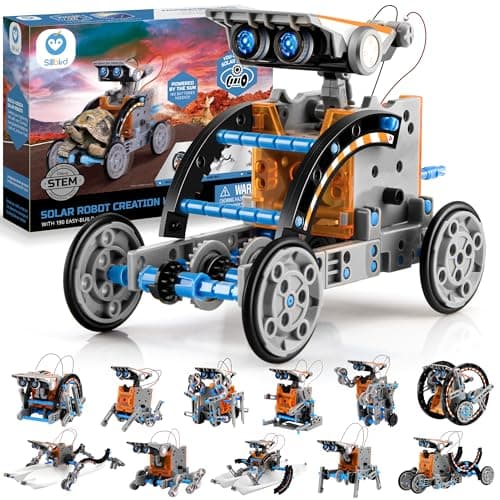
Sillbird 12-in-1 Solar Robot Building Kit

Best overall under $25, and the widest age range on the page

12-in-1 Solar Robot Building Kit

Sillbird

Sillbird publishes this 12-in-1 solar robot building kit for ages 8 to 13, which is the widest published grade of anything here and the reason it leads rather than the price. Twelve machines come out of one parts bin and every one of them is driven by a solar cell: no battery, no charging, no cable, nothing to replace. That last point is what makes it the best value on this page — most things under $25 in this category are consumable, and this is not. It is also a better physics lesson than its price suggests, because the robot stops in shade and restarts in sun and the child works out why unprompted. Honest limits: it needs direct sun or a bright bulb, so a dark winter week kills it entirely; and the small plastic tabs are easy to over-tighten and snap, usually on the first build.

Age grade:
8–13
Batteries:
manufacturer does not publish a battery requirement
Noise:
Quiet
Mess:
Contained
Assembly:
manufacturer does not publish an assembly time
Price:
$14.22 as of November 25, 2026

Age grade, battery and assembly wording are quoted from Sillbird’s own product listing, read on September 7, 2026. The manufacturer’s exact words: “Ages 8-13”. Noise and mess are our reading, not a measurement — we have not played with this.

What it gets right

  • Solar-powered, so there is no battery cost and nothing to run out on Christmas afternoon
  • Twelve published builds from one parts set, which is real rebuild value
  • Published 8 to 13 grade with genuine assembly difficulty at the top end

What it doesn’t

  • Needs actual direct sunlight; on an overcast January day it does nothing at all
  • Small plastic parts that snap off if a build is forced

How loud

Small motor whirring. There is no speaker and no sound feature.

How much mess

Many small plastic parts during assembly. They belong in the box and the box has compartments.

Skip this if…

…you are giving it in midwinter in a dark climate. A solar robot that will not move is a bad first impression that the toy may never recover from.

$14.22See it on Amazon

$24.9943% off

Price checked November 25, 2026. Toy prices move constantly, especially in December — Amazon’s price at checkout is the one that counts.

#ad · we may earn a commission from this link to 12-in-1 Solar Robot Building Kit
02
ThinkFun ThinkFun Rush Hour Traffic Jam Logic Game

Best logic buy under $25, graded 8+, and nothing runs out

ThinkFun Rush Hour Traffic Jam Logic Game

ThinkFun

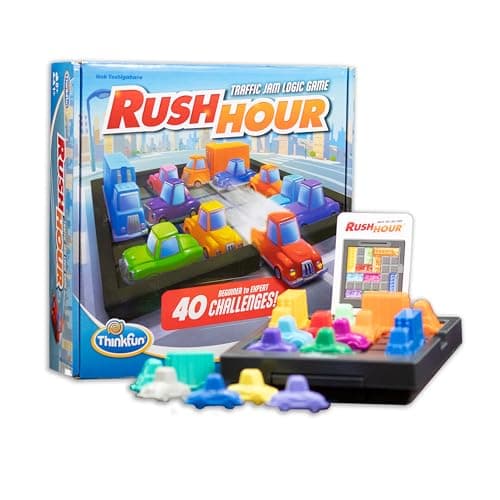
ThinkFun publishes Rush Hour for kids age 8 and up: a grid, sliding cars and a deck of challenge cards running from beginner to expert. Its own listing calls it a STEM toy and for once that is fair, because the challenges are genuine constraint problems with exactly one solution, so the child is searching a state space whether or not anybody uses the phrase. Under $25 it is the pick with the best ratio of thinking to money — no batteries, no setup, no second player, and it goes in a bag. Honest limits: it is finite, and a determined eight-year-old solves the whole deck in a few weeks, at which point the box is done unless an expansion gets bought; and losing one small car breaks specific numbered challenges rather than the game as a whole, which is worse.

Age grade:
8+
Batteries:
manufacturer does not publish a battery requirement
Noise:
Silent
Mess:
Contained
Assembly:
manufacturer does not publish an assembly time
Price:
$13.99 as of November 25, 2026

Age grade, battery and assembly wording are quoted from ThinkFun’s own product listing, read on September 7, 2026. The manufacturer’s exact words: “for Kids Age 8 and Up”. Noise and mess are our reading, not a measurement — we have not played with this.

What it gets right

  • Genuinely single-player, so it works when no adult is available
  • Forty challenges with a real difficulty curve — the last ones defeat adults
  • The whole thing packs into its own board for travel

What it doesn’t

  • Finite. Once the forty cards are solved, it is done until the expansion packs
  • The published 8+ grade is honest; a six-year-old will stall around challenge ten

How loud

Plastic cars sliding on a plastic grid.

How much mess

A grid, sixteen vehicles and a card deck, all of which fit in the tray.

Skip this if…

…you want something the family plays together. Rush Hour is solitary by design and does not convert into a group game.

$13.99See it on Amazon

$19.9930% off

Price checked November 25, 2026. Toy prices move constantly, especially in December — Amazon’s price at checkout is the one that counts.

#ad · we may earn a commission from this link to ThinkFun Rush Hour Traffic Jam Logic Game

03
Doctor Jupiter Ultimate Science Experiments Kit

Best multi-experiment kit under $25, graded 8+

Ultimate Science Experiments Kit

Doctor Jupiter

Doctor Jupiter publishes this Ultimate Science Experiments Kit for ages 8+, and it is the best answer on this page to the sentence “they like science” when nobody can say which part of it. Breadth is what it sells: reactions, density, gas, colour and crystals in one box, which is a survey course rather than a subject, and the child's reaction to it tells you what to buy next. Under $25 that is a sensible way to spend money you are not sure about. Honest limits, and both are structural rather than a complaint about this box in particular: it is consumable, so the supplies are gone in a few weekends and the plastic apparatus is what remains; and the activities are short, so an eight-year-old can get through half the booklet in one sitting and declare it finished.

Age grade:
8+
Batteries:
manufacturer does not publish a battery requirement
Noise:
Quiet
Mess:
Spreads
Assembly:
manufacturer does not publish an assembly time
Price:
$16.99 as of November 25, 2026

Age grade, battery and assembly wording are quoted from Doctor Jupiter’s own product listing, read on September 7, 2026. The manufacturer’s exact words: “Ages 8+”. Noise and mess are our reading, not a measurement — we have not played with this.

What it gets right

  • Consumables included, so the kit works on day one without a shopping trip
  • Multiple short experiments rather than one long one, which suits an eight-year-old's session length
  • Published 8+ grade and the chemistry is genuinely age-appropriate

What it doesn’t

  • Consumables run out and refills are not sold separately — after that it is a box of empty tubes
  • Needs an adult nearby, so it is not an independent activity

How loud

Nothing electronic in the box.

How much mess

Powders, liquids and colored reactions on a kitchen table. Cover the surface first; most of it wipes off, some of it stains.

Skip this if…

…nobody has an hour to supervise. A science kit done alone by an unsupervised eight-year-old is either boring or a problem, and neither is what you paid for.

$16.99See it on Amazon

$19.9915% off

Price checked November 25, 2026. Toy prices move constantly, especially in December — Amazon’s price at checkout is the one that counts.

#ad · we may earn a commission from this link to Ultimate Science Experiments Kit

04
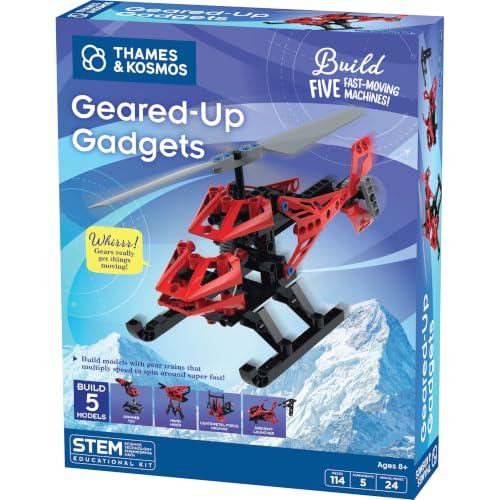
Thames & Kosmos Geared-Up Gadgets 5-in-1 Engineering Set

Best mechanics under $25, graded 8+, and it needs no adult

Geared-Up Gadgets 5-in-1 Engineering Set

Thames & Kosmos

Thames & Kosmos publishes this Geared-Up Gadgets set for Ages 8+, with gears and transmissions as the entire subject: one parts set, five working models — a rescue copter, an aircraft launcher, a hand mixer, a spinner toy and a centripetal force machine — and a 24-page manual that explains the drive behind each. A child who works through it has internalised why a small gear driving a large one trades speed for force, which is the most useful mechanical idea there is and the one that makes every later build better. The maker states no batteries required, so there is no screen, no app, nothing to charge and no adult needed, and that matters more at this price than the parts count. Honest limits: five builds is a finite sequence, so this is a few good weekends rather than a year; and the parts are the maker's own, with no LEGO compatibility claimed, so they do not fold into a brick collection afterwards.

Age grade:
8+
Batteries:
No batteries required
Noise:
Quiet
Mess:
Contained
Assembly:
manufacturer does not publish an assembly time
Price:
$21.95 as of November 25, 2026

Age grade, battery and assembly wording are quoted from Thames & Kosmos’s own product listing, read on September 7, 2026. The manufacturer’s exact words: “Ages 8+”. Noise and mess are our reading, not a measurement — we have not played with this.

What it gets right

  • Gears and transmissions are what the manual teaches, not just what the models happen to contain
  • Five models from the same parts set, so finishing the first build does not finish the kit
  • The maker publishes no batteries required, which is unusual for a kit whose models move

What it doesn’t

  • Five builds is a finite sequence, and the parts are Thames & Kosmos’s own — nothing on the listing claims LEGO compatibility — so they do not fold into a brick collection afterwards
  • The maker grades it Ages 8+ in the listing title and “ages 6 and up” in a feature bullet on the same listing; we publish the higher number, but the inconsistency is theirs

How loud

Gears and a hand crank. The maker states no batteries required, so nothing in the box makes a sound on its own.

How much mess

Plastic parts that live in the box they came in. It is published as a 5-in-1, so it is one model at a time out of the same parts — they come apart again rather than accumulating.

Skip this if…

…the household already owns a lot of LEGO Technic. The listing claims no LEGO compatibility, so a Technic bin buys more mechanism per dollar than starting a second, separate parts system does.

$21.95See it on Amazon

Price checked November 25, 2026. Toy prices move constantly, especially in December — Amazon’s price at checkout is the one that counts.

#ad · we may earn a commission from this link to Geared-Up Gadgets 5-in-1 Engineering Set

05
4M 4M Crystal Growing Science Kit

Best for a child who will wait, graded 10 and up

4M Crystal Growing Science Kit

4M

4M recommends this crystal growing kit for ages 10 years and up and puts seven crystals and display cases in the box. It is the only pick on this page where the activity is mostly waiting, and that is the point rather than a flaw: crystals form over days, so the child sets something up and then has to leave it alone, check it, and leave it alone again. Nothing else under $25 teaches that, and the display cases mean the result is kept rather than thrown out. Honest limits, and the grade is the first one: 10+ is the maker's own published wording and it is about the chemicals, so this is not a younger child's kit regardless of how careful they are. The second is that it is strictly single-use — once the seven crystals are grown, the box is finished.

Age grade:
10+
Batteries:
manufacturer does not publish a battery requirement
Noise:
Silent
Mess:
Contained
Assembly:
manufacturer does not publish an assembly time
Price:
$19.49 as of November 25, 2026

Age grade, battery and assembly wording are quoted from 4M’s own product listing, read on September 7, 2026. The manufacturer’s exact words: “Recommended for ages 10 years and up”. Noise and mess are our reading, not a measurement — we have not played with this.

What it gets right

  • The finished crystals are keepable objects and the display cases mean they get kept
  • Seven separate growths, so a failure does not end the kit
  • Published 10+ grade, and the boiling water step is why

What it doesn’t

  • Days of waiting between the setup and the result, which is not obvious from the box
  • Requires boiling water and adult involvement at the critical step

How loud

Nothing.

How much mess

Hot water and a chemical powder at the start; after that the crystals just sit there. Contained but not zero.

Skip this if…

…the child needs a result today. Crystal growing is the slowest gift in this guide by an order of magnitude and it disappoints anyone expecting an afternoon.

$19.49See it on Amazon

Price checked November 25, 2026. Toy prices move constantly, especially in December — Amazon’s price at checkout is the one that counts.

#ad · we may earn a commission from this link to 4M Crystal Growing Science Kit

06
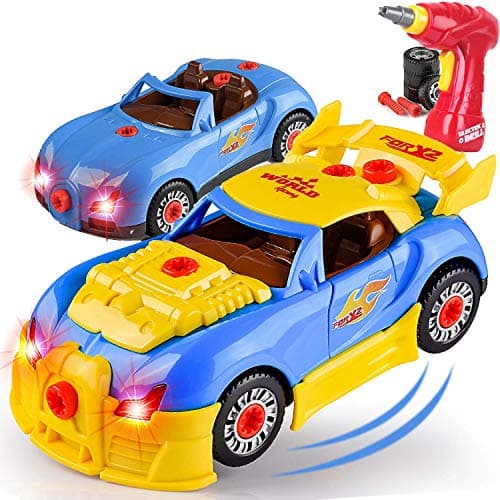
Liberty Imports Take Apart Toy Vehicles with Power Drill

Best under-$25 pick for a young child, graded 3 to 5

Take Apart Toy Vehicles with Power Drill

Liberty Imports

Liberty Imports publishes this take-apart vehicle set for ages 3 to 5 and sells it as a STEM construction kit, which is the rare case where the label is accurate: the vehicles come apart with a battery-powered drill and go back together, so the build is the toy rather than an obstacle before it. It is the only pick on this page graded below eight, and for a three- to five-year-old who has just worked out that objects have insides, taking a car apart and putting it back together is a better proposition than a car that already works. It repeats, too. Honest limits: the screws are small, numerous and a set with three missing is a set that does not work, so it needs a container; and it is loud — the drill buzzes, the vehicles have their own sounds and lights, and no sound level is published anywhere.

Age grade:
3–5
Batteries:
manufacturer does not publish a battery requirement
Noise:
Loud
Mess:
Contained
Assembly:
manufacturer does not publish an assembly time
Price:
$17.99 as of November 25, 2026

Age grade, battery and assembly wording are quoted from Liberty Imports’s own product listing, read on September 7, 2026. The manufacturer’s exact words: “Ages 3-5”. Noise and mess are our reading, not a measurement — we have not played with this.

What it gets right

  • Assembly is the activity rather than an obstacle before the activity
  • The drill gives a three-year-old a genuine sense of having built something
  • Repeats well — a vehicle can be taken apart again tomorrow

What it doesn’t

  • Small screws in a set graded 3+; they need a container and they will not stay in it
  • Sounds and lights on top of the drill make this one of the noisier things here

How loud

The drill buzzes and the vehicles have sounds and lights. Nothing about this set is quiet, and no sound level is published.

How much mess

Screws are the risk. They are small, they are numerous, and the set is unusable when three go missing.

Skip this if…

…you want it to survive a younger sibling. The screws are the small part, and a two-year-old will find them before you do.

$17.99See it on Amazon

Price checked November 25, 2026. Toy prices move constantly, especially in December — Amazon’s price at checkout is the one that counts.

#ad · we may earn a commission from this link to Take Apart Toy Vehicles with Power Drill

07
Stomp Rocket Stomp Rocket Jr. Glow Rocket Launcher

Best outdoor physics under $25, graded 3 and up, nothing to charge

Stomp Rocket Jr. Glow Rocket Launcher

Stomp Rocket

Stomp Rocket recommends this launcher from 3 and up and states it is 100% kid-powered — no batteries, no cords, no plugs. Jump on the pad and the rocket goes up. That is the whole toy, and under $25 it is the cleanest demonstration of force and trajectory money can buy: a hard stomp goes higher than a soft one, an angled launcher goes further than a vertical one, and a child will run that experiment forty times in an afternoon without being asked. The exercise is built in, because the rockets have to be fetched. Honest limits: rockets end up on roofs and in gutters, and refills are a recurring purchase; and there is no indoor version of this, so a small yard with a neighbour behind it is the wrong setting.

Age grade:
3+
Batteries:
No batteries required and no cords or plugs to fumble with
Noise:
Some noise
Mess:
No mess
Assembly:
manufacturer does not publish an assembly time
Price:
$19.99 as of November 25, 2026

Age grade, battery and assembly wording are quoted from Stomp Rocket’s own product listing, read on September 7, 2026. The manufacturer’s exact words: “Recommended for ages 3 and up”. Noise and mess are our reading, not a measurement — we have not played with this.

What it gets right

  • No batteries at all, stated on the listing, so there is nothing to run out mid-game
  • The exercise is built in — a child cannot use this without running
  • Glow rockets extend it into the evening, which children find genuinely thrilling

What it doesn’t

  • Rockets end up on roofs and in gutters, and refills are a recurring purchase
  • Needs a garden or a park; there is no indoor version of this

How loud

A stomp and a whoosh, repeated. No electronics; the manufacturer states there are no batteries at all.

How much mess

Rockets land in the garden and get fetched. Losing one on a roof is the only real risk.

Skip this if…

…you only have a small yard with a fence and a neighbor. These go higher than expected and retrieving them is somebody else's problem.

$19.99See it on Amazon

Price checked November 25, 2026. Toy prices move constantly, especially in December — Amazon’s price at checkout is the one that counts.

#ad · we may earn a commission from this link to Stomp Rocket Jr. Glow Rocket Launcher

08
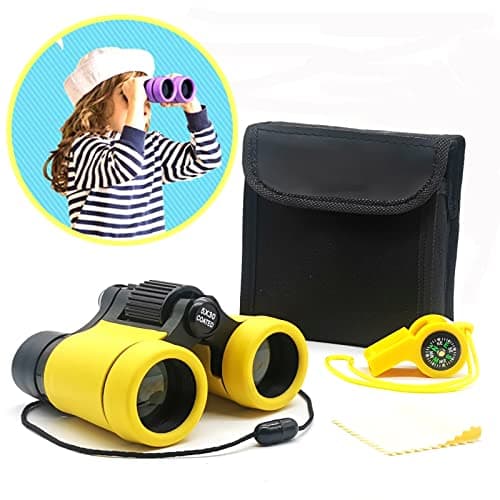
ARTOMIDE ARTOMIDE Kids Binoculars with Compass

Budget pick — cheapest real instrument here, graded 3 to 12

ARTOMIDE Kids Binoculars with Compass

ARTOMIDE

ARTOMIDE publishes these for ages 3 to 12 with a compass and a whistle on the strap and a shockproof body. They are the budget pick by a wide margin and they earn the slot rather than merely sitting at the bottom of the price list, because they are a real optical instrument rather than a toy with lenses in it, and because of where science actually happens for a young child — outdoors, at short notice, at a bird on a far fence. The published range to twelve is unusually wide for anything this cheap. Honest limits: a young child has to be taught to set the barrel spacing to their own eyes or they see two circles and give up, which is a five-minute lesson nobody includes; and the compass is a toy compass, good for roughly north and no further.

Age grade:
3–12
Batteries:
manufacturer does not publish a battery requirement
Noise:
Silent
Mess:
No mess
Assembly:
manufacturer does not publish an assembly time
Price:
$9.99 as of November 25, 2026

Age grade, battery and assembly wording are quoted from ARTOMIDE’s own product listing, read on September 7, 2026. The manufacturer’s exact words: “Ages 3-12”. Noise and mess are our reading, not a measurement — we have not played with this.

What it gets right

  • Published from 3 years, which is five years earlier than any telescope here, and the lowest-priced thing in this registry by some distance
  • Rubber armor and a stated drop-resistant housing — this is the rare optic designed around being dropped
  • Folding barrels adjust to a small child's eye spacing, which is the usual reason kids' binoculars do not work
  • Usable in daylight, so it gets used in the hundreds of hours a telescope cannot

What it doesn’t

  • 5x magnification is modest, and the maker states a furthest usable range of roughly 328 to 492 feet in good conditions
  • A toy-grade optic: the view is clear in the center and soft at the edges
  • Will not show a single crater on the Moon, which is what a child asking for a telescope is actually asking for

How loud

Optics and a plastic whistle. The whistle is the only thing in the box that makes a sound, and it is the first thing to confiscate.

How much mess

One object on a neck strap.

Skip this if…

…the child specifically asked to look at space. Binoculars are the better optic for a six-year-old in almost every way except the one they care about, and a substitute gift that misses the point lands badly.

$9.99See it on Amazon

Price checked November 25, 2026. Toy prices move constantly, especially in December — Amazon’s price at checkout is the one that counts.

#ad · we may earn a commission from this link to ARTOMIDE Kids Binoculars with Compass

The toys

The toys this guide is about

Every one of these carries its manufacturer’s published age grade and a live Amazon price, read November 25, 2026. Full rankings live in the roundups linked above.

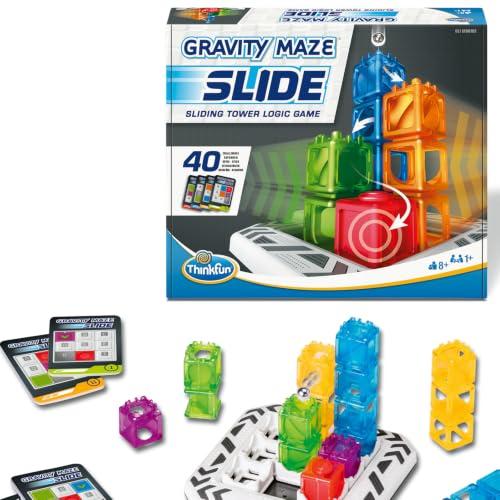
  • ThinkFun ThinkFun Gravity Maze Slide Marble Logic Game

    Right at the line, and the better logic buy if it has not moved

    ThinkFun Gravity Maze Slide Marble Logic Game

    Age grade 8+

    ThinkFun publishes Gravity Maze Slide for ages 8+ with 40 logic challenges — towers, a marble, and a card giving the start and the target. It sits at the very top of this page's budget, which is why it is listed here rather than ranked: check the live price in the table before deciding between this and the ranked sliding-car game.

  • Sobrzy Sobrzy 50mm Beginner Telescope for Kids

    Just over the line, and the cheapest real telescope we hold

    Sobrzy 50mm Beginner Telescope for Kids

    Age grade 8–12

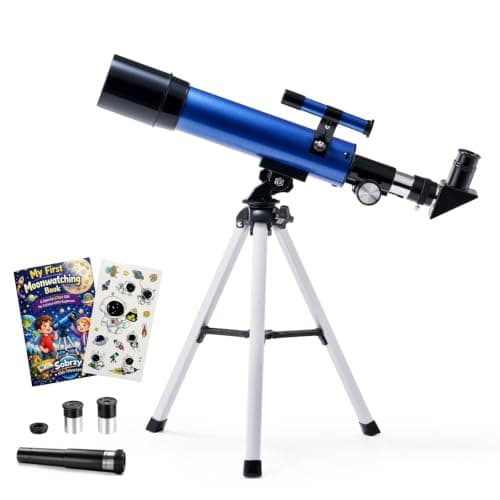
    Sobrzy publishes this 50mm, 100x beginner telescope for ages 8 to 12, with tripod, two eyepieces and a finder scope. It is over $25 and it is here because it is the next thing to buy if the binoculars above get used: the finder scope is what stops a child's telescope being pointed at nothing for twenty minutes.

  • Snap Circuits Snap Circuits Jr. SC-100 Electronics Kit

    What to save for, and the best STEM purchase on this site

    Snap Circuits Jr. SC-100 Electronics Kit

    Age grade 8+

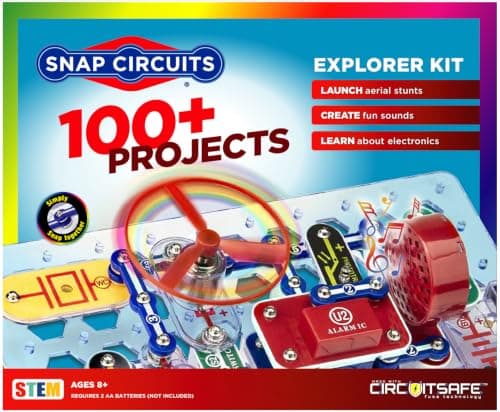
    Snap Circuits publishes the Jr. SC-100 for ages 8+ with 100+ projects. Components snap onto a grid, so a working circuit takes ninety seconds with no tools and nothing is consumed. It is well over this page's budget and it is the single thing we would most recommend saving for.

  • Learning Resources Code & Go Robot Mouse, Rechargeable

    Over the line, and the screen-free coding answer

    Code & Go Robot Mouse, Rechargeable

    Age grade 4+

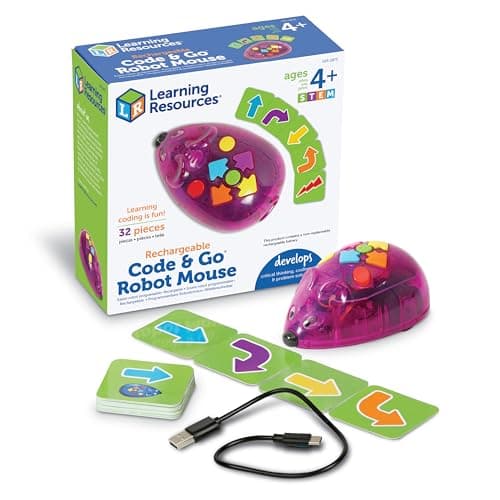
    Learning Resources grades this 4+ and states no screens are required. The child builds a sequence with direction buttons, lays a route and runs it. It charges over USB, so there is nothing to buy again — which makes the higher price look different after a year.

#ad · As an Amazon Associate we earn from qualifying purchases. How this works.

How we picked

Toys we claim to have played with: 0

Every toy site tells you they tested forty toys with a focus group of real children. We have not played with any of these, and we say so. Here is what we do instead: we read the manufacturer’s own listing and print its published age grade word for word, we record the battery requirement and the assembly note where the maker publishes one and say plainly when it does not, we pull the price live from Amazon so it is never a number we remembered, and we name one thing on every list we would not buy.

The noise and mess ratings are our judgment from what the listing describes — not measurements. Almost no toy manufacturer publishes a decibel figure, which is itself worth knowing. The full method is published, including what disqualifies a toy.

Questions

Questions people actually ask

What is the best STEM toy under $25?
The 12-in-1 solar robot kit, graded 8 to 13. Twelve machines come out of one parts bin and the whole thing runs on a solar cell, so there is no battery and nothing to replace — which under $25 is rarer than it should be.
What happened to the Klutz LEGO Gear Bots kit?
Amazon no longer sells it — the listing reads “currently unavailable” and the only live offers are reseller bundles at more than twice the old price. Our replacement on this page is the Thames & Kosmos Geared-Up Gadgets set, graded Ages 8+, which teaches the same subject — gears and transmissions — with five working models and a 24-page manual, and needs no batteries. The parts are not LEGO-compatible, which is the one thing the Klutz kit did better.
Are cheap science kits worth it?
Sometimes. The test is whether the money buys something you could not improvise: a solar cell, a graded challenge deck or a pair of binoculars passes, while a tray plus three supermarket ingredients does not. The multi-experiment kit above passes partly, which is why its consumability is printed on its card.
What STEM toys under $25 work for a 5-year-old?
The take-apart vehicle set, graded 3 to 5, and the rocket launcher, graded 3 and up. Most of the good value in this category is graded 8+ because of small parts, so the under-$25 shelf for a five-year-old is genuinely thin — the five-year-old page covers the full range.
Do these prices change?
Constantly. Every price in the table is pulled live from our price layer with the date it was last checked printed underneath, and nothing on this site has a price typed into the page. If a pick has crossed the $25 line since the last check, the table shows the real number rather than our claim.

Keep reading

Receipts

Sources

We do not run a playroom test lab and we do not pretend to. Age grades, battery requirements and assembly notes are quoted from each manufacturer’s own product listing, read on September 7, 2026; prices come live from Amazon’s API and are stamped with the date they were checked. Where a maker publishes nothing, the page says “manufacturer does not publish this” rather than guessing. Read the full method.