Guides · Guides
Toy brands, and what the name on the box actually buys
“Good brand” is not a useful category. What is useful is knowing the five concrete things a brand can give you that an unbranded equivalent cannot, because four of them are printed and checkable and the fifth is visible in a second-hand listing.
We earn a commission if you buy through our links. It does not change the price you pay and it does not decide our picks — our method is published in full, including the part where we say we have not played with these toys. How this works.
What a brand is, functionally
Strip out the advertising and a toy brand is a set of promises about what happens after the money leaves your hand: whether the thing is replaced when it breaks, whether next year’s set works with this year’s, whether a part can be bought in three years, and whether the range still exists when the child’s younger sibling reaches the same age. Those are all checkable. Everything else about a brand is a logo.
The five things worth paying for
- A warranty that is actually published. Magna-Tiles publishes a lifetime warranty against manufacturing defects, which is an unusual thing for a toy maker to put in writing and it is a large part of what the price is. A warranty you can read is worth more than a reputation you have heard about.
- An open standard. Wooden train track is close to a universal format, so a BRIO starter loop accepts hand-me-downs, garage-sale finds and cheap expansion packs. LEGO is the other example: a brick bought in 1985 still works. Compatibility is the feature that makes a small first purchase safe, and it is why DUPLO against Mega Bloks is a question about systems rather than about plastic.
- A range that survives decades. Schleich figures and Calico Critters families are sold individually and have been consistent for a very long time, which means a collection started this year can still be added to in five. A collectible from a brand that discontinues ranges is a collection designed to be incomplete — the distinction we draw on the collector page.
- Materials stated on the listing. FSC-certified beech, hardwood, urethane, anodized aluminum, steel. A manufacturer willing to name the material is a manufacturer you can hold to something, and material is most of what decides whether a toy survives — see toys that survive.
- Parts and after-sales. Radio Flyer’s parts support is disproportionately good for the price of the toys, which matters on anything with wheels or hardware. A ride-on with no replaceable wheel is a disposable ride-on.
Where the brand premium buys nothing
The licensed character. A film logo adds cost, subtracts play life — the story arrives already decided — and adds nothing structural. The same reasoning applies to the word “educational”, which is unregulated, and to “STEM”, which is on roughly half the toy aisle and means almost nothing; our STEM page uses a harder test — does the child build something that then either works or does not?
The other place to be careful is the near-identical product with two logos on it. In several of the categories we cover, competing items appear to come off the same line with different badges, and the price gap between them is a marketing budget rather than a specification. The way to tell is to compare published numbers: weight limit, piece count, material, age grade. If those match and the price does not, you have your answer.
The brands we keep returning to, and for what
This is not a ranking and there is no best brand. It is a list of what each one is reliably good at, based on what they publish:
- LEGO — the system, and thirty years of backward compatibility. The cheapest honest entry is a classic box with a case rather than a themed set.
- Melissa & Doug — wood at ordinary prices, across a very wide range, with published grades that tend to be conservative.
- Hape — wooden construction and marble runs, where the engineering has to hold a tolerance and that is the case for the price. The marble run comparison is where that shows up most clearly.
- BRIO — FSC-certified beech and the near-universal track format.
- Magna-Tiles — the published lifetime warranty, which is the whole argument in the magnetic tiles comparison.
- Schleich — hand-painted, individually sold, effectively unbreakable figures, which is why they show up in second-hand boxes twenty years later.
- Radio Flyer — steel where steel matters, and parts support.
- ThinkFun — logic puzzles that verify themselves, so no adult has to mark the answer.
- HABA — the rare maker of genuinely good games graded for two-year-olds.
- Thames & Kosmos — real science kits with real glassware and supervision requirements printed rather than implied.
How to check a brand claim yourself, in a minute
- Find the published age grade. Its absence on a toy listing is itself a finding.
- Search the brand plus “warranty”. Either there is a document or there is not.
- Check compatibility before you check price. Will it work with what is already in the house?
- Look up the product on the CPSC recall database. It is free, it takes thirty seconds, and it is the single most useful minute of toy research available to anybody.
- Look at the second-hand market. Brands whose toys resell are brands whose toys last. That is a real signal and nobody can buy it.
If what you are really weighing is whether a higher price buys more play rather than a better badge, toys worth the money answers that directly, and how much to spend covers the budget version of the same question.
The toys
The toys this guide is about
Every one of these carries its manufacturer’s published age grade and a live Amazon price. Full rankings live in the roundups linked above.
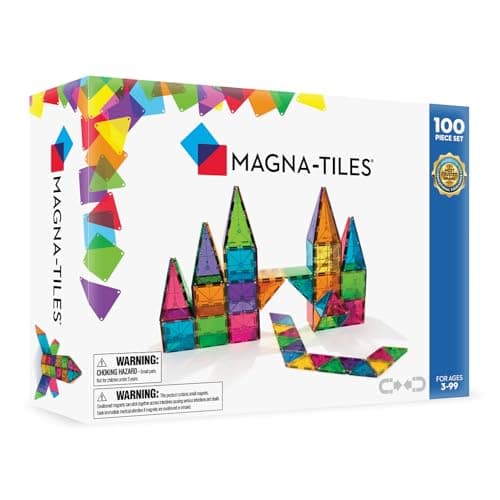
The warranty is the product
Magna-Tiles Classic 100-Piece Set
Age grade 3+
Graded 3+, and the reason it is the expensive one: a published lifetime warranty against manufacturing defects, which very few toy makers will write down. Hundred big flat pieces, back in the bin in two minutes. Never for an under-three — the flat magnet shape is exactly what the small-parts rule exists for.
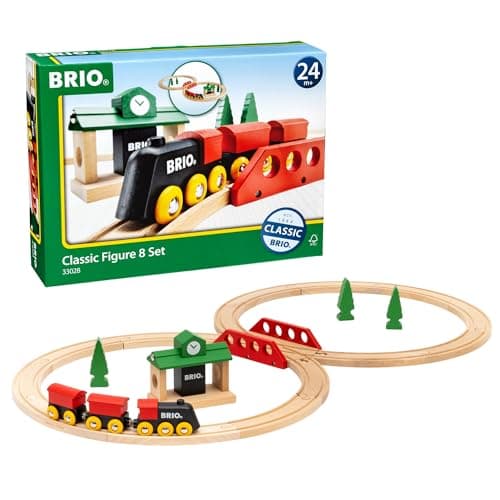
The open standard, in twenty-two pieces
BRIO World Classic Figure 8 Train Set
Age grade 2+
BRIO grades it 2 and up, in FSC-certified beech, and the wooden track format is close to universal — which is what makes a small starter set a safe first purchase rather than a commitment. It is a starter loop at a premium price, and unbranded expansion packs are the sensible way to grow it.
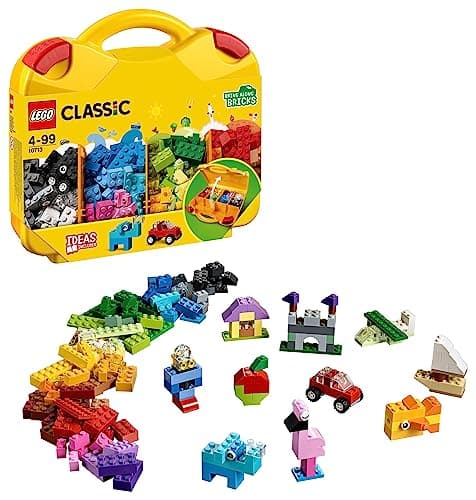
The cheapest honest way into a system
LEGO Classic Creative Suitcase 10713
Age grade 4+
LEGO grades this 4 and older, and the case is doing as much work as the bricks: compartments that close are the difference between LEGO in a box and LEGO in the carpet. Skip it if there is already a collection — then the money belongs in a set they actually want.
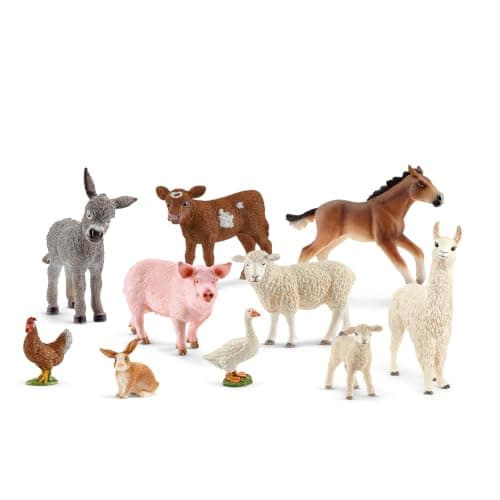
A range that is still there in five years
Schleich Farm World Animal Bundle, 10 Pieces
Age grade 3+
Ten hand-painted farm figures graded 3+, sold individually so a collection can grow one birthday at a time. Solid, individually sculpted and effectively unbreakable. The smaller animals are exactly the size the under-three rule covers, so not for a house with a baby on the floor.
#ad · As an Amazon Associate we earn from qualifying purchases. How this works.
Questions
Questions people actually ask
What is the best toy brand?
Are expensive toy brands worth it?
What toy brands last the longest?
Does brand matter for a baby?
How do I check whether a toy has been recalled?
Keep reading
Related
- Toys that survive a yearWhich materials actually hold up.
- Magna-Tiles or ConnetixA comparison where the warranty decides it.
- Buying toys secondhandWhere the brands that last show up cheapest.
- Toys worth the moneyWhether a higher price buys more play.
- How much to spendThe budget version of the same question.
Receipts
Sources
- 16 CFR Part 1501 — the federal small-parts regulation behind the “not for children under 3” warning (eCFR)
- ASTM F963 — Standard Consumer Safety Specification for Toy Safety
- US Consumer Product Safety Commission — Toy Safety business guidance
- US Consumer Product Safety Commission — recall database
We do not run a playroom test lab and we do not pretend to. Age grades, battery requirements and assembly notes are quoted from each manufacturer’s own product listing, read on September 7, 2026; prices come live from Amazon’s API and are stamped with the date they were checked. Where a maker publishes nothing, the page says “manufacturer does not publish this” rather than guessing. Read the full method.