Science kits fail for one of two reasons: the kit is a single afternoon dressed up as a subject, or it needs an adult at every step and the adult is busy. These six are sorted on exactly that — how many hours are actually in the box, and how much of it the child can do alone.
We earn a commission if you buy through our links. It does not change the price you pay and it does not decide our picks — our method is published in full, including the part where we say we have not played with these toys. How this works.
#ad · Prices come live from Amazon’s API and were last checked October 5, 2026. Where we have no verified live price we show none — we would rather leave a gap than print a number that has gone stale. Age grades are the manufacturer’s own; noise is our reading, not a measurement.
The short verdict
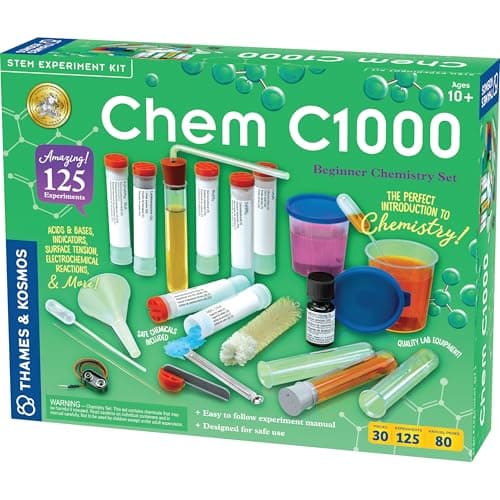
For a ten-plus child who is genuinely interested, buy the Thames & Kosmos Chem C1000 — 125 experiments and an 80-page manual make it the only kit here that teaches a subject rather than demonstrating one. If the child is five to twelve and you want the gift that does not run out, buy the microscope instead: it is the only item on this page with no finite number of experiments in it. If they are eight and engineering-minded rather than chemistry-minded, the twelve-in-one solar robot is the better box. If you do not know the child well, the 8+ sampler is the sensible bet.
The two ways a science kit fails
The first is that the box contains one afternoon. A kit with six experiments in it is a Saturday, and the packaging very rarely says so — it says “science”, which implies a subject. The honest question to ask of any kit is how many separate sessions are in there, and whether each one is a thing the child does or a thing they watch.
The second is that every step needs an adult. A kit requiring boiling water, a measured reagent and supervision is not a kit a nine-year-old uses on a wet Tuesday — it is a kit a nine-year-old asks about on a wet Tuesday while somebody is cooking dinner. Both of those failures are predictable from the box, which is what the table below is for.
Hours in the box, and who has to be in the room
Kit
Published grade
What is actually in the box
Adult needed?
Thames & Kosmos Chem C1000
10+
125 experiments, 80-page manual, safety gear
Nearby throughout. It is real chemistry
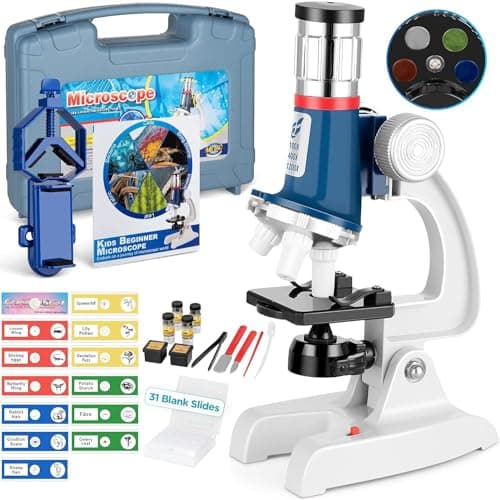
58-piece microscope kit
5–12
100x–1200x, metal body, LED, case. No fixed number of uses
First session only. Needs 2 AA
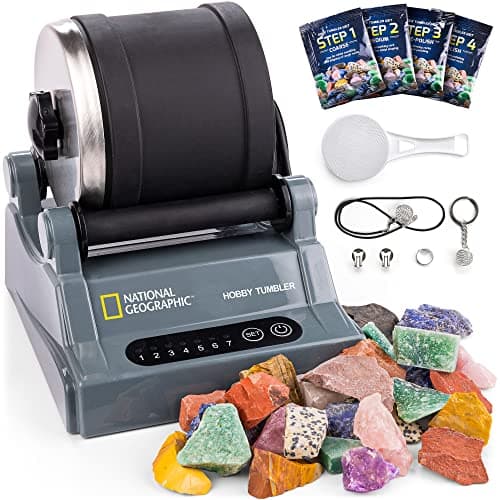
National Geographic rock tumbler
8+
A machine that runs for days per stage, plus grit and rough stone
Setup only — but it needs a garage, not a bedroom
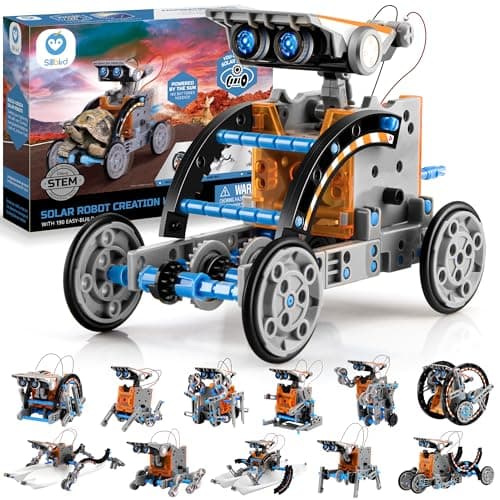
12-in-1 solar robot kit
8–13
Twelve rebuildable models, solar powered, no batteries
No, but the child must follow instructions
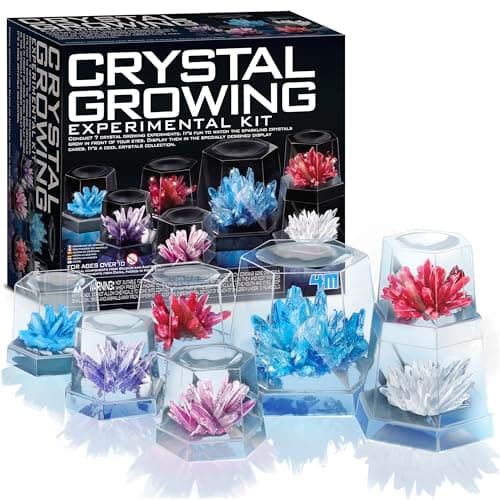
4M crystal growing kit
10+
Seven crystals plus display cases. Days of waiting
Yes, at the boiling-water step
Ultimate science experiments kit
8+
A broad spread of short experiments across several subjects
Varies by experiment
Depth or breadth — pick one deliberately
The real decision on this page is not which brand. It is whether you are buying a subject or a sampler, and the right answer depends entirely on information you may not have. A child who has already announced they like chemistry should get the chemistry set; the sampler will feel like being handed a taster menu by somebody who was not listening. A child whose interests are still moving should get the sampler, or better, the microscope — which is breadth of a different kind, because the child chooses the subject every time they use it.
Worth noting that the two kits with the highest published grades here are both 10+, and both for substantive reasons rather than cautious ones: the chemistry set contains real reagents and the crystal kit needs boiling water. Age grades explained covers what sits behind a published number, and we do not recommend below one.
What we would skip
The volcano. Specifically, any kit whose headline experiment is a one-shot reaction with a consumable at its center — it is a four-minute event, it is over, and what is left in the box is a plastic mold. We would also skip any kit that promises “100 experiments” without a manual thick enough to describe them, because the count is usually reached by listing variations of the same reaction. The pattern is on the skip list, and toys worth the money covers where a higher price in this category buys something and where it does not.
If the interest is electronics or optics rather than chemistry
Then this is the wrong page and two better ones exist: Snap Circuits Jr. vs Classic compares the two electronics kits directly, including which one a child outgrows, and toys for the STEM kid is the full list including the telescopes and the logic games. For a younger child whose science interest is really about animals, gifts for a kid who loves animals ends where this page begins — at the microscope.
In detail
Every pick, in full
01
Best overall, for a 10-plus kid who is actually interested
Thames & Kosmos Chem C1000 Chemistry Set
Thames & Kosmos
Graded 10+, 125 experiments, an 80-page manual and safety gear in the box. It is the only kit here that is a course rather than an activity: the manual builds from one idea to the next, so a child who works through it ends up understanding acids, bases and electrochemical reactions rather than having watched six reactions happen. That is also the catch — it needs a child who will read, a surface it is allowed to sit on, and an adult within shouting distance. Nothing about it is a stocking filler.
Age grade:
10+
Batteries:
manufacturer does not publish a battery requirement
Noise:
Silent
Mess:
Spreads
Assembly:
manufacturer does not publish an assembly time
Price:
$59.95 as of October 5, 2026
Age grade, battery and assembly wording are quoted from Thames & Kosmos’s own product listing, read on September 7, 2026. The manufacturer’s exact words: “Ages 10+”. Noise and mess are our reading, not a measurement — we have not played with this.
What it gets right
+125 experiments and a manual written like a textbook rather than a comic
+Published 10+ grade is honest and should be respected — this is not a seven-year-old's kit
+Genuinely prepares a child for school chemistry rather than just entertaining them
What it doesn’t
−Requires adult supervision throughout, which is a real time commitment
−Chemicals are consumed and replacements have to be sourced individually
How loud
Nothing electronic.
How much mess
Real chemicals on a real surface. This wants a bench, an adult and a wipeable table, in that order.
Skip this if…
…the child is under the published age. A chemistry set below its grade is the one item in this guide where going early is genuinely unsafe, not just disappointing.
Best for a 5-to-12-year-old, and the one with no end date
58-Piece Kids Microscope Kit
Uarzt
Graded 5 to 12, 100x to 1200x, with a metal body, LED light and a carrying box. The reason it ranks this high is that a microscope is not a kit — it does not run out. Every kit below has a finite number of experiments in it; this has whatever the child can find in a garden. The metal body is the specification that matters, because the plastic equivalents flex and lose focus. It needs two AA batteries that are not included, and a first session with an adult or the child decides it is broken.
Age grade:
5–12
Batteries:
Requires 2 AA batteries (not included)
Noise:
Silent
Mess:
Contained
Assembly:
manufacturer does not publish an assembly time
Price:
$39.99 as of October 5, 2026
Age grade, battery and assembly wording are quoted from Uarzt’s own product listing, read on September 7, 2026. The manufacturer’s exact words: “Ages 5-12”. Noise and mess are our reading, not a measurement — we have not played with this.
What it gets right
+Metal body rather than the plastic toy microscopes at the same price, so focus actually holds
+Prepared slides included, so there is something to look at immediately
+Published 5 to 12 range makes it a genuinely long-lived purchase
What it doesn’t
−Requires 2 AA batteries, not included, for the LED
−Glass slides in a kit graded from five needs an adult present the first few times
How loud
Nothing but an LED.
How much mess
Slides and small tools in a case. The slides are glass, which is the thing to supervise.
Skip this if…
…the child is at the young end and unsupervised. Focusing a microscope is fiddly and glass slides break — five-year-olds need company for this one.
Best for the child who cannot wait, and therefore needs to
National Geographic Hobby Rock Tumbler Kit
Blue Marble
Graded 8+. The child loads rough stones and grit, the barrel runs for days per stage, and at the end they have polished stones they made themselves. Almost nothing else in a toy box enforces patience the way a machine that cannot be hurried does, and the output is a real object rather than a score. One warning that outranks every feature: it hums continuously for days, no decibel figure is published anywhere on the listing, and it belongs in a garage, a basement or a utility room rather than a bedroom.
Age grade:
8+
Batteries:
manufacturer does not publish a battery requirement
Noise:
Loud
Mess:
Contained
Assembly:
manufacturer does not publish an assembly time
Price:
$58.00 as of October 5, 2026
Age grade, battery and assembly wording are quoted from Blue Marble’s own product listing, read on September 7, 2026. The manufacturer’s exact words: “Ages 8+”. Noise and mess are our reading, not a measurement — we have not played with this.
What it gets right
+The result is genuinely impressive — polished stones a child made themselves
+Teaches patience in a way very few toys manage, because the machine enforces it
+Published 8+ grade and the process is safe once the barrel is sealed
What it doesn’t
−Runs for days and hums the entire time; it cannot live in a bedroom
−Grit is consumable and a full four-stage batch uses a lot of it
How loud
The barrel runs continuously for days per stage. It is a constant low rumble, not a burst. No decibel figure is published, and the usual advice is a garage or a basement.
How much mess
Grit and slurry at each stage change. Messy for ten minutes, four times per batch.
Skip this if…
…you live in an apartment with thin walls or the child's room is the only place for it. The noise is continuous and the run time is measured in weeks.
Graded 8 to 13, twelve builds from one set of parts, powered by a solar panel rather than a battery. This is the kit for the child whose science interest is really an engineering interest — the twelve models come apart and rebuild, so the box lasts twelve sessions rather than one, and the solar panel means the honest constraint is sunshine instead of AAs. Small plastic parts and a manual with a lot of steps: a child who gives up on instructions will stall on build three.
Age grade:
8–13
Batteries:
manufacturer does not publish a battery requirement
Noise:
Quiet
Mess:
Contained
Assembly:
manufacturer does not publish an assembly time
Price:
$19.99 as of October 5, 2026
Age grade, battery and assembly wording are quoted from Sillbird’s own product listing, read on September 7, 2026. The manufacturer’s exact words: “Ages 8-13”. Noise and mess are our reading, not a measurement — we have not played with this.
What it gets right
+Solar-powered, so there is no battery cost and nothing to run out on Christmas afternoon
+Twelve published builds from one parts set, which is real rebuild value
+Published 8 to 13 grade with genuine assembly difficulty at the top end
What it doesn’t
−Needs actual direct sunlight; on an overcast January day it does nothing at all
−Small plastic parts that snap off if a build is forced
How loud
Small motor whirring. There is no speaker and no sound feature.
How much mess
Many small plastic parts during assembly. They belong in the box and the box has compartments.
Skip this if…
…you are giving it in midwinter in a dark climate. A solar robot that will not move is a bad first impression that the toy may never recover from.
Recommended by the maker for ages 10 and up, with seven crystals to grow and display cases to keep them in. It belongs here because it is the opposite of everything else in a toy box: about twenty minutes of setup and then days of nothing happening, with a keepable result at the end. Two things to say out loud before it is unwrapped — it needs boiling water and an adult at that step, and nothing at all arrives on the day. A child expecting an afternoon activity will be disappointed and a patient one will not.
Age grade:
10+
Batteries:
manufacturer does not publish a battery requirement
Noise:
Silent
Mess:
Contained
Assembly:
manufacturer does not publish an assembly time
Price:
$18.98 as of October 5, 2026
Age grade, battery and assembly wording are quoted from 4M’s own product listing, read on September 7, 2026. The manufacturer’s exact words: “Recommended for ages 10 years and up”. Noise and mess are our reading, not a measurement — we have not played with this.
What it gets right
+The finished crystals are keepable objects and the display cases mean they get kept
+Seven separate growths, so a failure does not end the kit
+Published 10+ grade, and the boiling water step is why
What it doesn’t
−Days of waiting between the setup and the result, which is not obvious from the box
−Requires boiling water and adult involvement at the critical step
How loud
Nothing.
How much mess
Hot water and a chemical powder at the start; after that the crystals just sit there. Contained but not zero.
Skip this if…
…the child needs a result today. Crystal growing is the slowest gift in this guide by an order of magnitude and it disappoints anyone expecting an afternoon.
The broad sampler, and the one to buy if you do not know the child
Ultimate Science Experiments Kit
Doctor Jupiter
Graded 8+, with a wide spread of short experiments rather than one subject done deeply. That is both the argument for it and against it: as a gift for a child whose interests you do not know, a sampler is the sensible bet, because something in it will land and you have not committed them to chemistry. For a child who already knows they like a particular thing, every other kit on this page is a better use of the same money. Expect several experiments to be ten-minute demonstrations.
Age grade:
8+
Batteries:
manufacturer does not publish a battery requirement
Noise:
Quiet
Mess:
Spreads
Assembly:
manufacturer does not publish an assembly time
Price:
$19.99 as of October 5, 2026
Age grade, battery and assembly wording are quoted from Doctor Jupiter’s own product listing, read on September 7, 2026. The manufacturer’s exact words: “Ages 8+”. Noise and mess are our reading, not a measurement — we have not played with this.
What it gets right
+Consumables included, so the kit works on day one without a shopping trip
+Multiple short experiments rather than one long one, which suits an eight-year-old's session length
+Published 8+ grade and the chemistry is genuinely age-appropriate
What it doesn’t
−Consumables run out and refills are not sold separately — after that it is a box of empty tubes
−Needs an adult nearby, so it is not an independent activity
How loud
Nothing electronic in the box.
How much mess
Powders, liquids and colored reactions on a kitchen table. Cover the surface first; most of it wipes off, some of it stains.
Skip this if…
…nobody has an hour to supervise. A science kit done alone by an unsupervised eight-year-old is either boring or a problem, and neither is what you paid for.
Every toy site tells you they tested forty toys with a focus group of real children. We have not played with any of these, and we say so. Here is what we do instead: we read the manufacturer’s own listing and print its published age grade word for word, we record the battery requirement and the assembly note where the maker publishes one and say plainly when it does not, we pull the price live from Amazon so it is never a number we remembered, and we name one thing on every list we would not buy.
The noise and mess ratings are our judgment from what the listing describes — not measurements. Almost no toy manufacturer publishes a decibel figure, which is itself worth knowing. The full method is published, including what disqualifies a toy.
Questions
Questions people actually ask
What is the best science kit for kids?+
For a ten-plus child who is genuinely interested, the Thames & Kosmos Chem C1000 — 125 experiments and an 80-page manual make it a course rather than an afternoon. For five to twelve, the microscope kit, because it is the only option here that never runs out of experiments.
What science kit is good for an 8-year-old?+
The rock tumbler (8+), the twelve-in-one solar robot (8–13) or the broad sampler kit (8+). The chemistry and crystal kits here are both graded 10+ for substantive reasons — real reagents and boiling water — and we do not recommend below a published grade.
Are science kits worth buying?+
They are when the box contains more than one afternoon and the child can do most of it alone. Ask how many separate sessions are in there and how many need an adult at every step; the two answers predict almost everything about whether it gets used twice.
Is a microscope better than a science kit?+
For most children, yes, and for one reason: it has no finite number of experiments in it. A kit ends. A microscope keeps working on whatever the child finds in a garden, which is why it is the pick we would give a child whose interests are still moving.
How noisy is a rock tumbler?+
Loud enough to matter and no manufacturer publishes a figure, which is itself the finding. It hums continuously for days per stage, so it belongs in a garage, a basement or a utility room — never a bedroom. Our noise ratings explain how we read a listing when no decibel number exists.
We do not run a playroom test lab and we do not pretend to. Age grades, battery requirements and assembly notes are quoted from each manufacturer’s own product listing, read on September 7, 2026; prices come live from Amazon’s API and are stamped with the date they were checked. Where a maker publishes nothing, the page says “manufacturer does not publish this” rather than guessing. Read the full method.