Guides · Guides
Fine motor toys, and what fine motor actually means
The phrase is printed on so many boxes that it has stopped meaning anything. Underneath it are four specific movements of the hand, and one rule that sorts the toys which build them from the toys that only claim to: the hand has to do the work.
We earn a commission if you buy through our links. It does not change the price you pay and it does not decide our picks — our method is published in full, including the part where we say we have not played with these toys. How this works.
The four movements the phrase covers
“Fine motor” means the small movements of the hands and fingers, as opposed to the whole-body ones. In practice, almost everything sold under the label is asking for one of four things:
- Pincer grip — thumb and forefinger picking up something small. Posting a coin, pressing a button through a hole, pinching a bead.
- Wrist and forearm rotation — turning. A knob, a key, a screw, a jar lid, a peg being twisted into place.
- Hand strength — squeezing, pushing, pulling and holding on. Dough, pegs, clips, silicone bubbles, scissors.
- Two hands doing different jobs at once — the hardest and most useful one. One hand steadies the paper, the other cuts. One hand holds the bead tray, the other places the bead.
That is the whole taxonomy. Once you can name which of the four a toy is asking for, the marketing copy becomes irrelevant, and you can also see immediately when a toy is asking for none of them.
The one rule: the hand has to do the work
A shape sorter builds hand skill because the child rotates the shape until it goes in. An electronic shape sorter that announces “triangle!” when a button is pressed builds the ability to press a button. Both are sold as fine motor toys. Only one of them asks the hand to do anything difficult.
The same test sorts most of the category in a second, and it is the same test we apply on open-ended play and the STEM page for different reasons. Toys that do the interesting part themselves are the single most common disappointment in the toy aisle, and the reason is always the same: the child is a spectator.
What we are not claiming
We are not clinicians and this is not therapeutic advice. What we will say is what the American Academy of Pediatrics says in its clinical report on toy selection: the value in early play comes from the child’s own engagement and the interaction around it rather than from the object’s feature list. No toy on this site is a treatment, and if you have an actual concern about a child’s hand development, that is a conversation with a pediatrician rather than a shopping decision. We say this because the fine-motor label is used to sell a great deal of ordinary plastic to worried people.
By age: what to reach for
- 6 to 12 months: grasp and release, and transferring an object from one hand to the other. Stacking cups, rings, soft blocks. Anything above the small-parts threshold and nothing below it.
- 10 to 24 months: pincer grip and pushing. This is the age where a single simple object repeated fifty times is worth more than a busy toy with nine functions.
- 2 to 3 years: rotation and placement — pegs, posting, chunky puzzles, fastenings. Also dough, which is pure hand strength.
- 4 to 6 years: scissors, threading, drawing with a proper grip. Two hands doing different jobs becomes the main event.
- 6 to 8 years: precision and patience — beads, small construction, weaving, tweezers. The work gets finer rather than harder.
What to look for on the box
- Which of the four movements does it require? If you cannot name one, it is not a fine motor toy whatever the listing says.
- Does the toy respond to the hand, or to a button? The first is the category; the second is a different product.
- Is the published age grade at or below the child? Small parts are the entire hazard here, and the pieces that make a good fine motor toy are by definition small ones. The regulation behind that warning is explained on the choking-hazard guide.
- Can the child do it alone? A skill practiced only when an adult is free is practiced rarely.
- Is it repeatable? The value is in the fiftieth repetition, not the first, so an object with one finished state is worth less than one that resets.
Household objects beat most of the market
A jug of water and two cups. Tongs and a bowl of pasta shells. A purse with a zip and a buckle. Clothes pegs and the edge of a box. Each of those asks for one of the four movements, all of them are free, and none of them is on a shelf in a toy shop. The paid version worth buying is art materials, because the hand work is continuous rather than a one-off task — toys for the artist is that list. The reason we print this on a site funded by product links is that it is true, and the version of this argument we would rather make is: buy one good thing that gets used every day, not five that make a claim. That is the whole of one toy instead of five.
The toys
The toys this guide is about
Every one of these carries its manufacturer’s published age grade and a live Amazon price. Full rankings live in the roundups linked above.
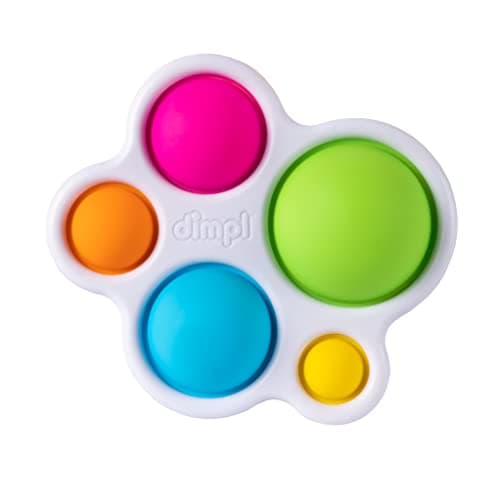
Pincer grip and push, from ten months
Fat Brain Toys Dimpl
Age grade 10 months+
Graded from 10 months: five silicone bubbles in a frame that pop back and forth. One object, one movement, infinitely repeatable, and genuinely quiet for something this satisfying. It is a baby toy and honest about it — past two, a child pops it twice and hands it back.
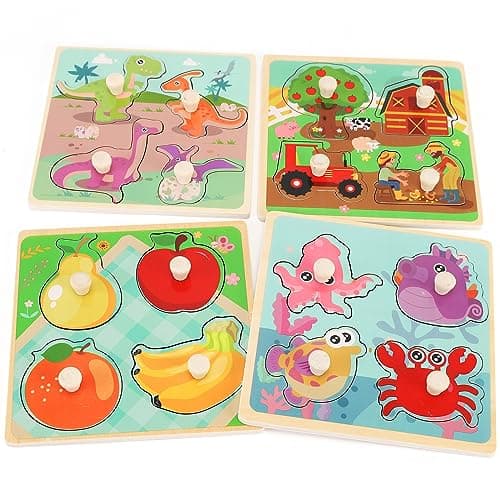
Rotation and placement, at two
Wooden Peg Puzzles for Toddlers, 4 Pack
Age grade 2–4
Graded 2 to 4. The knob is the whole design: it gives a two-year-old’s hand something to pinch and turn that a flat puzzle piece does not. Four boards, and the pieces belong to specific boards — worth knowing before they get mixed.
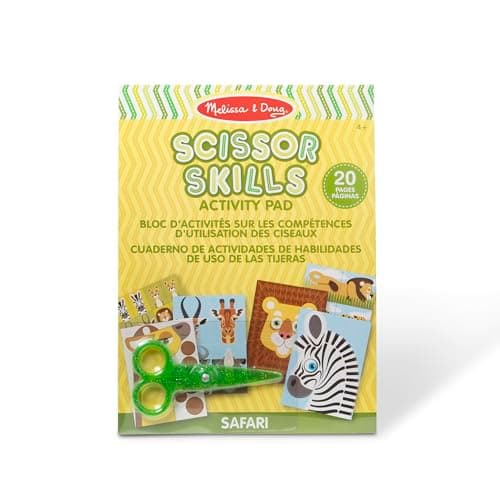
Two hands, different jobs, at four
Melissa & Doug Safari Scissor Skills Activity Pad
Age grade 4–6
Graded 4 to 6 and it includes child-safe scissors, which is why it works: the usual failure of a cutting activity is household scissors that are either too sharp or too blunt. One hand holds, the other cuts. Produces a great deal of paper confetti, all in one place.
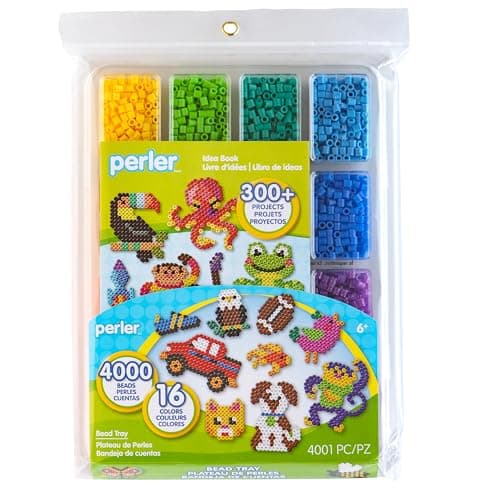
Precision, at six and up
Perler Fuse Beads Kit with Storage Tray
Age grade 6+
Graded 6+, and the pegboard work is as fine as this gets before it becomes a craft. Two honest conditions: the manufacturer states all ironing is an adult job, and thousands of loose beads are the definitive small part — which disqualifies it outright in a house with a toddler.
#ad · As an Amazon Associate we earn from qualifying purchases. How this works.
Questions
Questions people actually ask
What are fine motor skills in a child?
What are good fine motor toys for a 2-year-old?
Do electronic toys help fine motor skills?
What household objects work for fine motor practice?
Should I be worried about my child's fine motor skills?
Keep reading
Related
- Montessori toys explainedSelf-correcting objects, which is the same idea with a different name.
- Toys for the artistWhere the scissors, threading and drawing picks live.
- Toys for a 2-year-oldThe age this page is most often searched for.
- The choking-hazard guideFine motor toys are small parts by definition.
- What open-ended actually meansThe other half of the same test.
Receipts
Sources
- American Academy of Pediatrics — “Selecting Appropriate Toys for Young Children in the Digital Era” (clinical report)
- 16 CFR Part 1501 — the federal small-parts regulation behind the “not for children under 3” warning (eCFR)
- US Consumer Product Safety Commission — Toy Safety business guidance
We do not run a playroom test lab and we do not pretend to. Age grades, battery requirements and assembly notes are quoted from each manufacturer’s own product listing, read on September 7, 2026; prices come live from Amazon’s API and are stamped with the date they were checked. Where a maker publishes nothing, the page says “manufacturer does not publish this” rather than guessing. Read the full method.