Four wheeled toys that a toddler can actually use, sorted by what the child can physically do rather than by what the box photograph implies. The gap between a first birthday and a balance bike is about eighteen months long, and this is what fills it.
We earn a commission if you buy through our links. It does not change the price you pay and it does not decide our picks — our method is published in full, including the part where we say we have not played with these toys. How this works.
#ad · Prices come live from Amazon’s API and were last checked Sep 18, 2026. Where we have no verified live price we show none — we would rather leave a gap than print a number that has gone stale. Age grades are the manufacturer’s own; noise is our reading, not a measurement.
What a child can actually ride, month by month
Wheeled toys are the category where the box photograph and the published age grade disagree most often, and the disagreement costs money. Roughly, and with the usual caveat that children vary by months rather than by weeks:
12 to 18 months: a sit-on toy pushed with both feet flat on the floor. Steering is optional at this stage; the child is mostly discovering that they can move themselves.
18 to 24 months: sit-to-stand, and the first toys with a published grade that spans several years become worth buying. This is also where a push handle earns its keep, because the child’s stamina is shorter than the walk home.
2 to 3 years: pedaling becomes possible, so a trike works; so does a balance bike, which teaches a different and harder skill. Toys for a 2-year-old puts both in context against everything else that works at that age.
3 to 4 years: balance bike properly, or a three-wheel kick scooter. Our scooter comparison picks that up.
The four kinds of ride-on, and what each one is teaching
These are not four versions of the same toy. A push car teaches the child that they are the engine. A sit-to-stand scoot teaches weight transfer. A trike teaches pedaling, which is a coordination pattern, not a balance one. A balance bike teaches balance, which is the part of cycling that actually takes time to learn, and it is why balance bike against tricycle is a real question rather than a brand preference.
The practical consequence: buying a trike and a balance bike in the same year is buying two different lessons, not a duplicate. Buying a trike for a child who already rides a balance bike is buying backwards, and they will tell you so.
Assembly is the part nobody mentions
Three of the four above need an adult with a box, an allen key and half an hour, and the steel trike needs real hardware rather than plastic clips. This matters twice: once on Christmas Eve, and once for whoever is buying as a gift for someone else’s child. A ride-on is the least convenient thing in the house to assemble under time pressure, and we keep a page on that specific problem — how long a toy takes to assemble — because the box never tells you.
Under three: what to check before it is unwrapped
Every product on this page carries a published grade at or below two years, which means the under-three small-parts rule applies to all of them. The federal regulation behind the “not for children under 3” warning is a physical test, not a maturity judgment, and it is explained in full on our choking-hazard guide. On a ride-on the parts worth looking at are the bell, the handlebar grips and any pull-cord accessory — removable, smaller than they look, and at exactly mouth height when a toddler is sitting down.
What we would skip
The battery-powered 12-volt ride-on car. We do not cover them and the reasons are consistent: the child steers nothing that matters, the appeal is almost entirely in the first week, the charge cycle is long enough that the toy is unavailable at the exact moment it is wanted, and a dead sealed battery is usually the end of the toy rather than a replaceable part. It is the most expensive ride-on in the shop and the one most likely to be in a garage a year later. The general form of this argument is on the skip list.
If this is a first-birthday present rather than a considered purchase for your own child, first birthday gifts is the better starting point — it is written for someone buying for a family whose garage they have never seen, and a bulky ride-on is not always a welcome thing to give.
In detail
Every pick, in full
01
The one that covers the whole gap
Radio Flyer Scoot 2 Scooter
Radio Flyer
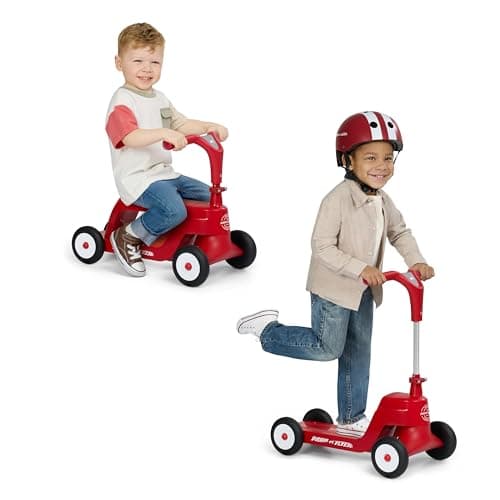
Graded 1 to 4, and the sit-to-stand conversion is why: the same object is a sit-on push-along at one and a standing scoot-along at three, which is the difference between a toy used for a season and a toy used for three years. It works indoors as well as outside, which matters more than it should in February. Plastic wheels are loud on laminate and can mark some floors — a rug or an outdoor-only rule fixes that.
Age grade:
1–4
Batteries:
manufacturer does not publish a battery requirement
Noise:
Quiet
Mess:
No mess
Assembly:
manufacturer does not publish an assembly time
Price:
$49.99 as of Sep 18, 2026
Age grade, battery and assembly wording are quoted from Radio Flyer’s own product listing, read on September 7, 2026. The manufacturer’s exact words: “Ages 1-4”. Noise and mess are our reading, not a measurement — we have not played with this.
What it gets right
+Sit-to-stand conversion means it covers the whole published 1 to 4 window rather than one year of it
+Works indoors as well as out, which matters in winter
+Radio Flyer parts and after-sales support are unusually good for a toy this cheap
What it doesn’t
−Plastic wheels are loud and mark some floors
−A confident three-year-old will want a proper balance bike instead
How loud
Plastic wheels on a hard floor. Indoors on laminate this is not silent, but there is nothing electronic.
How much mess
One object.
Skip this if…
…the child is already steady on a balance bike. This is the step before that, and buying both is buying the same year twice.
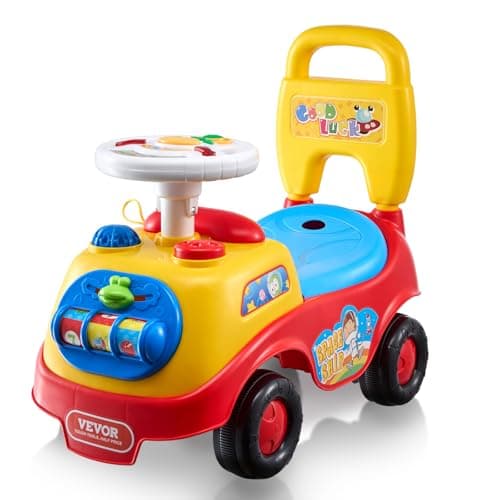
Graded from 19 months, which is an unusually precise published figure and worth respecting. The feature that earns its place is the parent push handle: when the child is done — and they will be done half a mile from home — an adult steers it back. That makes it a stroller substitute rather than only a toy, and nothing else here does that job. Adult assembly is required and it is fiddlier than the box suggests.
Age grade:
19 months+
Batteries:
manufacturer does not publish a battery requirement
Noise:
Quiet
Mess:
No mess
Assembly:
manufacturer does not publish an assembly time
Price:
$28.13 as of Sep 18, 2026
Age grade, battery and assembly wording are quoted from VEVOR’s own product listing, read on September 7, 2026. The manufacturer’s exact words: “Ages 19+ Months”. Noise and mess are our reading, not a measurement — we have not played with this.
What it gets right
+The push handle means an adult can steer it home when the child is done, which no other ride-on here offers
+Published 19-month grade is unusually precise and worth respecting
+Doubles as an indoor toy on a rainy day
What it doesn’t
−Adult assembly required, and it is fiddlier than the box suggests
−Outgrown at three, and it is bulky to store in the meantime
How loud
Wheels. No electronics.
How much mess
One object.
Skip this if…
…you already own a stroller and a balance bike. This sits between them and does neither job as well as the dedicated thing.
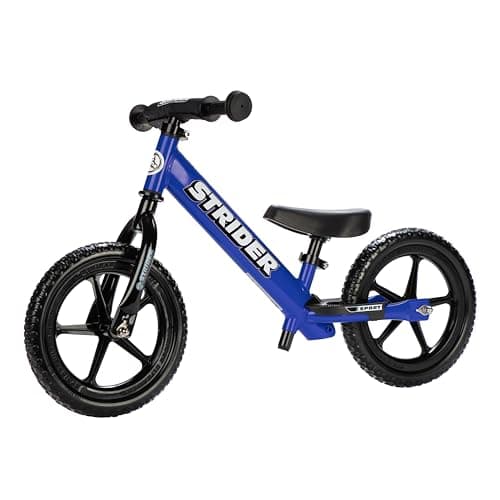
Graded 1 to 4, with a seat and handlebar that both adjust across that range, and no pedals at all. A balance bike teaches the hard half of cycling first, and children who learn on one generally step straight onto a pedal bike with no training wheels and no drama. The base model has no brake — stopping is done with feet — and it costs meaningfully more than a supermarket balance bike that is heavier and does the same job.
Age grade:
1–4
Batteries:
manufacturer does not publish a battery requirement
Noise:
Quiet
Mess:
No mess
Assembly:
manufacturer does not publish an assembly time
Price:
$149.99 as of Sep 18, 2026
Age grade, battery and assembly wording are quoted from Strider’s own product listing, read on September 7, 2026. The manufacturer’s exact words: “for Kids Ages 1–4 Years”. Noise and mess are our reading, not a measurement — we have not played with this.
What it gets right
+The published 1 to 4 range is real — the seat and bars both adjust, so it is three years of use from one purchase
+Balance first, pedals later, which is the approach that avoids training wheels altogether
+No chain, no brakes to adjust, nothing to service
What it doesn’t
−Expensive against the supermarket balance bikes, which are heavier but do the same job
−No brake on the base model — stopping is done with feet
How loud
Tires on pavement. No electronics.
How much mess
It is a bike. It lives by the door.
Skip this if…
…there is nowhere flat and traffic-free to ride. A balance bike needs a driveway, a park path or a quiet pavement, and without one it stays in the garage.
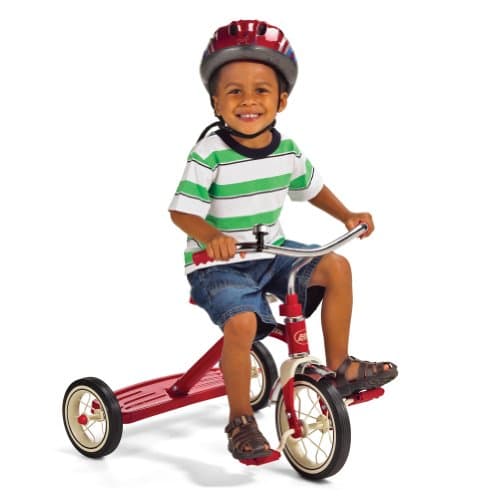
Graded 2 to 4, steel frame, adjustable seat, and pedals driving the front wheel directly so a two-year-old can work out the mechanism by looking at it. The steel is the reason the same trike turns up at a third garage sale. Two honest caveats: assembly involves real hardware rather than clips, and direct-drive pedals are inefficient enough that a four-year-old finds it slow.
Age grade:
2–4
Batteries:
manufacturer does not publish a battery requirement
Noise:
Some noise
Mess:
No mess
Assembly:
manufacturer does not publish an assembly time
Price:
$79.99 as of Sep 18, 2026
Age grade, battery and assembly wording are quoted from Radio Flyer’s own product listing, read on September 7, 2026. The manufacturer’s exact words: “Ages 2-4”. Noise and mess are our reading, not a measurement — we have not played with this.
What it gets right
+Steel frame — this is the trike that gets handed down rather than thrown out
+Adjustable seat covers the published 2 to 4 range properly
+Pedals directly on the front wheel, so a two-year-old can work out the mechanism themselves
What it doesn’t
−Adult assembly and it involves real hardware, not clips
−Direct-drive pedals are inefficient and a four-year-old will find it slow
How loud
Steel and rubber on pavement, plus a bell the child will discover in the first minute and ring for a year.
How much mess
One object, kept outdoors or in a hall.
Skip this if…
…the child already rides a balance bike. Trikes teach pedaling but not balance, and a balance-bike child is past the point where a trike helps.
Every toy site tells you they tested forty toys with a focus group of real children. We have not played with any of these, and we say so. Here is what we do instead: we read the manufacturer’s own listing and print its published age grade word for word, we record the battery requirement and the assembly note where the maker publishes one and say plainly when it does not, we pull the price live from Amazon so it is never a number we remembered, and we name one thing on every list we would not buy.
The noise and mess ratings are our judgment from what the listing describes — not measurements. Almost no toy manufacturer publishes a decibel figure, which is itself worth knowing. The full method is published, including what disqualifies a toy.
Questions
Questions people actually ask
What is the best ride-on toy for a 1-year-old?+
A sit-on push-along the child can move with both feet flat on the floor. At twelve months steering and pedaling are both beyond them, so the honest pick is whichever toy has a published grade starting at one year — and a sit-to-stand design is the one that is still useful at three.
Trike or balance bike for a 2-year-old?+
They teach different things. A trike teaches pedaling; a balance bike teaches balance, which is the harder and more transferable half of riding a bicycle. If you only buy one and the goal is cycling, buy the balance bike.
Are push-along ride-ons worth buying if we own a stroller?+
Only if the push handle matters to you. A ride-on with a handle sits between a stroller and a bike and does neither job as well as the dedicated thing — it earns its place on short walks where the child wants to ride and then abruptly does not.
Do ride-on toys need assembly?+
Almost all of them, and more than the box implies. A steel trike involves real hardware. If it is a birthday-morning gift, build it the night before.
What about electric ride-on cars?+
We do not recommend them. The child is a passenger rather than a rider, the novelty is front-loaded into the first week, and a failed sealed battery usually ends the toy. The money buys much more play in a balance bike.
We do not run a playroom test lab and we do not pretend to. Age grades, battery requirements and assembly notes are quoted from each manufacturer’s own product listing, read on September 7, 2026; prices come live from Amazon’s API and are stamped with the date they were checked. Where a maker publishes nothing, the page says “manufacturer does not publish this” rather than guessing. Read the full method.