The short version
A newborn cannot reach for anything, cannot grip on purpose, cannot hold their own head up, and sleeps for most of the day. For roughly the first eight weeks, a toy is something an adult holds within view and moves slowly. That is not a reason to buy nothing — it is a reason to buy four small things rather than ten large ones, and to spend the rest on the four-to-twelve-month stage, when a baby can actually do something.
So this page is five items long, which is shorter than every other newborn list you will find, and all but one of the five sit at the cheap end of the toy shop. The live price on every card is read from Amazon rather than typed by us, so check it against the date printed beside it.
What we required of a pick, in order
1. A published age grade of nought months
This is the whole reason the page is short. Of every product in our registry, exactly five carry a manufacturer-published grade that starts at birth. Everything else marketed for newborns either starts at three months — which is a different baby — or publishes no age grade at all, which we treat as disqualifying for a ranked pick on a page about the most fragile customer in the shop. If you want to see what the grade actually tests, our choking hazard guide covers the small-parts rule in full.
2. Something a baby under three months can use at all
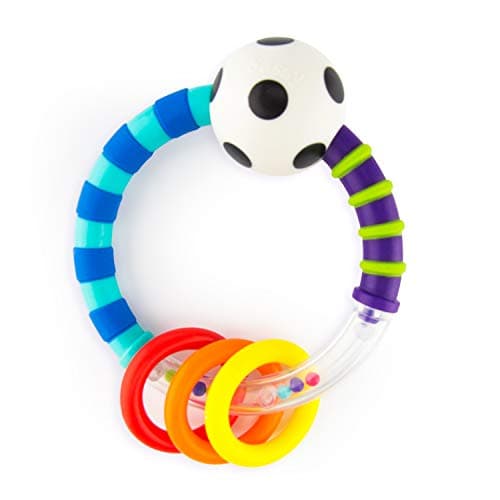
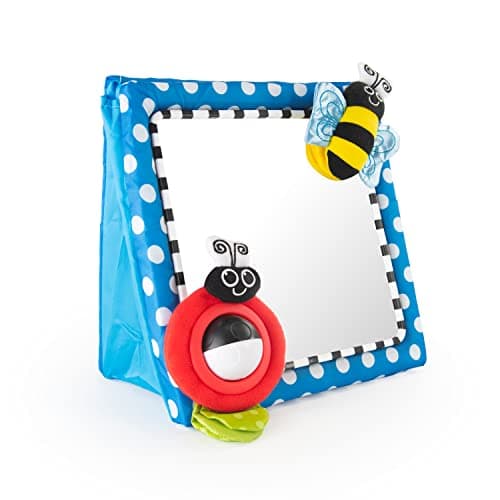
Three capabilities are available in the first twelve weeks: looking, hearing, and being put on the floor. A toy that needs grasping, sitting, pressing or stacking is not a newborn toy however it is labeled. High contrast, a mirror, a sound a baby cannot make alone, and something soft to be placed beside them — that is close to the entire honest category.
3. No small parts, nothing detachable
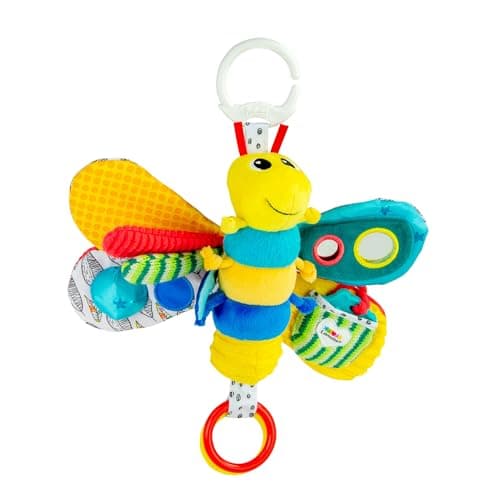
Every pick above is either one sealed piece or has its chewable parts tethered. On a page for a baby who will be placed on a mat unsupervised for the thirty seconds it takes to answer the door, that is not a preference.
4. A second act
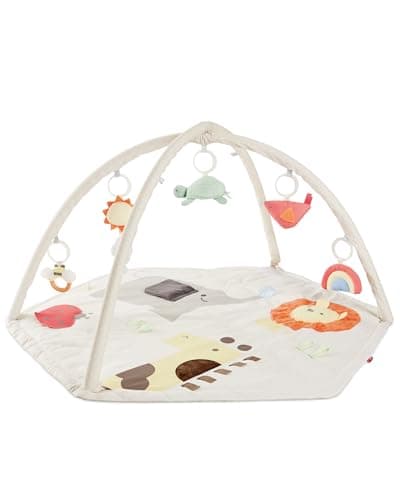
The honest weakness of newborn toys is that the window is weeks long. We gave weight to things that become something else: a ball that gets chased at ten months, a rattle that becomes a teether, a play gym that becomes a mat. The mirror is the exception — it is genuinely finished once the baby sits up, and we have said so on the card.
The four newborn toys we would not rank, and why
We resolved these four live from their current listings alongside the five above. All four are real, in stock, and popular. None of them publishes an age grade anywhere in the listing text, and on this site a missing published grade means a product cannot be a ranked pick — so rather than quietly leave them out, here is what they are:
- A high-contrast card set. The listing describes it as growing from a newborn visual aid to toddler flash cards, which is marketing copy rather than a grade. The idea is sound and the cards are the cheapest high-contrast option going; we simply will not rank a product whose maker will not state an age.
- Crinkle paper. Six inches square, washable, and babies love the sound. Published as a newborn essential, graded nowhere.
- A black-and-white deluxe play gym. Visually the nicest gym we looked at, with a light-and-music toy on it. No published age anywhere in the listing, and a light-and-music element is precisely where we want a maker to commit to a number.
- A sensory discovery board with a mirror. Tummy-time board, three ways to play, no published grade.
This is not a claim that those four are unsafe. It is a claim that the age grade is the one fact we refuse to infer, and you can read why on how we pick.
What to buy instead of more toys
The three things most often recommended to new parents by other new parents are not toys at all: a white-noise source, a wrap or carrier, and a muslin cloth in every room. We sell none of those and we are not going to pretend otherwise in the middle of a toy list. The relevant point for this page is that the first three months is the stage where a gift is most likely to be stored unopened, which is why gifts that are not toys exists.
If you are the relative buying for a newborn and you want the gift to land, the move is to buy for the baby they will be in six months rather than the baby they are. A stacking toy graded from six months, bought in March for a January baby, gets used for a year. A newborn rattle bought in January gets used for five weeks.
Noise, batteries and mess, at this age
Nothing on this page needs a battery. That is not a coincidence or a filter we applied after the fact — it is that electronics in the first twelve weeks are pointed at the adult rather than the baby, because a baby of eight weeks cannot operate anything. The one battery-powered newborn item we looked at (the deluxe gym, above) is also the one with no published grade.
On noise: four of the five picks make a sound only when somebody moves them, which is the definition we use across the site. The play gym has a squeaker, a chime, a rattle and two crinkles, all baby-powered. There is no decibel figure published for any toy on this page, and that absence is the subject of our noise ratings page.
On mess: a newborn makes an enormous amount of mess and none of it comes from toys.
Where the money actually goes
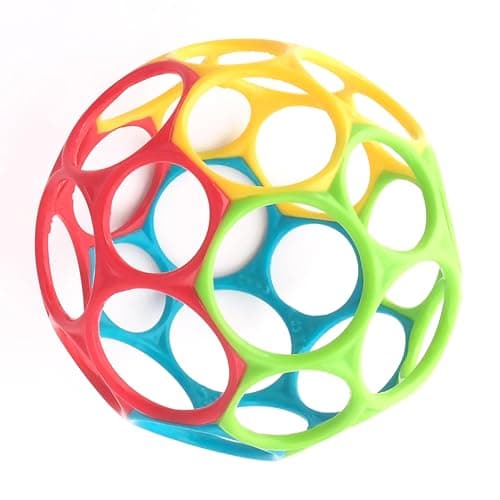
Four of the five picks here are inexpensive and one is not: the play gym costs several times what the other four cost put together. If the budget is one purchase, our order is: the ball, then the clip-on, then the gym — and we would skip the gym entirely if there is a baby shower coming, because it is the thing somebody else buys.
For the stage after this one, the first-year page is where the spending actually belongs: toys for babies 0 to 12 months runs from three months to a year and is sorted by published grade, and first birthday gifts covers the twelve-month mark. If you are buying for a baby who is already walking and talking, skip both and go to toys for an 18-month-old.
A note on what we have and have not done
We have not used any of these toys with a baby. What we have done is read every current listing in full, taken the age grade, the materials and the published features from the manufacturer's own words, and checked the price live. Our scores are judgments compiled from that published information — not test results, and we say so in those words on how we pick. On a newborn page, the difference between those two things matters more than anywhere else on this site.
If you are buying before the baby is born
Buy the ball and nothing else. The useful information — whether this baby tolerates tummy time, whether they are in a car daily, whether a gym already arrived from a grandparent — does not exist yet, and all three change the answer.
If you are buying for a baby of six to twelve weeks
The high-contrast rattle and the clip-on toy are the two that fit this window exactly. Add the mirror if the household has mentioned tummy time going badly.
If you are the relative who wants to buy the big thing
Ask first, then buy the gym. It is the one item here where a duplicate is a genuine problem, and the one where asking does not spoil anything.
What not to buy for a newborn, at any price
Anything graded 3+. Anything with a loose small part. Anything with a cord or ribbon longer than a hand span. And anything whose maker will not publish an age — not because it is necessarily dangerous, but because at this age the published grade is the only check you have.