Guides · Guides
How toy age grades are set
The number on the box comes from a real process, and it means different things at different ages. Under three it is a safety test; over three it is largely a judgment about difficulty. Knowing which is which changes how you buy.
We earn a commission if you buy through our links. It does not change the price you pay and it does not decide our picks — our method is published in full, including the part where we say we have not played with these toys. How this works.
Who decides
The manufacturer sets the age grade, working within a framework of federal regulation and the industry safety standard. In the US, toys must comply with ASTM F963 — the Standard Consumer Safety Specification for Toy Safety — which the Consumer Product Safety Commission has made a mandatory requirement. Compliance is verified through testing at accredited laboratories.
So the number is not marketing, but it is also not a developmental assessment of your specific child. It is a compliance-and-suitability judgment about a product.
Under three, the grade is a physical test
The dividing line at three exists because of 16 CFR Part 1501, the federal small-parts regulation. It defines a small part by a physical test: a cylinder roughly 1.25 inches across and up to 2.25 inches deep, approximating a young child’s throat. If any component — or any piece that comes off under expected use and abuse — fits entirely inside it, the toy cannot be labeled for under-threes.
That is why the “3+” label appears on toys that seem obviously harmless. It is a measurement result, not an opinion, and supervision does not change it. The full argument is on the choking hazard guide.
Over three, the grade is mostly about difficulty
Above three, age grades shift toward capability: can the child manipulate the pieces, follow the instructions, read what needs reading, sustain the attention the activity requires? A 6+ construction set is usually graded for the instruction booklet rather than the bricks; an 8+ electronics kit is graded for reading a schematic rather than for dexterity.
This is genuinely useful information and it is under-used. When a set is graded above a child’s age, the usual outcome is not danger — it is an adult building it while the child watches, and the child concluding they are not good at it.
Where the grade also carries a hazard
Some grades above three still encode a physical risk rather than a difficulty judgment:
- Magnets. Loose high-powered magnets can attract through tissue if more than one is swallowed. Sealed magnetic tiles exist to prevent exactly this.
- Coin cells. An ingestion hazard causing chemical injury, covered on our battery page.
- Projectiles and long cords. Eye injury and strangulation respectively.
- Chemistry sets. Graded 10+ for genuine handling reasons, with real supervision requirements in the manual.
Ranges like “8–12”
An upper bound is a marketing estimate of when a child loses interest, not a safety statement. It is worth largely ignoring: plenty of six-year-olds enjoy toys graded 3–6, and plenty of adults build sets graded 8–12. Only the lower bound carries weight. This matters most when buying for a teenager, because almost every good kit in that category is graded 8+ or 10+ — see educational gifts for a 13-year-old for why that is a labeling artifact rather than a mismatch.
How we use grades on this site
Every product here carries its manufacturer’s published grade as data rather than as prose, read from the live listing. Every page written for an age group is checked against it automatically, and the site fails to build if a pick is graded above the page’s audience. A toy whose maker publishes no grade cannot be added at all.
Grades occasionally change. If a listing disagrees with us, the listing wins and we want to know — the contact page is the fastest route.
One category where the lower bound is doing double duty is the one people search for most: toys sold on hand skills. The pieces that make a good fine motor toy are small by definition, which is exactly what the under-three grade exists to cover — fine motor toys, by age works through the four movements involved and which grade fits which of them.
The toys
The toys this guide is about
Every one of these carries its manufacturer’s published age grade and a live Amazon price, read October 23, 2026. Full rankings live in the roundups linked above.
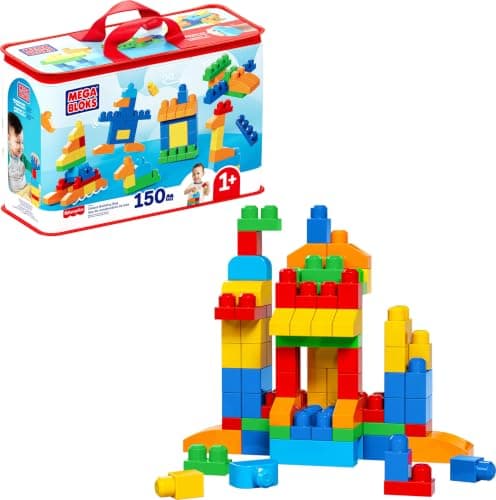
Graded 1+
MEGA BLOKS First Builders Deluxe Building Bag
Age grade 1+
One of very few construction sets a one-year-old can be given, and the grade is the entire reason.
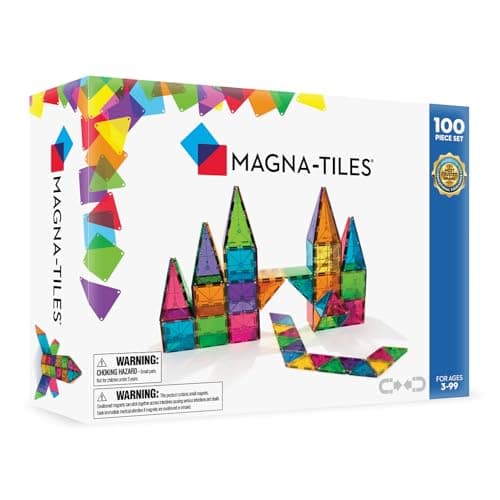
Graded 3+
Magna-Tiles Classic 100-Piece Set
Age grade 3+
A small-parts judgment, not a difficulty one — which is why supervision does not move the line.

Graded 10+
Thames & Kosmos Chem C1000 Chemistry Set
Age grade 10+
A grade that genuinely encodes handling risk, with real supervision requirements in the manual.
#ad · As an Amazon Associate we earn from qualifying purchases. How this works.
Questions
Questions people actually ask
Who decides the age on a toy box?
Does 3+ mean my child is not ready for it?
Can I ignore the upper age in a range like 8-12?
Are age grades legally required?
Do toy age grades ever change?
Keep reading
Related
Receipts
Sources
- ASTM F963 — Standard Consumer Safety Specification for Toy Safety
- 16 CFR Part 1501 — the federal small-parts regulation behind the “not for children under 3” warning (eCFR)
- US Consumer Product Safety Commission — Toy Safety business guidance
- CPSC — Small Parts regulations for toys and children's products
We do not run a playroom test lab and we do not pretend to. Age grades, battery requirements and assembly notes are quoted from each manufacturer’s own product listing, read on September 7, 2026; prices come live from Amazon’s API and are stamped with the date they were checked. Where a maker publishes nothing, the page says “manufacturer does not publish this” rather than guessing. Read the full method.