Guides · Guides
What “open-ended” actually means
It is the single most useful concept in toy buying and it appears on packaging that has nothing to do with it. Here is the working definition, and a test you can run in the shop.
We earn a commission if you buy through our links. It does not change the price you pay and it does not decide our picks — our method is published in full, including the part where we say we have not played with these toys. How this works.
The working definition
A toy is open-ended when the child decides what the outcome is. That is the whole thing. A set of blocks has no correct arrangement; a shape sorter has exactly one. A box of figures has no story; a talking toy that recites its own catchphrases has one.
The word gets attached to products that are nothing of the sort, usually as a synonym for “wooden” or “educational”. Neither is related. A wooden toy with one outcome is closed; a plastic system with infinite arrangements is open. The second of those two words gets its own page: educational toys vs just-for-fun toys sets the two shelves against each other and finds the label predicts nothing.
The test
Ask: can this be finished? If a child can complete it and be done — the puzzle solved, the shape sorted, the model built as shown — it is closed. If there is no state that counts as finished, it is open.
A second, sharper version: does the toy do anything by itself? The more a toy does on its own — lights, sounds, sequences, instructions — the less there is for the child to supply, and the narrower the play becomes.
Why it predicts longevity
A closed toy is finished when the child reaches the outcome. That might be five minutes or five weeks, but there is an end, and after the end the toy is a familiar object rather than an activity. An open-ended toy has no end, so its life is bounded by the child’s interest instead of by the toy’s design — which is a far longer horizon.
This is why almost everything on our what survives a year page is open-ended, and why the property beats price, material and brand as a predictor.
Closed toys are not bad
This is where the concept usually gets over-applied. Closed toys do things open-ended ones cannot. A puzzle teaches persistence toward a specific goal. A board game teaches rules, turns and losing. A shape sorter teaches a genuine cognitive step, and it teaches it because there is exactly one right answer.
The failure is a collection made entirely of closed toys, which is what happens by default because closed toys demonstrate better in a shop and photograph better on a box. A reasonable ratio is most of the collection open-ended, with a handful of good closed toys for the things they do well.
The spectrum, with examples
- Fully open: blocks, magnetic tiles, plain bricks, art materials, figures, dress-up, sand and water.
- Mostly open: track systems, marble runs, construction sets bought for the pieces rather than the model.
- Mostly closed: puzzles, board games, logic-challenge games, science kits.
- Fully closed: single-function electronic toys, models built once and displayed, anything with a script.
The cheapest open-ended things in any house
A large cardboard box. A blanket over two chairs. Pans and wooden spoons. Sticks. This is not a sentimental point — it is the same principle applied honestly, and it is worth stating on a site that earns money when you buy things. The reason to buy blocks rather than rely on cardboard is durability and quantity, not a difference in kind.
If you have met this argument before under a different name, that is because you have: Montessori toys, explained reaches nearly the same shortlist from a different starting point, and it is also the page that says plainly that nobody regulates the word.
Open-endedness has one more payoff worth naming, and it is the reason these toys dominate shared settings: a material works for one child or six without a rules change. Toys for a classroom or a homeschool room applies that to a buyer with different constraints — thirty children, no batteries to manage and pieces that vanish permanently.
The toys
The toys this guide is about
Every one of these carries its manufacturer’s published age grade and a live Amazon price, read October 23, 2026. Full rankings live in the roundups linked above.
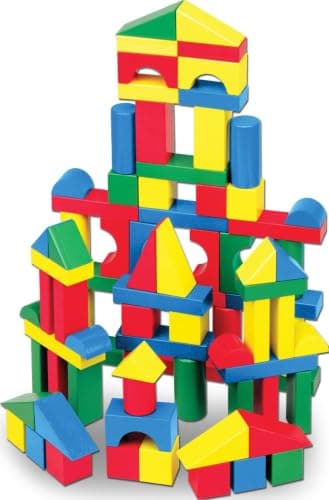
The purest open-ended toy
Melissa & Doug Wooden Building Blocks, 100 Pieces
Age grade 2+
No correct arrangement exists, which is why the play changes completely between two and seven.
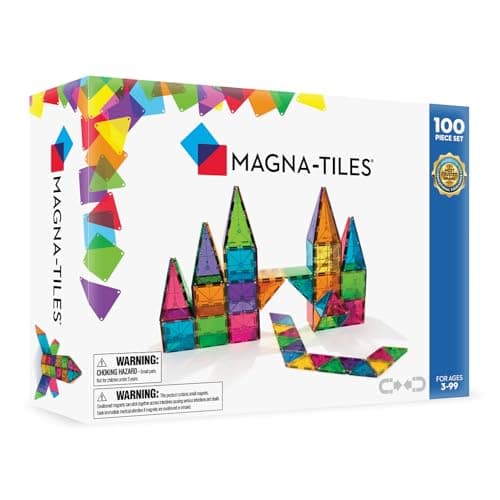
Open-ended and modern
Magna-Tiles Classic 100-Piece Set
Age grade 3+
Plastic, magnetic, and more open-ended than most wooden toys — material has nothing to do with it.
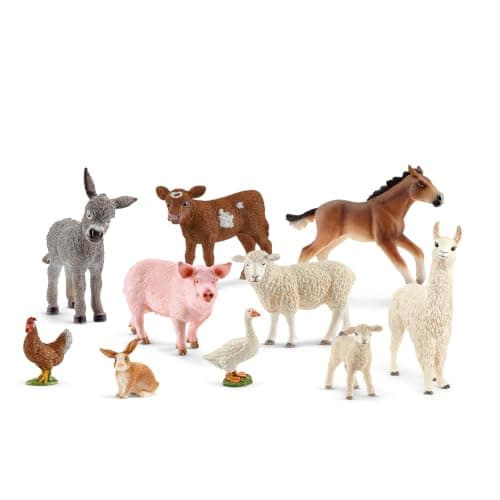
Open-ended without being a construction set
Schleich Farm World Animal Bundle, 10 Pieces
Age grade 3+
The child supplies every story. Nothing about the figure decides what happens.
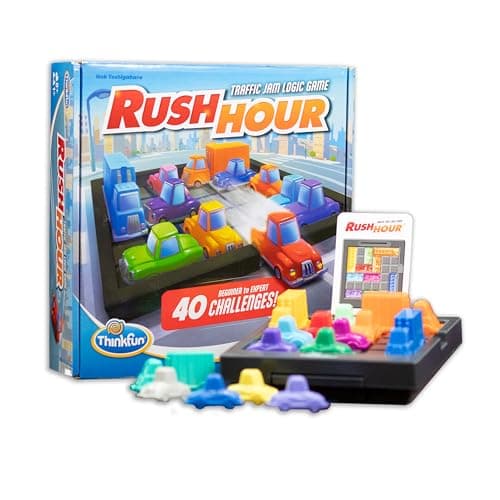
A closed toy worth owning
ThinkFun Rush Hour Traffic Jam Logic Game
Age grade 8+
Forty puzzles with exactly one solution each — and an excellent toy, which is the point about balance.
#ad · As an Amazon Associate we earn from qualifying purchases. How this works.
Questions
Questions people actually ask
What is open-ended play?
Are open-ended toys better?
How can I tell if a toy is open-ended?
Are wooden toys always open-ended?
What is the best open-ended toy?
Keep reading
Related
Receipts
Sources
- American Academy of Pediatrics — “Selecting Appropriate Toys for Young Children in the Digital Era” (clinical report)
- US Consumer Product Safety Commission — Toy Safety business guidance
We do not run a playroom test lab and we do not pretend to. Age grades, battery requirements and assembly notes are quoted from each manufacturer’s own product listing, read on September 7, 2026; prices come live from Amazon’s API and are stamped with the date they were checked. Where a maker publishes nothing, the page says “manufacturer does not publish this” rather than guessing. Read the full method.