Guides · Guides
Toys for a toddler with a speech delay
No toy is a treatment, and anything sold as one is selling you something. What published guidance from speech-language professionals describes is a way of playing — and some toys make that easy while others do the talking for you.
We earn a commission if you buy through our links. It does not change the price you pay and it does not decide our picks — our method is published in full, including the part where we say we have not played with these toys. How this works.
The short answer
No toy treats a speech delay. If a child is behind on talking, the people to see are a pediatrician and a speech-language pathologist, and the honest thing a toy site can do is say that first. What a toy can do is make the kind of play that published guidance describes easier to fall into -- and the best of those are cheap, quiet and wooden.
If you want one thing to buy today: a set of peg puzzles graded 2 to 4. Each piece is a single named object held in a hand, which is the simplest version of the name-and-point exchange that the published advice is built around. We are not clinicians, we have not tested these toys, and nothing on this page is a diagnosis or a therapy plan.
What the published guidance actually says
The Communication Health Support Association, which is powered by the American Speech-Language-Hearing Association, publishes a plain-language set of tips for speech and language development; it is linked in our sources. Read it and a pattern emerges that has very little to do with buying anything. The toy-relevant parts are these:
- Books with large, colorful pictures -- and talking about the pictures rather than reading every word.
- Naming and pointing. Its own example is asking “What’s this?” and getting the child to point to or name objects.
- Familiar objects in a box, for ages two to four: the child pulls one out and you talk about what it is and what it is for.
- Dolls or homemade puppets, with silly voices, talking about what the characters want and feel.
- Animal sounds connected to the animal -- the dog says woof-woof.
- Copying games, like clapping or peek-a-boo, where the child does what you do.
- Narrating ordinary routines -- bath, dressing, feeding, what the day will look like.
Notice what is missing from that list: a product. Four of the seven need nothing you do not already own, and one of them is a cardboard box with some kitchen things in it. That is the honest headline of this page.
What that means when you are choosing a toy
Every item on that list has the same structure: the child and an adult are both doing something, and the words are the bridge between them. So the useful question about a toy is not what it teaches, it is who does the talking.
A peg puzzle has no voice, so the voice is yours and the child’s. A toy that names the shape when the shape goes in has already done the job, and the child’s part is to press it again. That is the entire argument against the electronic version, and it is the one place where this page gets firm.
| Toy feature | Who talks | What the child does |
|---|---|---|
| Wooden peg puzzle, no electronics | The adult and the child | Points, names, asks for the next one |
| Cooperative first game, wooden pieces | Everyone at the table | Requests, waits, comments, takes a turn |
| Train loop or small world | The adult narrates, the child joins | Repeats, labels, asks for more |
| Shape sorter with a box of pieces | The child, to get the next piece | Gestures, sounds or words -- all count |
| Talking tablet or electronic learning toy | The toy | Presses a button and listens |
The toys to leave on the shelf
Anything whose selling point is that it says words. A tablet that names letters, a book that reads itself, a cube that announces each colour: all of them fill the gap where a child was about to try. There is also a clinical report from the American Academy of Pediatrics on choosing toys in the digital era in our sources, and the direction of its argument is the same as ours -- the value is in the back-and-forth, not the device.
Skip anything sold specifically as a speech or language toy. There is no standard behind that claim, nobody certifies it, and the premium is real: educational toys vs just-for-fun toys takes the same scalpel to the broader version of the same word. And skip the idea that more toys will help. A smaller set that comes out one at a time produces more talking than a full box, which is the argument on how many toys a child actually needs.
Five things that cost nothing
Because this page would be dishonest if it only listed products:
- The box of familiar objects. A spoon, a hairbrush, a sock, a cup. One out at a time, named, used, put back. This is on the published list almost word for word.
- Wait longer than feels comfortable. Four or five seconds of silence after you ask is where a child gets the chance to try.
- Narrate the boring parts. Dressing, bath, the walk to the car. Language lives in repetition, and routines repeat.
- Say it back, slightly bigger. They say “car”, you say “big red car”. No correction, no drilling.
- Put the thing where they can see it but not reach it. A reason to communicate beats any toy that removes one.
None of that is our invention and none of it is a treatment plan. It is the published advice, restated by somebody who sells toys and is telling you that you do not need many.
One more honest note on age grades
A toddler with a speech delay is still a toddler, and the age grade on a box is about physical safety rather than ability. The temptation to buy down an age band -- a baby toy for a two-year-old, because the words are behind -- is understandable and usually wrong: it bores them, and the thing you wanted was a reason to talk, not an easier toy. The temptation to buy up is worse, because of the small-parts rule. How toy age grades are set explains what the number is and is not based on.
The toys
The toys this guide is about
Every one of these carries its manufacturer’s published age grade and a live Amazon price, read October 17, 2026. Full rankings live in the roundups linked above.
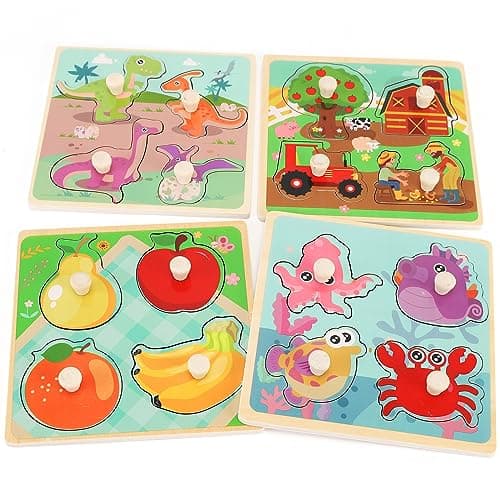
Naming, one object at a time
Wooden Peg Puzzles for Toddlers, 4 Pack
Age grade 2–4
Published for 2 to 4, four puzzles in the pack. The published guidance leans on naming and pointing -- asking a child what something is and getting them to point to it or say it -- and a peg puzzle is the simplest possible version of that, because each piece IS one named object, held in a hand. Quiet, wooden, nothing electronic. It is a stepping stone: a three-year-old already doing jigsaws will not go back to it.
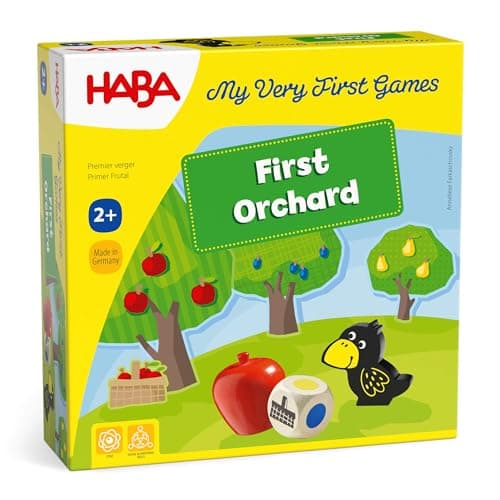
Taking turns, and the words that come with it
HABA My Very First Games — First Orchard
Age grade 2–4
Published for 2 to 4. A cooperative game with wooden fruit is the earliest point where a toddler has to wait, request, hand over and comment -- the social scaffolding under early language, and all of it out loud. Silent, nothing in the box but wood and a die. The honest limit: by four they will find it slight and ask for a real game, and they will be right.
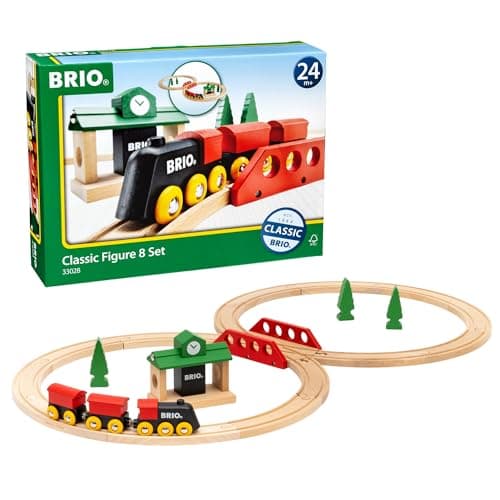
The thing you narrate over
BRIO World Classic Figure 8 Train Set
Age grade 2+
Graded 2+. A train loop is useful here for a dull reason: it gives an adult something to talk about at the child's eye level for twenty minutes -- the train goes, the train stops, under, over, again. The wheels are the only sound and it is a pleasant one. It is a starter loop at a premium price, and an unbranded expansion pack doubles the track for a fraction of a second branded set.
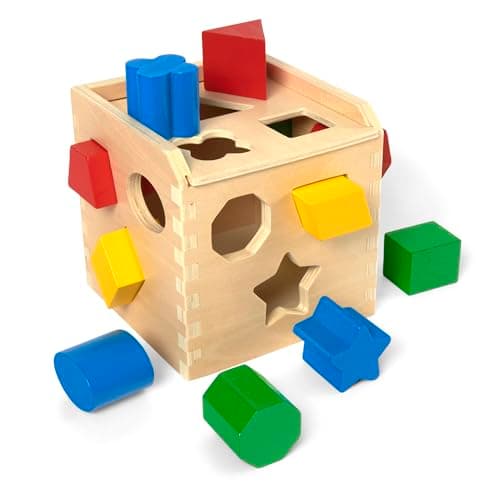
Request, then receive
Melissa & Doug Shape Sorting Cube
Age grade 2–4
Published for 2 to 4, twelve wooden shapes. The reason it is here is the shape of the exchange rather than the shapes themselves: a child wants the next piece, an adult has it, and that is a reason to communicate -- a gesture, a sound or a word, all of which count. Wood on wood, no electronics. The grade is 2+ and twelve small wooden shapes at eighteen months is the wrong side of the small-parts line.
#ad · As an Amazon Associate we earn from qualifying purchases. How this works.
Questions
Questions people actually ask
What toys help a 2-year-old with a speech delay?
Are electronic learning toys bad for speech development?
What do speech therapists use toys for?
Should I buy toys marketed for speech delay?
My child is 2 and not talking much. Should I buy toys for a younger age?
Keep reading
Related
- Toys for a 2-year-oldThe full list for the age, with the same preference for toys that have no voice.
- Pretend play toys, 2 to 6Dolls, puppets and small worlds -- the category the published guidance leans on most.
- Fine motor toysThe same approach applied to hands rather than words.
- Toys that need no batteriesA useful proxy: a toy with no battery cannot do the talking for a child.
- Toys for autistic kids: what to check on the boxA different question with the same honesty about what a listing can and cannot tell you.
Receipts
Sources
- Communication Health Support Association (powered by ASHA) — “Tips for Your Child’s Speech and Language Development”
- American Academy of Pediatrics — “Selecting Appropriate Toys for Young Children in the Digital Era” (clinical report)
- 16 CFR Part 1501 — the federal small-parts regulation behind the “not for children under 3” warning (eCFR)
- US Consumer Product Safety Commission — Toy Safety business guidance
We do not run a playroom test lab and we do not pretend to. Age grades, battery requirements and assembly notes are quoted from each manufacturer’s own product listing, read on September 7, 2026; prices come live from Amazon’s API and are stamped with the date they were checked. Where a maker publishes nothing, the page says “manufacturer does not publish this” rather than guessing. Read the full method.