Skip to content
Windup & Wonder

Head to head · Compare

Balance bike vs tricycle

They look like alternatives and they teach opposite things. A tricycle teaches pedaling; a balance bike teaches balance. Only one of those is the hard part of riding a bike.

By Stephen V.Updated How we pick
#ad

We earn a commission if you buy through our links. It does not change the price you pay and it does not decide our picks — our method is published in full, including the part where we say we have not played with these toys. How this works.

The short answer

The picks, at a glance

#ToyBest forAge gradeNoisePrice
01The one we would buy1–4Quiet$149.99Amazon
02The right answer for a specific child2–4Some noise$79.99Amazon
03The step before either1–4Quiet$49.99Amazon

#ad · Prices come live from Amazon’s API and were last checked Sep 8, 2026. Where we have no verified live price we show none — we would rather leave a gap than print a number that has gone stale. Age grades are the manufacturer’s own; noise is our reading, not a measurement.

The core argument

Riding a bike is two skills: balancing and pedaling. Balancing is difficult and takes weeks. Pedaling is easy and takes about ten minutes. A tricycle — and a bike with training wheels — teaches the easy skill first and actively prevents the hard one, because a stable machine never requires a weight shift.

A balance bike inverts that. The child pushes with their feet, learns to glide, learns to steer into a lean, and learns to stop. When they move to a pedal bike, the only new thing is the pedals. This is why balance-bike children so often skip training wheels entirely, and it is the strongest single argument in this whole comparison.

The unlearning problem

Training wheels do not merely delay balance — they teach a habit that has to be unlearned. A child on stabilizers learns to steer by turning the handlebars and to stay upright by leaning on the outer wheel, both of which are wrong on a two-wheeler. The miserable fortnight most people remember from learning to ride is largely that unlearning.

Where the tricycle genuinely wins

  • A cautious child. Some two-year-olds will not get on anything that can fall over. The bike they will ride beats the bike that is better in principle.
  • Being pushed. Push-handle trikes work as pushchair alternatives, which balance bikes cannot do at all.
  • Carrying things. The bucket on the back is used more than anyone expects.
  • Flat, smooth surfaces only. On a smooth path a trike is fine; on grass or gravel it is close to unusable.

Sizing, which matters more than brand

The one thing to get right on a balance bike is seat height: the child should be able to sit with both feet flat on the ground, knees slightly bent. Too high and they cannot push confidently; too low and they cannot glide. Weight matters almost as much — a bike a toddler cannot pick up when it falls is a bike they will stop using, and the difference between a light and a heavy balance bike is very obvious to a two-year-old.

When the answer is neither

Under about 18 months, neither. A four-wheeled scoot-along is the right stage, or nothing at all — there is no benefit to starting early. Over about five, skip both and go straight to a pedal bike; a five-year-old learns balance on the bike itself in an afternoon or two, and a balance bike bought at that age has a very short life.

Helmets

From the first ride, on either. A child who rides unhelmeted for a fortnight will resist one afterwards, and the habit is far easier to establish than to introduce. Budget for it as part of the purchase rather than as an extra.

In detail

Every pick, in full

01
Strider Strider 12 Sport Balance Bike

The one we would buy

Strider 12 Sport Balance Bike

Strider

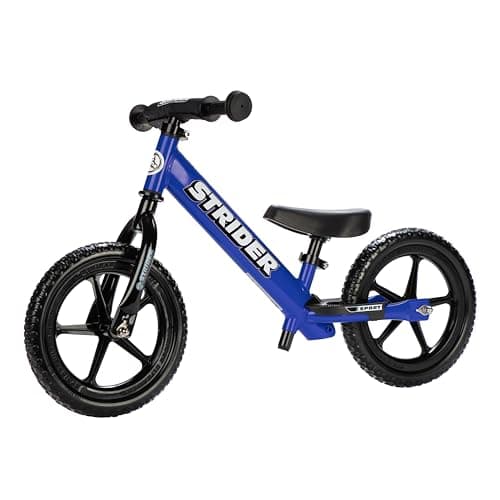
Graded from about 18 months. A balance bike teaches the difficult half of cycling first: weight shift, steering into a lean, and stopping. Children who learn this way typically move onto a pedal bike with no training wheels at all, because the only thing left to learn is pedaling. It is also light enough for a toddler to pick up alone, which decides whether it gets used.

Age grade:
1–4
Batteries:
manufacturer does not publish a battery requirement
Noise:
Quiet
Mess:
No mess
Assembly:
manufacturer does not publish an assembly time
Price:
$149.99 as of Sep 8, 2026

Age grade, battery and assembly wording are quoted from Strider’s own product listing, read on September 7, 2026. The manufacturer’s exact words: for Kids Ages 1–4 Years. Noise and mess are our reading, not a measurement — we have not played with this.

What it gets right

  • The published 1 to 4 range is real — the seat and bars both adjust, so it is three years of use from one purchase
  • Balance first, pedals later, which is the approach that avoids training wheels altogether
  • No chain, no brakes to adjust, nothing to service

What it doesn’t

  • Expensive against the supermarket balance bikes, which are heavier but do the same job
  • No brake on the base model — stopping is done with feet

How loud

Tires on pavement. No electronics.

How much mess

It is a bike. It lives by the door.

Skip this if…

there is nowhere flat and traffic-free to ride. A balance bike needs a driveway, a park path or a quiet pavement, and without one it stays in the garage.

$149.99See it on Amazon

Price checked Sep 8, 2026. Toy prices move constantly, especially in December — Amazon’s price at checkout is the one that counts.

#ad · we may earn a commission from this link to Strider 12 Sport Balance Bike

02
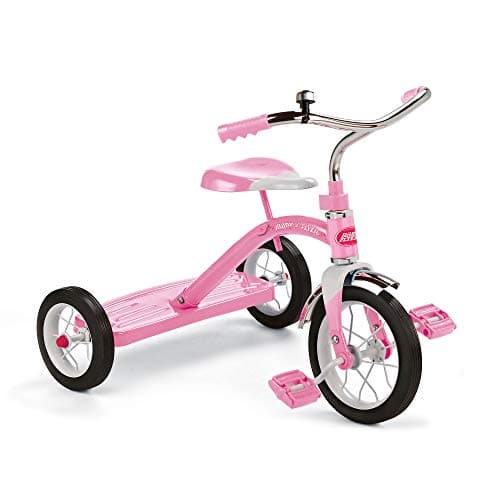
Radio Flyer Radio Flyer Classic Red Tricycle

The right answer for a specific child

Radio Flyer Classic Red Tricycle

Radio Flyer

Graded 2+. A tricycle is stable at rest, which suits a cautious child who is not ready to be unsupported, and it teaches pedaling directly. It is heavier, it does not handle uneven ground, and it does not transfer to a two-wheeler — but for a nervous two-year-old, the one they will actually get on beats the one that is theoretically better.

Age grade:
2–4
Batteries:
manufacturer does not publish a battery requirement
Noise:
Some noise
Mess:
No mess
Assembly:
manufacturer does not publish an assembly time
Price:
$79.99 as of Sep 8, 2026

Age grade, battery and assembly wording are quoted from Radio Flyer’s own product listing, read on September 7, 2026. The manufacturer’s exact words: Ages 2-4. Noise and mess are our reading, not a measurement — we have not played with this.

What it gets right

  • Steel frame — this is the trike that gets handed down rather than thrown out
  • Adjustable seat covers the published 2 to 4 range properly
  • Pedals directly on the front wheel, so a two-year-old can work out the mechanism themselves

What it doesn’t

  • Adult assembly and it involves real hardware, not clips
  • Direct-drive pedals are inefficient and a four-year-old will find it slow

How loud

Steel and rubber on pavement, plus a bell the child will discover in the first minute and ring for a year.

How much mess

One object, kept outdoors or in a hall.

Skip this if…

the child already rides a balance bike. Trikes teach pedaling but not balance, and a balance-bike child is past the point where a trike helps.

$79.99See it on Amazon

Price checked Sep 8, 2026. Toy prices move constantly, especially in December — Amazon’s price at checkout is the one that counts.

#ad · we may earn a commission from this link to Radio Flyer Classic Red Tricycle

03
Radio Flyer Radio Flyer Scoot 2 Scooter

The step before either

Radio Flyer Scoot 2 Scooter

Radio Flyer

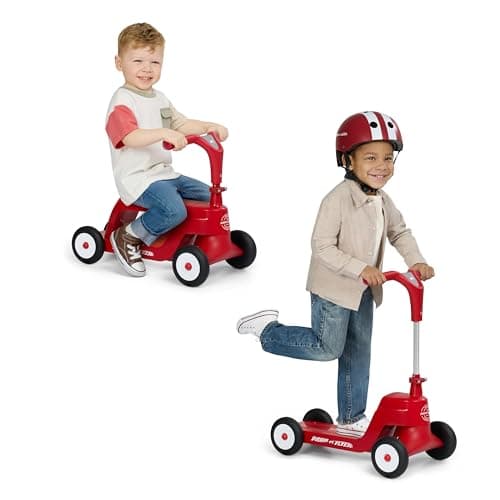
Graded 1+. A four-wheeled scoot-along for a child who is walking confidently but not ready for two wheels. It is the bridge purchase, useful for roughly a year, and worth considering when 18 months feels early for a balance bike.

Age grade:
1–4
Batteries:
manufacturer does not publish a battery requirement
Noise:
Quiet
Mess:
No mess
Assembly:
manufacturer does not publish an assembly time
Price:
$49.99 as of Sep 8, 2026

Age grade, battery and assembly wording are quoted from Radio Flyer’s own product listing, read on September 7, 2026. The manufacturer’s exact words: Ages 1-4. Noise and mess are our reading, not a measurement — we have not played with this.

What it gets right

  • Sit-to-stand conversion means it covers the whole published 1 to 4 window rather than one year of it
  • Works indoors as well as out, which matters in winter
  • Radio Flyer parts and after-sales support are unusually good for a toy this cheap

What it doesn’t

  • Plastic wheels are loud and mark some floors
  • A confident three-year-old will want a proper balance bike instead

How loud

Plastic wheels on a hard floor. Indoors on laminate this is not silent, but there is nothing electronic.

How much mess

One object.

Skip this if…

the child is already steady on a balance bike. This is the step before that, and buying both is buying the same year twice.

$49.99See it on Amazon

Price checked Sep 8, 2026. Toy prices move constantly, especially in December — Amazon’s price at checkout is the one that counts.

#ad · we may earn a commission from this link to Radio Flyer Scoot 2 Scooter

How we picked

Toys we claim to have played with: 0

Every toy site tells you they tested forty toys with a focus group of real children. We have not played with any of these, and we say so. Here is what we do instead: we read the manufacturer’s own listing and print its published age grade word for word, we record the battery requirement and the assembly note where the maker publishes one and say plainly when it does not, we pull the price live from Amazon so it is never a number we remembered, and we name one thing on every list we would not buy.

The noise and mess ratings are our judgment from what the listing describes — not measurements. Almost no toy manufacturer publishes a decibel figure, which is itself worth knowing. The full method is published, including what disqualifies a toy.

Questions

Questions people actually ask

Is a balance bike better than a tricycle?
For learning to ride, yes — it teaches balance, which is the hard part, and children who start on one usually skip training wheels entirely. A tricycle teaches pedaling, which takes about ten minutes to learn anyway.
What age can a child start a balance bike?
From about 18 months, provided they can sit with both feet flat on the ground and knees slightly bent. Seat height and bike weight matter far more than brand.
Do balance bikes really skip training wheels?
Usually. Once balance and steering are automatic, the only new skill on a pedal bike is pedaling. Training wheels additionally teach habits that have to be unlearned.
Is a tricycle ever the right choice?
For a cautious child who will not get on anything that can tip, for being pushed, or for carrying things around a flat garden. The bike a child will actually ride beats the theoretically better one.
What size balance bike should I buy?
Fit is set by seat height rather than wheel size: both feet flat on the ground, knees slightly bent. A 12-inch wheel covers roughly 18 months to four for most children.

Keep reading

Receipts

Sources

We do not run a playroom test lab and we do not pretend to. Age grades, battery requirements and assembly notes are quoted from each manufacturer’s own product listing, read on September 7, 2026; prices come live from Amazon’s API and are stamped with the date they were checked. Where a maker publishes nothing, the page says “manufacturer does not publish this” rather than guessing. Read the full method.