Guides · Guides
Board games by age: what a child can actually do
Every failed board game purchase is the same mistake — buying for the skill the box lists rather than for the skill the game actually demands. Reading and counting are the easy part. Waiting for three other people, and losing, are the hard part, and they arrive years apart.
We earn a commission if you buy through our links. It does not change the price you pay and it does not decide our picks — our method is published in full, including the part where we say we have not played with these toys. How this works.
The short version
At two to four, buy cooperative games where everybody plays the board together. At five, stay cooperative — a five-year-old can take a turn but usually cannot yet lose one. At six, switch to competitive games with a short round length, because a six-year-old can finally tolerate an outcome. From eight, round length stops mattering and the game can take an hour. If you buy one game for a four-year-old, buy a cooperative one; if you buy one for a seven-year-old, buy a competitive one. That single switch is most of this page.
Why the number on the box misleads
The age grade on a board game is set mostly by two things: whether the game needs reading and whether it needs counting past ten. Both are real, and neither is what stops a game working in a living room. What stops a game working is one of these four:
- Turn length. A three-year-old can wait about fifteen seconds. If the other players take a minute each, the child has left.
- Losing. This is the big one and it arrives late. A four-year-old experiences losing as something being taken away, not as a result. A six-year-old can usually survive it. Nothing about reading predicts this.
- Hidden information. Holding a hand of cards you must not show anybody is a genuinely hard cognitive task, which is why card games skew older than their complexity suggests.
- Total length. Twenty minutes is a game at five. An hour is a commitment at eight and a punishment at five.
The ladder
| Stage | What the child can do | Buy this kind of game | Example from our picks |
|---|---|---|---|
| 2–4 | Take a turn, recognize a color or a symbol, wait a few seconds. Cannot lose, cannot hold cards | Cooperative, no reading, five-minute rounds, chunky pieces | First Orchard (graded 2–4) |
| 5 | Follow two rules at once, count to ten, wait for two other players. Losing is still very hard | Still cooperative. Introduce a goal the group can fail at — that is how losing gets practiced safely | Race to the Treasure! (graded 5+) |
| 6–7 | Tolerate an outcome, plan one move ahead, read a little, hold a small hand of cards | Competitive, short rounds, visible board state. No long reading | Ticket to Ride: First Journey, CATAN Junior (both 6+) |
| 8+ | Strategy across a whole game, bluffing, a sixty-minute sitting | Anything. Length and hidden information stop being the constraint | See the board game comparison |
Cooperative first is not a soft option
It is worth being precise about why cooperative games sit at the bottom of this ladder, because it is not about protecting feelings. In a cooperative game the players race the board, so everybody wins or everybody loses together — which means a child gets to practice the mechanical parts of game-playing (taking a turn, following a rule, accepting a bad dice roll) without the one part they cannot yet manage. And they do get to lose: a good cooperative game is losable, and losing as a team is the version a five-year-old can survive.
Then move on. A child who is seven and still only plays cooperative games has not had the other half of the lesson. Two months of cooperative play and then a competitive game with ten-minute rounds is the sequence that works.
Family games with a wide age gap
The hardest brief in this category is two children four years apart. The usual outcome is a game pitched at the older one that the younger one loses every time, which teaches the younger one to stop playing. Two things fix it: pick a game whose youngest grade matches the youngest player, and pick one with high luck content — dice and card draws mean a six-year-old can beat a ten-year-old legitimately, which is the only thing that keeps both of them at the table. Memory and matching games are the extreme version of this and genuinely favor the younger child. There is more on multi-child households in gifts for siblings.
What we would skip
The electronic game with a talking unit in the middle. It is loud by design, the batteries die mid-game, and the unit dictates pace — which removes the one genuinely valuable thing a board game does, which is make children manage each other. The loud-toys list covers the pattern. We would also skip the licensed re-skin of a classic. It is the same game with a character printed on it, usually at a higher price and on thinner card, and the license is the only thing you are paying for. If you want the general test for whether a toy earns its place, that is how to choose a toy.
Where to buy from here
The head-to-head of specific games — what is actually in the box, round lengths, player counts — is best board games for kids compared. For a five-year-old specifically, toys for a 5-year-old has the cooperative pick in context, and gifts for a kid starting kindergarten explains why turn-taking practice is worth buying in the specific year a child starts school.
The toys
The toys this guide is about
Every one of these carries its manufacturer’s published age grade and a live Amazon price, read October 5, 2026. Full rankings live in the roundups linked above.
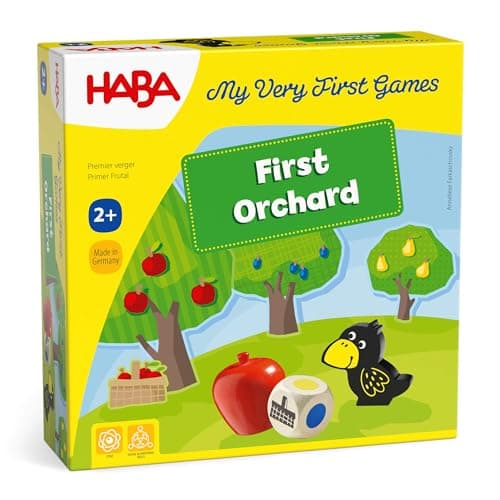
The 2-to-4 rung: cooperative, no reading, chunky pieces
HABA My Very First Games — First Orchard
Age grade 2–4
Graded 2 to 4 and made in Germany. Players work together to pick the fruit before the raven arrives, so there is no individual loser, and the pieces are large enough for a two-year-old's hands. It is the only game in our registry whose published grade starts at two, which makes it the entry point to this whole ladder.
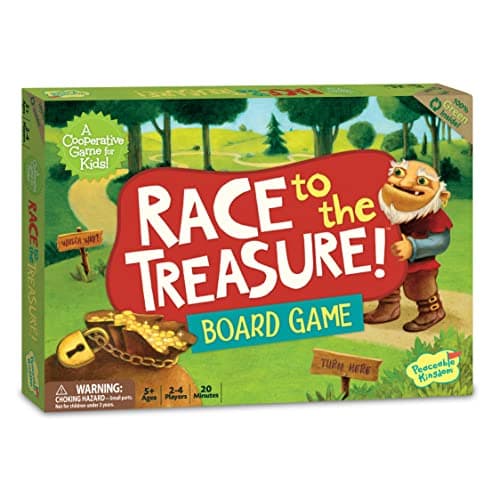
The 5 rung: cooperative, but genuinely losable
Peaceable Kingdom Race to the Treasure!
Age grade 5+
Graded 5+, two to four players, path-building and fully cooperative — the group races the game. The important detail is that the group can lose, which is how a five-year-old practices losing in the one format where it does not fall on them personally. Play it for a couple of months, then move up.
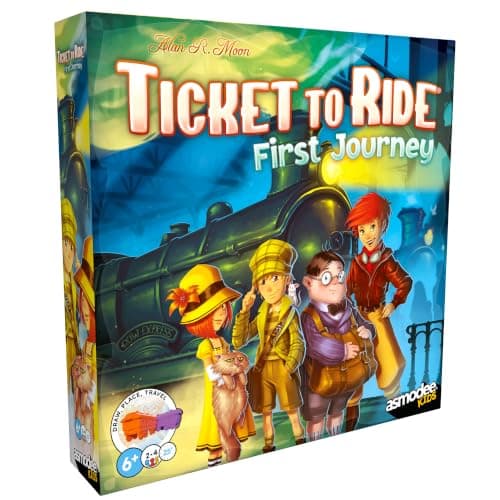
The 6-to-7 rung: competitive, short, no reading required
Ticket to Ride: First Journey
Age grade 6+
Graded 6+. A cut-down route-building game with picture cards rather than text, so a six-year-old plays it without reading, and rounds are short enough that losing is survivable because another game starts in fifteen minutes. It is also the one on this list adults do not have to pretend to enjoy.
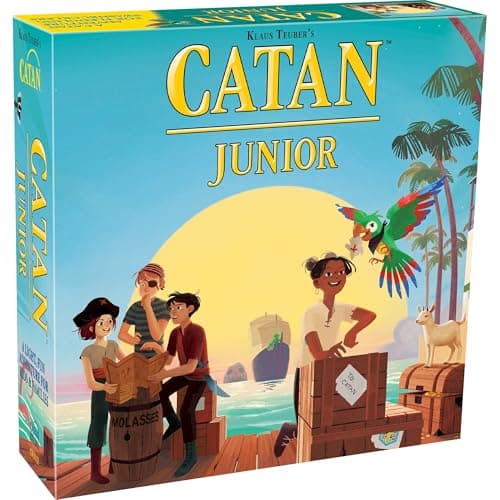
The 6-plus rung for a child who wants to think
CATAN Junior
Age grade 6+
Graded 6+, two to four players, 30 minutes of playtime. It keeps the trading and building skeleton of the adult game and removes the reading and the arithmetic, which makes it the first genuinely strategic game most children meet. Expect the first two plays to need an adult explaining the trade step.
#ad · As an Amazon Associate we earn from qualifying purchases. How this works.
Questions
Questions people actually ask
What board games can a 4-year-old play?
When can kids play competitive board games?
Are the age grades on board games accurate?
What board game works with kids four years apart?
Are cooperative games too easy?
Keep reading
Related
- Best board games for kidsThe head-to-head: what is in each box, round lengths and player counts.
- Toys for a 5-year-oldWhere the cooperative rung sits in a full list for the age.
- Gifts for a kid starting kindergartenWhy turn-taking practice is worth buying in that specific year.
- Gifts for siblingsThe wide-age-gap problem, in more detail.
- How to choose a toyThe general test this page is one application of.
Receipts
Sources
- American Academy of Pediatrics — “Selecting Appropriate Toys for Young Children in the Digital Era” (clinical report)
- US Consumer Product Safety Commission — Toy Safety business guidance
- 16 CFR Part 1501 — the federal small-parts regulation behind the “not for children under 3” warning (eCFR)
We do not run a playroom test lab and we do not pretend to. Age grades, battery requirements and assembly notes are quoted from each manufacturer’s own product listing, read on September 7, 2026; prices come live from Amazon’s API and are stamped with the date they were checked. Where a maker publishes nothing, the page says “manufacturer does not publish this” rather than guessing. Read the full method.