Almost every bad scooter purchase is an age mistake rather than a brand mistake: a two-wheeler bought for a four-year-old, or a toddler three-wheeler bought for a seven-year-old who is embarrassed by it. The published grade is the whole decision, so this page is organized around it.
We earn a commission if you buy through our links. It does not change the price you pay and it does not decide our picks — our method is published in full, including the part where we say we have not played with these toys. How this works.
#ad · Prices come live from Amazon’s API and were last checked Sep 18, 2026. Where we have no verified live price we show none — we would rather leave a gap than print a number that has gone stale. Age grades are the manufacturer’s own; noise is our reading, not a measurement.
Three wheels or two is a question about the child, not the scooter
A kick scooter asks a child to do two hard things at once: balance on one foot while pushing with the other, and steer by turning the handlebars. Most children cannot do both before about five. A three-wheel scooter removes one of them — it steers by leaning, and the third wheel means a wobble is not a fall — which is why the published grades on lean-to-steer scooters start at two and the grades on two-wheelers start at five or eight.
That is the entire decision, and it is worth stating plainly because it is the one most gift buyers get wrong. Buying up costs you the year the scooter would have been used: a two-wheeler given to a four-year-old sits in the garage until they are six, by which point it is scuffed, forgotten and the wrong size. The same logic runs in reverse — a lean-to-steer toddler scooter handed to a seven-year-old is an insult with wheels on.
Wheel size matters more than brand
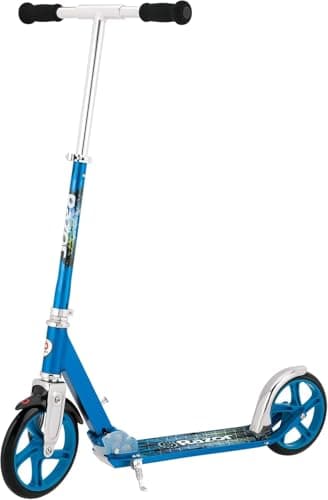
The specification that changes how a scooter feels is the wheel. Small, hard plastic wheels are fine on a smooth driveway and stop against the first raised paving slab, which is exactly where a child goes over the bars. Larger urethane wheels — 8 inches on the Razor above — roll over the same crack without noticing it, and polyurethane is also quieter than hard plastic on pavement. If you are choosing between two scooters at a similar price, the wheels are a better tiebreaker than the graphics.
The second specification worth reading is the rider weight limit. It is the honest measure of how long the scooter lasts, and it is the reason a 110 lb limit reads as three or four years of use rather than one. Our toys that survive page makes the general version of this argument: the published limit is a manufacturer telling you when their product stops working.
Do the light-up wheels need batteries?
On both LED scooters here, no — the manufacturers state the lights are driven by the wheels turning. That matters more than it sounds. A light-up toy that runs on button cells is a recurring cost, a recurring argument and a battery-safety question; a light-up wheel that generates its own power is a magnet spinning past a coil and it cannot go flat. This is one of the few places in the toy aisle where the flashy feature is genuinely free, and it is the kind of detail we track on the battery reality page.
Folding, and where the scooter actually lives
A scooter that folds lives in a hall cupboard. A scooter that does not lives against a wall in the hall, in the way, until somebody moves it to the shed, after which it is used four times a year. This is not a small thing, and it is not on any spec sheet as a benefit. If the household has no garage, the folding hinge is the feature to pay for.
What we would skip
The unbranded two-wheel scooter bought for a four- or five-year-old because it looks like the one the older cousin has. It is the single most common wasted scooter purchase: too tall, too twitchy, no stable middle setting, and a child who concludes they cannot scoot. Also skip any scooter whose listing does not publish an age grade at all — on a wheeled toy the grade is load-bearing, and its absence tells you what the seller does and does not know about their own product.
A helmet is not an optional accessory on any of these. None of the four is sold with one, which we think is worth saying on a page that recommends them.
If you are choosing between a scooter and something else
For a child under two the answer is not a scooter at all — ride-on toys covers what actually works at that age, and balance bike against tricycle covers the next decision after it. For an older child weighing a scooter against a board, scooter against skateboard is the comparison you want, and it reaches a different conclusion than most people expect. If the whole question is really “how do I get this child outside”, start with toys for the outdoor kid instead.
In detail
Every pick, in full
01
The first scooter, from two
3-Wheel Kids Kick Scooter with LED Wheels
Gotrax
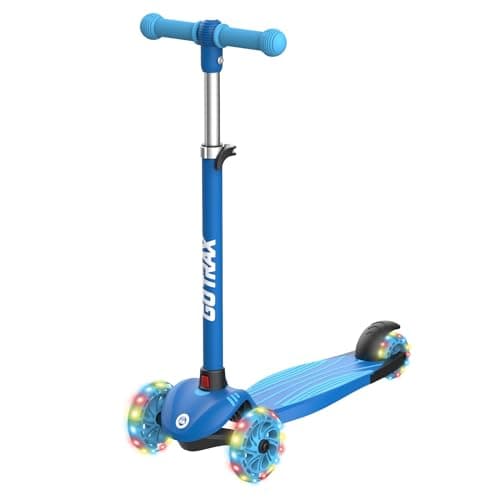
Gotrax grades this 2 to 8 and the three-wheel, lean-to-steer design is what makes a scooter possible at two rather than five: the child shifts weight instead of turning the bars, so the scooter stays upright while they work out what their feet are doing. Three handlebar heights cover most of that range. The LED wheels are driven by the wheels turning, so there is nothing to charge and nothing to replace. Treat the top of the published range as optimistic — by about six most children want two wheels.
Age grade:
2–8
Batteries:
manufacturer does not publish a battery requirement
Noise:
Quiet
Mess:
No mess
Assembly:
manufacturer does not publish an assembly time
Price:
$37.99 as of Sep 18, 2026
Age grade, battery and assembly wording are quoted from Gotrax’s own product listing, read on September 7, 2026. The manufacturer’s exact words: “Ages 2-8”. Noise and mess are our reading, not a measurement — we have not played with this.
What it gets right
+Lean-to-steer three-wheel design is genuinely stable for a two-year-old
+LED wheels are generated by motion, so nothing needs charging or replacing
+Published 2 to 8 grade with adjustable bars is a long run for the money
What it doesn’t
−The upper end of the published range is optimistic — most eight-year-olds want a two-wheel scooter
−Lean-to-steer takes a week to learn and some toddlers fight it
How loud
Wheels on pavement. The LEDs are powered by the wheels turning, so there is no battery and no sound.
How much mess
One object.
Skip this if…
…the child is six or older and confident. They want a two-wheel scooter and will find this one embarrassing.
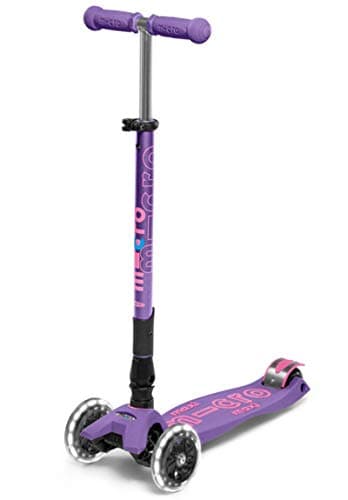
Graded 5 to 12 with a 110 lb rider limit, which is the specification that justifies the price: this is a scooter bought once, at five, and still used at eleven. Polyurethane wheels are noticeably quieter on pavement than hard plastic, and Micro states the LED front wheels need no batteries. It folds, which sounds like a detail until you are the one carrying it home. The honest catch is that it costs roughly three times a supermarket scooter and the replacement parts are proprietary.
Age grade:
5–12
Batteries:
No batteries required
Noise:
Quiet
Mess:
No mess
Assembly:
manufacturer does not publish an assembly time
Price:
$179.99 as of Sep 18, 2026
Age grade, battery and assembly wording are quoted from Micro’s own product listing, read on September 7, 2026. The manufacturer’s exact words: “Ages 5-12”. Noise and mess are our reading, not a measurement — we have not played with this.
What it gets right
+Published 5 to 12 range with a 110 lb limit — this genuinely lasts to secondary school
+LED wheels with no batteries, stated by the manufacturer
+Folds for storage and for carrying, which is the thing you appreciate on the walk home
What it doesn’t
−Expensive enough that losing it to a school bike rack genuinely hurts
−Replacement parts are proprietary and priced accordingly
How loud
Polyurethane wheels are notably quieter than hard plastic. No electronics — the LEDs are driven by the wheels.
How much mess
Folds, so it can live in a hall cupboard rather than against a wall.
Skip this if…
…the child is going to grow out of scootering in a year. The whole value case is longevity, and it does not work over a short horizon.
Graded 8+, with 8-inch urethane wheels on an anodized aluminum deck. Wheel size is the spec that decides whether a scooter is usable on an actual sidewalk: small hard wheels stop dead in the crack between two slabs, and 8-inch wheels roll over it. The aluminum frame carries an adult weight rating, so it is not outgrown at eleven. It is heavy for a small eight-year-old to carry up steps, and the rear fender brake takes practice.
Age grade:
8+
Batteries:
manufacturer does not publish a battery requirement
Noise:
Quiet
Mess:
No mess
Assembly:
manufacturer does not publish an assembly time
Price:
$124.49 as of Sep 18, 2026
Age grade, battery and assembly wording are quoted from Razor’s own product listing, read on September 7, 2026. The manufacturer’s exact words: “Ages 8+”. Noise and mess are our reading, not a measurement — we have not played with this.
What it gets right
+8-inch wheels handle real pavement rather than only smooth driveways
+Aluminum frame with an adult weight rating, so it does not get outgrown at eleven
+Folds, which is the difference between a scooter kept in the hall and one kept in the shed
What it doesn’t
−Heavy for a smaller eight-year-old to carry up steps
−Rear fender brake needs a firm foot and takes practice to use well
How loud
Urethane wheels are the quiet ones. Nothing electronic anywhere on it.
How much mess
Folds and leans against a wall.
Skip this if…
…the child is under the published 8+ grade. The deck height and the brake force are both set for a bigger child, and a six-year-old on this scooter is a fall waiting to happen.
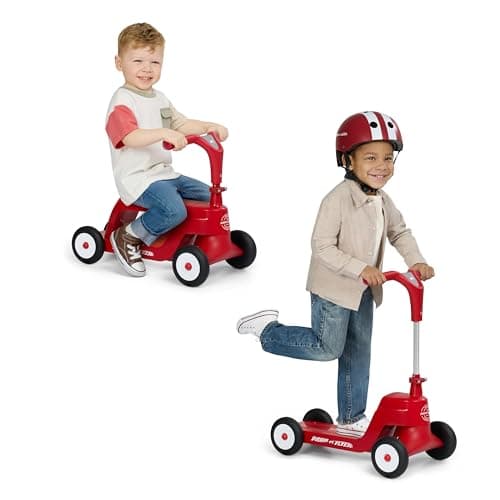
Graded 1 to 4, and it converts between sitting and standing, which is how it fills the awkward slot before a kick scooter is physically possible. Included here because it is the honest answer to a search for a scooter for a one-year-old: they cannot use one, and this is what they can use. Plastic wheels are loud indoors and mark some floors, and a confident three-year-old will want the real thing instead.
Age grade:
1–4
Batteries:
manufacturer does not publish a battery requirement
Noise:
Quiet
Mess:
No mess
Assembly:
manufacturer does not publish an assembly time
Price:
$49.99 as of Sep 18, 2026
Age grade, battery and assembly wording are quoted from Radio Flyer’s own product listing, read on September 7, 2026. The manufacturer’s exact words: “Ages 1-4”. Noise and mess are our reading, not a measurement — we have not played with this.
What it gets right
+Sit-to-stand conversion means it covers the whole published 1 to 4 window rather than one year of it
+Works indoors as well as out, which matters in winter
+Radio Flyer parts and after-sales support are unusually good for a toy this cheap
What it doesn’t
−Plastic wheels are loud and mark some floors
−A confident three-year-old will want a proper balance bike instead
How loud
Plastic wheels on a hard floor. Indoors on laminate this is not silent, but there is nothing electronic.
How much mess
One object.
Skip this if…
…the child is already steady on a balance bike. This is the step before that, and buying both is buying the same year twice.
Every toy site tells you they tested forty toys with a focus group of real children. We have not played with any of these, and we say so. Here is what we do instead: we read the manufacturer’s own listing and print its published age grade word for word, we record the battery requirement and the assembly note where the maker publishes one and say plainly when it does not, we pull the price live from Amazon so it is never a number we remembered, and we name one thing on every list we would not buy.
The noise and mess ratings are our judgment from what the listing describes — not measurements. Almost no toy manufacturer publishes a decibel figure, which is itself worth knowing. The full method is published, including what disqualifies a toy.
Questions
Questions people actually ask
What age can a child ride a scooter?+
A lean-to-steer three-wheel scooter works from about two, and the makers grade them that way. A two-wheel scooter needs balance and handlebar steering at the same time, which is usually five at the earliest and is graded eight and up on the bigger models.
Three wheels or two wheels for a 5-year-old?+
Five is the crossover. A child who has been riding a three-wheeler for a year is ready for two wheels; a five-year-old who has never scooted is better served by a three-wheeler for a season. Neither answer is about maturity — it is about whether they can balance and steer simultaneously.
Is an expensive scooter worth it?+
Sometimes, and the reason is the published rider weight limit rather than the badge. A scooter rated to 110 lb is four or five years of use; a cheap one rated to 50 lb is outgrown before it wears out. Quieter urethane wheels and a folding hinge are the other two things the money buys.
What size scooter wheels are best for a child?+
Bigger, on real pavement. Small hard wheels stop against a raised paving slab; larger urethane wheels roll over it. For a child riding on sidewalks rather than a smooth driveway, wheel size does more for the ride than anything else on the spec sheet.
Do LED scooter wheels need batteries?+
On both light-up scooters here the manufacturers state they do not — the lights are generated by the wheels turning. That is worth checking on any light-up scooter, because the ones that do take batteries take them in a sealed wheel hub.
We do not run a playroom test lab and we do not pretend to. Age grades, battery requirements and assembly notes are quoted from each manufacturer’s own product listing, read on September 7, 2026; prices come live from Amazon’s API and are stamped with the date they were checked. Where a maker publishes nothing, the page says “manufacturer does not publish this” rather than guessing. Read the full method.