Guides · Guides
Board games that work with exactly two
The box says two to four players. In practice a great many family games are quietly broken at two: the bluffing has nobody to bluff, the trading has no market, and the race has no pack. This is the list for a household where two is the normal number.
We earn a commission if you buy through our links. It does not change the price you pay and it does not decide our picks — our method is published in full, including the part where we say we have not played with these toys. How this works.
The short answer
With exactly two players, buy a game whose core is direct opposition rather than social manoeuvring. Connect 4 (graded 6+) is the best two-player game in our registry for a younger child, No Stress Chess (graded 7+) is the best one that teaches something lasting, Blokus (graded 7+) is the best for an adult who wants an actual contest, and UNO (graded 7+) is the right answer when the two players have very different ages and the game has to be winnable by both.
Everything on this page is playable in twenty minutes at a kitchen table by one grown-up and one child, which is the specific situation this list exists for and the one almost no family game list addresses.
Why most family games break at two
It is not usually that the rules forbid it — most boxes say “2 to 4” — it is that the thing that makes the game fun needs a crowd. Three mechanics fail at two, and they are the three mechanics most children’s games are built on.
- Hidden information and bluffing. With two players there is one opponent and one bluff, which is a coin flip rather than a read. Deduction games thin out badly.
- Trading and negotiation. A market with one other participant is not a market. Economic games become a staring contest.
- Racing against a pack. The tension in a race is the pack. Two players racing is two players, one of whom is behind and knows it — which for a child is the fastest route to not wanting to finish.
What survives is the fourth category: positional opposition. Every move directly limits the other player’s options, the state of the game is fully visible, and the interest is in the position rather than in the other people. That is why the oldest two-player games in the world — chess, draughts, go — are all positional, and it is the single most useful filter when you are standing in the shop.
The other two-player problem nobody mentions: the age gap
A parent and an eight-year-old are not two equal players, and this is where most two-player evenings actually fail. There are only three ways to handle it, and choosing one deliberately is better than discovering it mid-game.
- Pick a game with real luck in it. A card game where the draw matters is genuinely winnable by a seven-year-old against an adult, with nobody pretending. This is why UNO has outlived everything marketed against it.
- Pick a game that teaches as it goes. A chess set with action cards that tell the child which piece to move removes the memorisation barrier and lets a beginner play a real game on day one — while the adult is playing a real game too.
- Play co-operatively instead. Both players against the board. The age gap stops being a problem because there is no opponent. Our board games by age page lists the co-operative options by grade, and they are the right answer below about six.
What does not work is an adult playing badly on purpose. Children detect it quickly, usually sooner than the adult thinks, and a win that was handed over is worth nothing.
Setup time, and the twenty-minute rule
Two-player games get played on weeknights, in the half hour between dinner and bath. That is the actual constraint, and it rules out more games than any rules consideration. A game that takes six minutes to set up loses a quarter of the available time before anyone has had a turn. Everything on this page sets up in under two minutes and resolves in roughly ten to twenty, which is why these are the ones that get played repeatedly rather than the big box that comes out twice a year.
One more practical note on noise, since we rate it on every pick: a tower-stacking game is loud by design and a card game is silent. In a flat, after a younger sibling is asleep, that is not a small difference — quiet toys that are not boring covers the same constraint across the whole registry.
The four, side by side
| Game | Maker’s age grade | How much luck | Our noise rating |
|---|---|---|---|
| Connect 4 (2025 edition) | 6+ · box states 2 players | None | Some noise — the grid empties loudly |
| No Stress Chess | 7+ | Only in the card draw, which sets the move | Silent |
| Blokus | 7+ | None at all | Quiet |
| UNO | 7+ | High — which is what makes it fair across ages | Some noise — the shouting is the game |
The age grades are each maker’s published figure. Connect 4 is the only one whose listing prints a player count, and it prints two. The luck and noise columns are our judgment from what the listings describe, not measurements — the scale is set out on our noise ratings page. Live prices are below with the date they were read.
Four that work properly at two
Judged against the filters above — positional opposition, under two minutes to set up, honest about the age gap, and a published grade we will not recommend below.
The toys
The toys this guide is about
Every one of these carries its manufacturer’s published age grade and a live Amazon price, read October 11, 2026. Full rankings live in the roundups linked above.
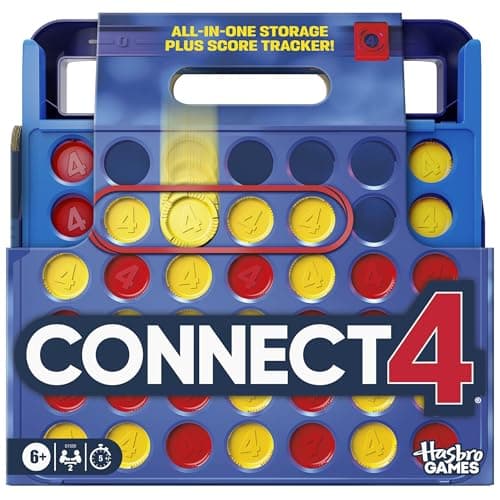
Best at two for a 6-to-9-year-old
Connect 4 (2025 Edition)
Age grade 6+
Graded 6+ and strictly a two-player game — the box says 2 players, not 2 to 4, which is itself the recommendation. It is pure positional opposition: everything is visible, every move blocks, and a six-year-old can play a genuinely competitive game against an adult within three rounds because the skill ceiling is low enough to reach and high enough to matter. The 2025 edition stores in its own case, which solves the only real problem the classic had. It clatters when it is emptied, and that is the whole noise story.
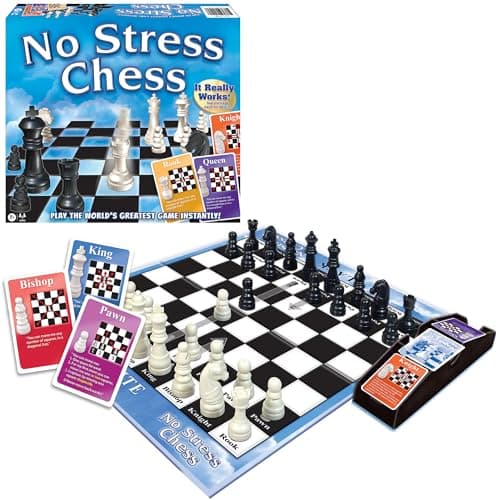
Best two-player game to actually own
No Stress Chess
Age grade 7+
Graded 7+, and the design solves the exact thing that stops families playing chess: a deck of action cards tells the beginner which piece to move, so a first game happens in five minutes instead of after a memorisation session. The board is reversible for ordinary chess once the cards are not needed, which means it is a chess set you grow into rather than a teaching toy you outgrow. Silent, no batteries, no consumables. Skip it only if the child has already learned the moves — then buy a plain set, cheaper.
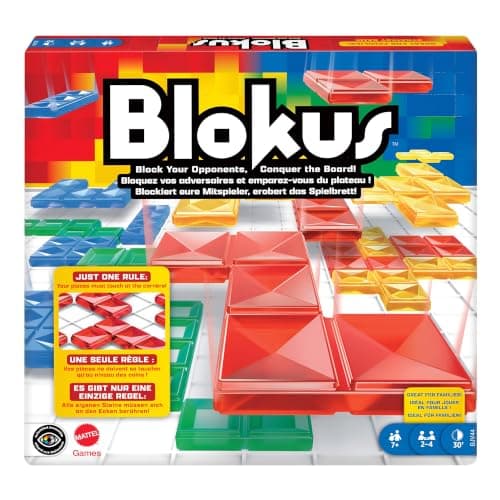
Best when the adult wants a real contest
Blokus Strategy Board Game
Age grade 7+
Published for 7 and older, with colour-blind-accessible pieces and effectively one rule: your pieces may only touch at the corners. It plays with two by using two colours each, and at two it is a sharper, tighter game than at four because every blocked corner is deliberate rather than accidental. This is the pick for an adult who is tired of losing on purpose — it is genuinely good, there is no luck in it at all, and a bright nine-year-old will start beating you. No batteries, no reading required, sets up in a minute.
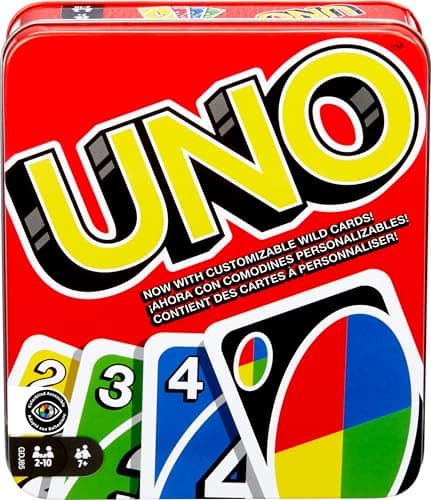
Best when the two players are far apart in age
UNO Card Game
Age grade 7+
Graded 7+ and the honest answer to the age-gap problem, because the luck in the draw is real: a seven-year-old beats an adult often enough that nobody has to pretend. It plays at two with no modification, it travels in a pocket, it needs no table, and a round takes ten minutes. It is also the noisiest thing here in the social sense — the shouting is the game. Skip it if you want something to think about; this is a game about the next card, and that is the point.
#ad · As an Amazon Associate we earn from qualifying purchases. How this works.
Questions
Questions people actually ask
What is the best board game for 2 players?
Why do family board games not work with two players?
How do you play a board game fairly with a much younger child?
Are card games better than board games for two?
Keep reading
Related
- Board games by ageThe same registry sorted by published grade, including the co-operative options.
- Kids' board games, head to headTwo specific games with player counts and play times side by side.
- Travel toysMost of these fit in a pocket, which is the other reason two-player games earn their place.
- Gifts under $25Every game on this page sits in that tier.
Receipts
Sources
- American Academy of Pediatrics — “Selecting Appropriate Toys for Young Children in the Digital Era” (clinical report)
- US Consumer Product Safety Commission — Toy Safety business guidance
- 16 CFR Part 1501 — the federal small-parts regulation behind the “not for children under 3” warning (eCFR)
We do not run a playroom test lab and we do not pretend to. Age grades, battery requirements and assembly notes are quoted from each manufacturer’s own product listing, read on September 7, 2026; prices come live from Amazon’s API and are stamped with the date they were checked. Where a maker publishes nothing, the page says “manufacturer does not publish this” rather than guessing. Read the full method.