Guides · Guides
Montessori toys, explained
There is no certification behind the word. Any seller can print it on any box, and a great many do, which means the label tells you nothing on its own — but the idea underneath it is real, specific and useful, and it is easy to check an object against.
We earn a commission if you buy through our links. It does not change the price you pay and it does not decide our picks — our method is published in full, including the part where we say we have not played with these toys. How this works.
Nobody owns the word
“Montessori” is not a certification, a standard or a trademark that anyone polices. There is no body that inspects a toy and grants it the name, which means a wooden rainbow and a plastic light-up cube can both carry the word on the listing, legally, with no further explanation. Some of the products in our own registry have it in their titles for exactly that reason, and we would rather say that than pretend the label is doing work it is not.
That is not a reason to dismiss it. Maria Montessori’s approach makes specific, testable demands of the objects a child is given, and those demands are easy to apply yourself in about fifteen seconds of looking at a box. Once you can do that, the word on the listing stops mattering entirely — which is the actual goal of this page.
The five things the approach asks of an object
- Real materials. Wood, metal, glass, fabric — things with weight, texture and temperature, which give a child honest feedback about the physical world. This is about information rather than aesthetics; a heavy object behaves differently from a light one and a child learns from the difference.
- One idea per object. A stacker stacks. A posting box posts. The point is that the child can isolate a single skill and repeat it until it is theirs, which is impossible in a toy that does nine things and rewards all of them with the same noise.
- Self-correcting. The object shows the child they are wrong without an adult saying so — the shape does not fit, the ring does not sit flat, the tower falls. A toy that signals failure with a red light and a voice has moved the correction from the material to a machine.
- Child-scale and child-initiated. Small enough to carry, light enough to fetch, reachable without asking. A toy on a high shelf is an adult’s toy.
- Grounded in the real. Under about three, the emphasis is on things that exist — animals, objects, tasks — rather than on fantasy. This is the most frequently argued-about part of the approach and it is worth knowing it is a position rather than a finding.
What that rules out
Almost everything that plays itself. If the toy lights up, counts, sings or announces success, the object is doing the interesting part and the child is pressing the button that makes it happen. That is a real distinction and not a snobbish one: a child pressing a button learns which button, and a child stacking a ring learns about mass, balance and their own hands.
It also rules out most toys with a single correct outcome that an adult has to supervise. And, practically, it rules out anything with a published age grade above the child in front of you — which is a harder line than the Montessori one and the only one on this site we treat as absolute. See age grades explained for why the under-three line in particular is not a suggestion.
What to check on the box, in fifteen seconds
- Is there a battery compartment? If yes, the toy probably does the work. Not always — a few genuinely good things run on batteries — but it is the fastest first filter, and the no-batteries list is the shortcut.
- Can you describe what it does in one sentence? If it takes three, the object has three jobs and a young child will sample all of them rather than settling into one.
- Does the toy tell the child they are wrong, or does it need an adult to? Self-correcting objects get used alone, which is most of their value.
- Is it made of something? Wood, cotton, metal. Not as a matter of taste — as a matter of what the material tells the hand.
- What age does the maker publish? Everything else on this list is a judgment. That one is a safety line.
You do not have to buy anything labeled Montessori
This is the part the market is least keen on. A set of wooden blocks, a peg puzzle, a stacking toy, a jug small enough to pour from and a basket of real objects will satisfy every criterion above, and none of them needs the word on the box. In many cases the unbranded version is both cheaper and more faithful to the idea than the expensive item sold as “Montessori-inspired”, which is a phrase that means nothing at all.
The same logic is why open-ended play and this page point at largely the same toys from different directions, and why the screen-free list and the builder’s shortlist both overlap them. If the question underneath yours is really “how few toys can I get away with”, then how many toys a child needs is the honest answer: fewer, rotated.
Where it is oversold
Two places. First, price: wooden toys made in small runs cost more to make, which is fair, but the premium attached to the word itself frequently is not, and a plain beech stacker and a boutique one are often the same object. Second, outcome claims. The American Academy of Pediatrics’ clinical report on toy selection is clear that what matters most in early play is the interaction around the toy rather than the toy — an adult on the floor beats any object on this or any other list. Nobody sells that, so nobody advertises it.
By age, briefly
- Under one: texture, weight, grasp and release. A handful of objects, not a shelf of them.
- One to three: posting, stacking, fastening, pouring, matching. This is the richest stretch for the approach and where most of the genuinely good material sits.
- Three to six: real tasks and real tools — cutting, sweeping, building, sorting — plus the first puzzles with a definite end state.
The toys
The toys this guide is about
Every one of these carries its manufacturer’s published age grade and a live Amazon price. Full rankings live in the roundups linked above.
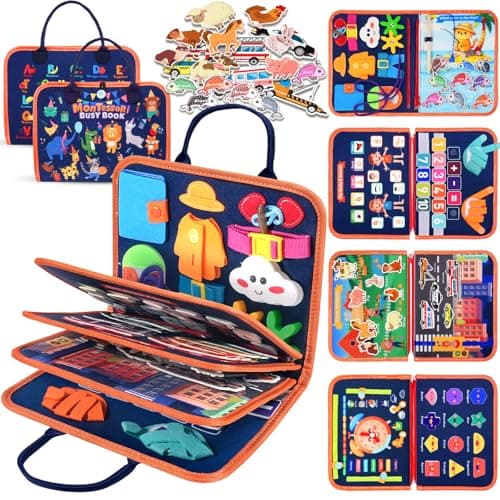
The clearest example of the idea
Montessori Busy Board for Toddlers
Age grade 1–3
Graded 1 to 3. Buckles, zips, laces and snaps — fastener practice and nothing else, self-correcting because either the buckle is done up or it is not, and no adult is required. The word Montessori is in the product title, which is the point this page makes: the title is marketing, and the object happens to earn it anyway.
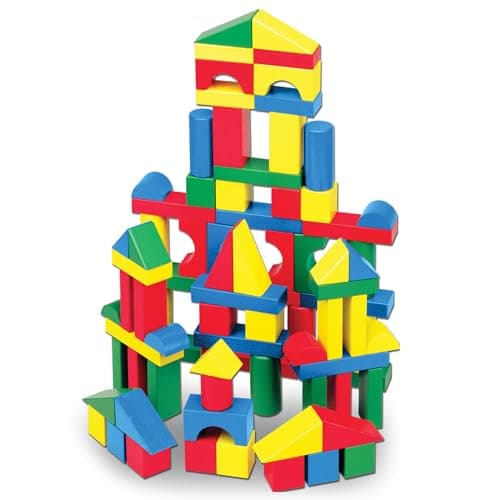
Real material, one idea, no batteries
Melissa & Doug Wooden Building Blocks, 100 Pieces
Age grade 2+
Graded 2+. A hundred wooden blocks in nine shapes satisfies every criterion above without the word appearing anywhere, and it stays in the house for a decade. Wood on a hard floor is genuinely loud, which is the honest caveat — a rug is part of the purchase.
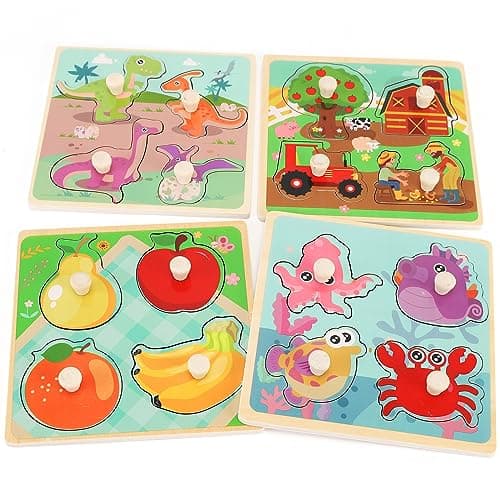
Self-correcting, at two
Wooden Peg Puzzles for Toddlers, 4 Pack
Age grade 2–4
Graded 2 to 4. The piece fits or it does not, and the knob gives a two-year-old’s hand something to grip that a flat piece does not. A stepping stone rather than a keeper: a three-year-old doing jigsaws will not go back to it.
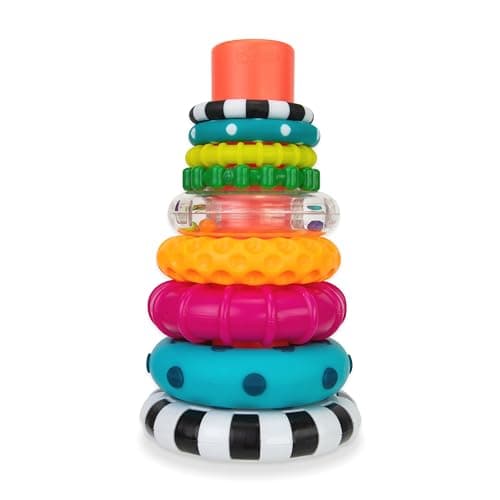
For the under-one end
Sassy Stacks of Circles Stacking Ring Toy
Age grade 6 months+
Graded 6 months and up, with rings that vary by surface texture — and at six months texture is most of what a baby is investigating. Skip it if the household already owns a stacker; two stackers is one too many.
#ad · As an Amazon Associate we earn from qualifying purchases. How this works.
Questions
Questions people actually ask
What makes a toy Montessori?
Is “Montessori” a certification?
Are Montessori toys worth the money?
What are good Montessori toys for a 1-year-old?
Can a toy with batteries be Montessori?
Keep reading
Related
- What open-ended actually meansThe same argument from a different direction.
- Toys for the screen-free kidThe overlapping shortlist, with picks.
- Toys that need no batteriesThe fastest filter in this whole guide.
- What age grades actually meanThe one line on this site that is not a judgment call.
- How many toys does a child needFewer, rotated — which is most of the advice.
Receipts
Sources
- American Academy of Pediatrics — “Selecting Appropriate Toys for Young Children in the Digital Era” (clinical report)
- US Consumer Product Safety Commission — Toy Safety business guidance
- 16 CFR Part 1501 — the federal small-parts regulation behind the “not for children under 3” warning (eCFR)
We do not run a playroom test lab and we do not pretend to. Age grades, battery requirements and assembly notes are quoted from each manufacturer’s own product listing, read on September 7, 2026; prices come live from Amazon’s API and are stamped with the date they were checked. Where a maker publishes nothing, the page says “manufacturer does not publish this” rather than guessing. Read the full method.