The short answer
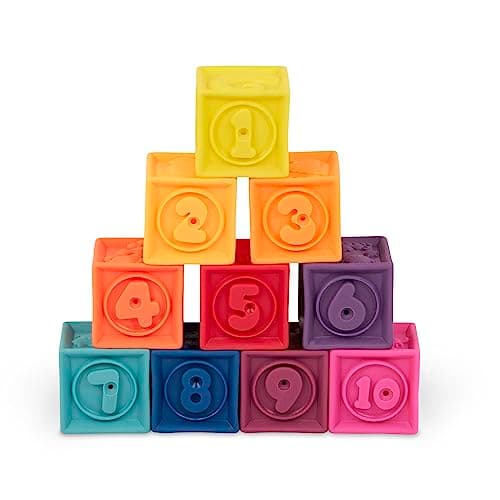
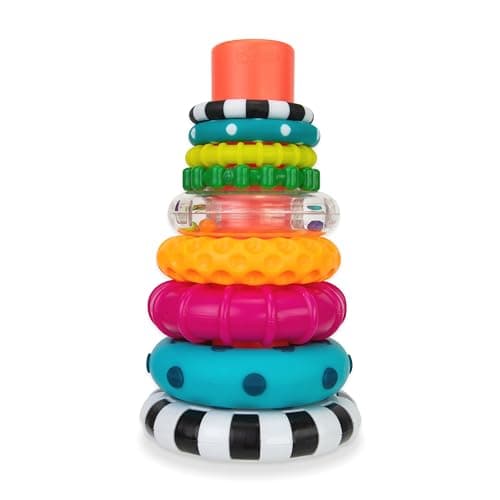
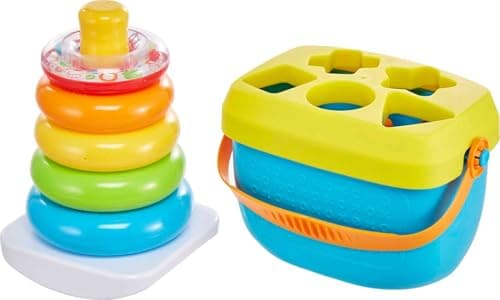
Buy the Fisher-Price Rock-a-Stack. It is graded six months and up by the people who make it, it needs no batteries, and it is the rare toy a baby plays with differently at six months, at a year and at eighteen months rather than outgrowing in a fortnight. If the baby already has one -- and plenty of six-month-olds do, because it is a standard shower present -- buy the fabric blocks instead and spend the difference on nothing at all.
That is the honest version of this page. A six-month-old needs about four toys. Everything below is here because it respects what a baby can actually do at this stage, and the age grade printed beside every pick is the manufacturer’s own wording rather than our guess.
What changes at six months
Four things arrive at roughly this age, and together they are the whole buying brief.
- Sitting, with or without a prop. A baby who can sit has both hands free for the first time, which is why six months is the age a toy box starts to matter at all.
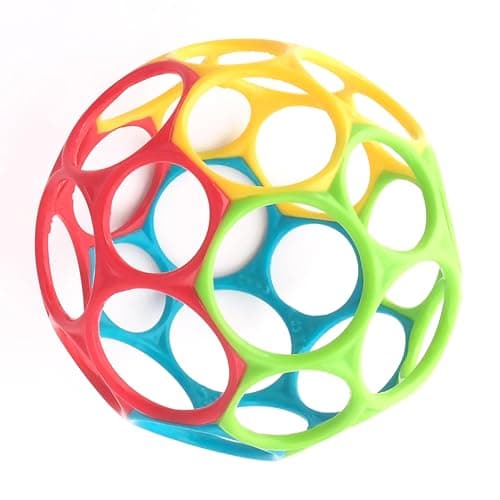
- Hand-to-hand transfer. They move an object from one hand to the other deliberately. Toys with two graspable ends -- rings, cups, a lattice ball -- hold attention roughly twice as long as toys with one.
- Mouthing everything. Not a phase to discourage, and the main safety constraint on this page. Every pick here is either too large to swallow or published for this age with mouthing assumed.
- Cause and effect, early version. Bang the thing, the thing makes a noise. This is the whole reason a cheap set of nesting cups outperforms most electronic toys at this age: the baby causes the effect rather than watching one.
The four situations people are actually shopping for
The searches that lead to a page like this are more specific than “toys”, so here is each one answered on its own terms.
Floor and tummy time
A ball that rolls a short distance and a set of rings. Nothing else is needed. The one thing worth owning that is not ranked above is a mirror propped at floor level, which is why the newborn page ranks one -- it carries over, and it does not stop working at six months.
Crawling, or nearly
The useful toy is the one that moves when pushed and then stops. That is a ball or a rolling rattle, and it is the entire category. An expensive crawling track does the opposite of what the search intends: it moves on its own, so the baby watches rather than chases.
The car seat and the stroller
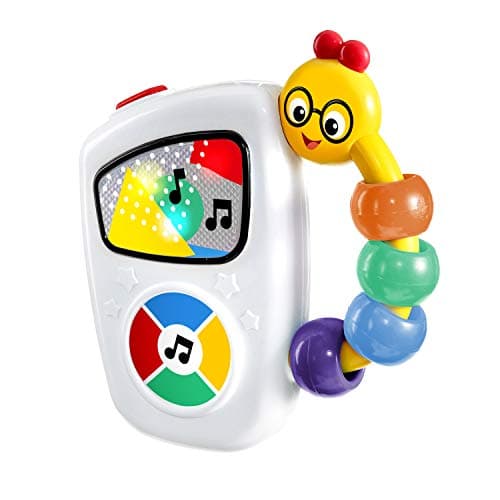
One clip-on toy, attached to the seat rather than handed over, because a six-month-old drops things and cannot retrieve them. This is the single case where we will accept a toy that makes electronic noise, and the trade is written out on the pick itself.
The crib
Nothing. This is the one shopping intent on the list with a flat answer: published safe-sleep guidance is for an empty crib, so a crib toy is a toy for the ten minutes a baby is awake in there with somebody in the room -- not a toy for sleep. If you want one object for that window, use a fabric block, and take it out afterwards.
The mouthing problem, plainly
Everything goes in the mouth at six months, so the small-parts rule is the test that matters. The federal regulation behind the “not for children under 3” warning defines a small part by a cylinder roughly the size of a young child’s windpipe: if a piece, or a part that can break off, fits inside it, the toy is not for this age. The longer explanation is on what “not for children under 3” actually means, and it is worth five minutes before any hand-me-down goes into the toy box.
The practical version: nothing with a battery compartment a baby can open, nothing with a ribbon or a tag longer than a finger, no bell sewn into fabric that a seam can release, and no toy from a set whose missing pieces you cannot account for.
What to skip at six months
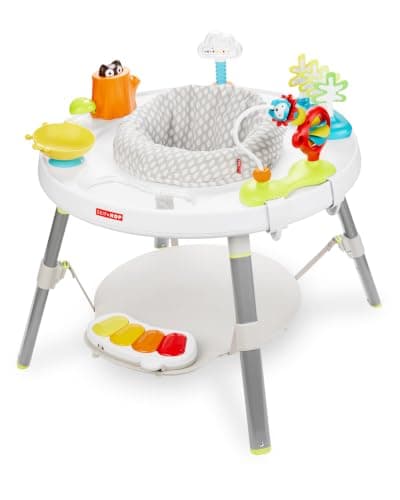
Anything sold on the word educational. No standard sits behind it and nothing a six-month-old does is instruction -- the argument in full is on educational toys vs just-for-fun toys. Skip anything that holds a baby upright for long stretches, skip toys whose only function is a light show, and skip the large plastic activity table graded from twelve months, however early the box implies a baby will enjoy it.
Also skip buying for the next stage. A toy graded 9 or 12 months bought now is three months of shelf life and a missed opportunity: a baby who can sit and mouth cannot do anything with a shape sorter, and by the time they can, the novelty has gone. Buy for the stage in front of you and let the first-year page handle the rest.
How few you need
Four. One thing to mouth, one thing to bang, one thing that rolls, one thing for the car. That is a complete toy box at six months, and a baby with four toys within reach plays with more of them than a baby with fifteen in a basket. We make the general case on how many toys a child actually needs, and it is at its most true in the first year, when the most engaging object in the room is a face.
If you are buying for somebody else’s baby and want one safe answer: the Rock-a-Stack or the fabric blocks. Both are under twenty dollars, both are graded for the age, both are washable. The rest of the money is better spent on the one-year-old list in six months’ time.