One is usable in ten minutes and gets ridden every day; the other takes weeks and produces a genuine skill. The right answer depends almost entirely on whether the child wants transport or a hobby.
We earn a commission if you buy through our links. It does not change the price you pay and it does not decide our picks — our method is published in full, including the part where we say we have not played with these toys. How this works.
#ad · Prices come live from Amazon’s API and were last checked October 23, 2026. Where we have no verified live price we show none — we would rather leave a gap than print a number that has gone stale. Age grades are the manufacturer’s own; noise is our reading, not a measurement.
Transport or hobby — that is the actual question
A scooter is transport. It is ridable almost immediately, it is stable at low speed, it works on the way to school, and it folds up at the other end. A child who gets a scooter uses it most days without thinking of it as an activity.
A skateboard is a hobby. The first fortnight is mostly falling off, the skill has a ceiling that takes years to approach, and there is a culture attached to it. A child who wants a skateboard usually wants that culture as much as the object, and giving them a scooter instead misses the point entirely.
Ask which one the child has asked for, and take the answer literally.
The comparison
Scooter
Skateboard
Time to ridable
Minutes
Weeks
Typical grade
5+ for a child scooter, 8+ for full size
6+ for a beginner board
Rough pavement
Fine with large wheels
Poor — small hard wheels catch
Injury pattern
Lower speed, fewer falls
Frequent falls while learning; wrists and elbows
Storage
Folds
Leans anywhere
Longevity
Years, if sized up
Years; parts are replaceable individually
Protective gear is part of the purchase
A helmet for both, from the first ride. For skateboarding specifically, wrist guards prevent the injury that actually happens — the instinct to catch a fall with an outstretched hand is what breaks wrists. Elbow and knee pads make the learning phase considerably less discouraging, which matters more than it sounds: a child who hurts themselves badly in week one frequently does not go back.
Budget for gear as part of the toy’s cost, and buy it in the same order. A child who rides for two weeks without it will resist it afterwards.
Sizing
For a scooter, the handlebar should reach roughly between the waist and the chest, and the deck should be wide enough for both feet. Buying slightly large is fine because handlebars adjust; buying a child-scale scooter for an eight-year-old is the mistake, because it will be outgrown within a year and it rides badly on anything but smooth ground. Our scooter comparison by age sets four of them side by side with the published grades and wheel sizes.
For a skateboard, a 22-inch cruiser suits a younger beginner; a full-size deck suits from about eight. The deck width matters more than the length for a first board. For the wider question of what to buy a child whose energy needs somewhere to go, gifts for a sporty kid covers the non-wheeled options alongside these.
And if the household has nowhere smooth and safe to ride — no pavement, no park, no quiet street — then neither, honestly. Both are outdoor equipment that requires somewhere to use them, and buying either into a situation with no surface is how they end up in a garage.
In detail
Every pick, in full
01
The one that gets used every day
Razor A5 Lux Kick Scooter
Razor
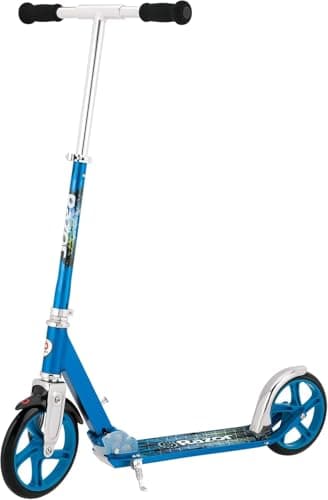
Graded 8+. A scooter is ridable in about ten minutes, which means it becomes transport rather than a project — it is how the child gets to a friend’s house. Big wheels handle rough pavement, the deck is tall enough to fit for years, and it folds, which is what keeps it from living on the lawn.
Age grade:
8+
Batteries:
manufacturer does not publish a battery requirement
Noise:
Quiet
Mess:
No mess
Assembly:
manufacturer does not publish an assembly time
Price:
$89.00 as of October 23, 2026
Age grade, battery and assembly wording are quoted from Razor’s own product listing, read on September 7, 2026. The manufacturer’s exact words: “Ages 8+”. Noise and mess are our reading, not a measurement — we have not played with this.
What it gets right
+8-inch wheels handle real pavement rather than only smooth driveways
+Aluminum frame with an adult weight rating, so it does not get outgrown at eleven
+Folds, which is the difference between a scooter kept in the hall and one kept in the shed
What it doesn’t
−Heavy for a smaller eight-year-old to carry up steps
−Rear fender brake needs a firm foot and takes practice to use well
How loud
Urethane wheels are the quiet ones. Nothing electronic anywhere on it.
How much mess
Folds and leans against a wall.
Skip this if…
…the child is under the published 8+ grade. The deck height and the brake force are both set for a bigger child, and a six-year-old on this scooter is a fall waiting to happen.
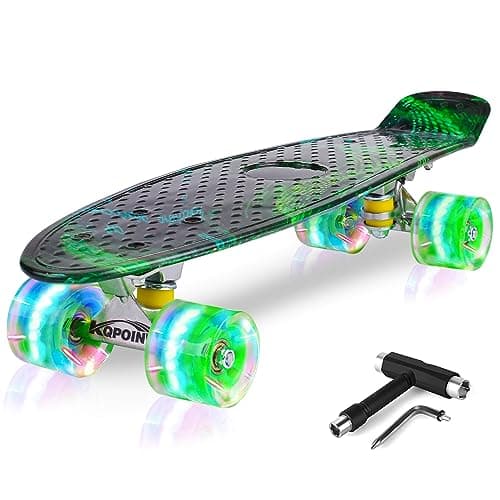
Graded 6+, 22 inches, and honestly harder: weeks before it is comfortable, and there is a genuine falling phase. What you get in exchange is a real skill with a ceiling, a social scene attached, and something the child owns entirely. Protective gear is not optional here.
Age grade:
6–12
Batteries:
manufacturer does not publish a battery requirement
Noise:
Some noise
Mess:
No mess
Assembly:
NO ASSEMBLY REQUIRED: Fully assembled and ready to hit the st
Price:
$39.99 as of October 23, 2026
Age grade, battery and assembly wording are quoted from Kqpoinw’s own product listing, read on September 7, 2026. The manufacturer’s exact words: “Ages 6-12”. Noise and mess are our reading, not a measurement — we have not played with this.
What it gets right
+Arrives assembled, which is the difference between riding it today and riding it next weekend
+22-inch length is genuinely the right size for the published 6 to 12 range
+Cheap enough that a child can find out whether they like skating without a large commitment
What it doesn’t
−Bearings and bushings at this price are basic and a serious child will replace them
−Helmet and pads not included, and this is the item on this page most likely to cause an injury
How loud
Urethane wheels on pavement and the crack of a board landing. No electronics.
How much mess
One board.
Skip this if…
…you will not also buy a helmet. A skateboard without one is not a gift, it is a hospital visit waiting for a date.
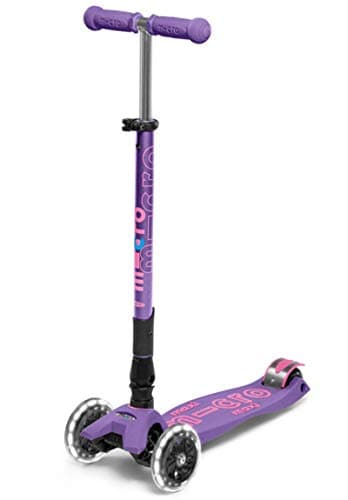
Graded 5+ with lean-to-steer, which is the version worth buying for a child under eight — the weight-shift steering transfers directly to bikes and boards later. Better made than most, and it holds resale value unusually well.
Age grade:
5–12
Batteries:
No batteries required
Noise:
Quiet
Mess:
No mess
Assembly:
manufacturer does not publish an assembly time
Price:
$179.99 as of October 23, 2026
Age grade, battery and assembly wording are quoted from Micro’s own product listing, read on September 7, 2026. The manufacturer’s exact words: “Ages 5-12”. Noise and mess are our reading, not a measurement — we have not played with this.
What it gets right
+Published 5 to 12 range with a 110 lb limit — this genuinely lasts to secondary school
+LED wheels with no batteries, stated by the manufacturer
+Folds for storage and for carrying, which is the thing you appreciate on the walk home
What it doesn’t
−Expensive enough that losing it to a school bike rack genuinely hurts
−Replacement parts are proprietary and priced accordingly
How loud
Polyurethane wheels are notably quieter than hard plastic. No electronics — the LEDs are driven by the wheels.
How much mess
Folds, so it can live in a hall cupboard rather than against a wall.
Skip this if…
…the child is going to grow out of scootering in a year. The whole value case is longevity, and it does not work over a short horizon.
Every toy site tells you they tested forty toys with a focus group of real children. We have not played with any of these, and we say so. Here is what we do instead: we read the manufacturer’s own listing and print its published age grade word for word, we record the battery requirement and the assembly note where the maker publishes one and say plainly when it does not, we pull the price live from Amazon so it is never a number we remembered, and we name one thing on every list we would not buy.
The noise and mess ratings are our judgment from what the listing describes — not measurements. Almost no toy manufacturer publishes a decibel figure, which is itself worth knowing. The full method is published, including what disqualifies a toy.
Questions
Questions people actually ask
Should I buy my child a scooter or a skateboard?+
A scooter if they want to get places; a skateboard if they want the skill and the scene. The scooter gets used far more often; the skateboard produces something they will be proud of. Take the child’s own request literally.
What age can a child start skateboarding?+
Beginner boards are commonly graded 6+, and protective gear is genuinely not optional — wrist guards especially, because catching a fall with an outstretched hand is the injury that happens.
What size scooter does a child need?+
Handlebars between waist and chest height, and a deck wide enough for both feet. Buying a child-scale scooter for an older child is the common mistake — it is outgrown fast and rides poorly.
Are expensive scooters worth it?+
This is the clearest case on our site where they are. Cheap scooters have loose steering and wheels that seize, and a child feels the difference on the first ride.
What protective gear does a child need?+
A helmet for both, always, from the first ride. For skateboarding add wrist guards, and add knee and elbow pads for the learning phase — a bad fall in week one often ends the whole interest.
We do not run a playroom test lab and we do not pretend to. Age grades, battery requirements and assembly notes are quoted from each manufacturer’s own product listing, read on September 7, 2026; prices come live from Amazon’s API and are stamped with the date they were checked. Where a maker publishes nothing, the page says “manufacturer does not publish this” rather than guessing. Read the full method.