Guides · Guides
Toys for autistic kids: what to check on the box
This is the most asked-about qualifier in our whole keyword set and the worst-served one, because almost everything written for it is either a product list with a therapeutic claim attached or a clinical article with nothing to buy. This page is neither. It is about four properties you can verify from a listing in about a minute.
We earn a commission if you buy through our links. It does not change the price you pay and it does not decide our picks — our method is published in full, including the part where we say we have not played with these toys. How this works.
What this page is, and what it refuses to be
We are not clinicians, we have not played with any of these toys, and we will not tell you that an object helps, treats, regulates or develops anything. Autism is not a shopping problem and nobody should sell it as one. What we can honestly do is the same thing we do everywhere else on this site: read the manufacturer’s own listing and report what it says about noise, durability, batteries and the number of things the toy does.
That turns out to be genuinely useful, because when parents of autistic children describe what they are looking for, the same four properties come up again and again — and all four are visible on a box. Your child’s therapist, teacher or pediatrician knows your child; we know what the listing claims. Use the first for the decision and the second for the check.
The four properties, and how to verify each one
1. Predictable — it does the same thing every time
The opposite of predictable is not loud, it is random: a toy that sometimes lights up, sometimes plays a different phrase, sometimes congratulates you and sometimes does not. A toy that behaves identically on the hundredth go is a toy a child can rely on. The check is simple — if the listing advertises “surprise”, “mystery”, “random” or “over 50 phrases”, it is the other kind.
2. No sound it makes by itself
The distinction that matters is not quiet versus loud, it is who starts the sound. A toy the child makes a noise with is under their control; a toy that makes a noise at them is not, and an unexpected sound is the most common single reason a toy is abandoned in the house. The check is the battery compartment: no batteries almost always means no sound it produces on its own. Our no-batteries list is that filter applied to every pick on the site, and quiet toys that are not boring is the same filter with the boring ones removed.
3. Durable under repetition, not just under a fall
Most durability claims are about a drop test. The harder requirement is a toy that survives the same motion ten thousand times — the same lid opened, the same tube pulled, the same piece posted — because repetition is wear, and a hinge rated for occasional use fails under it. Look for one-piece construction, silicone or thick-walled plastic, and the absence of small hinges, clips and battery doors. “Indestructible” is a marketing word and no manufacturer stands behind it; toys that survive is our own reading of which picks actually hold up and why.
4. One clear purpose
A toy that does one thing can be learned and then owned. A toy that does nine things has to be explored before it can be used, and the exploring is the part some children have no interest in doing. This is the same test the Montessori page applies for entirely different reasons, and the check is identical: can you describe what the toy does in one sentence? If it takes three, it has three jobs.
The properties against the toys below
| Toy | Published grade | Sound it makes by itself | What it does, in one sentence |
|---|---|---|---|
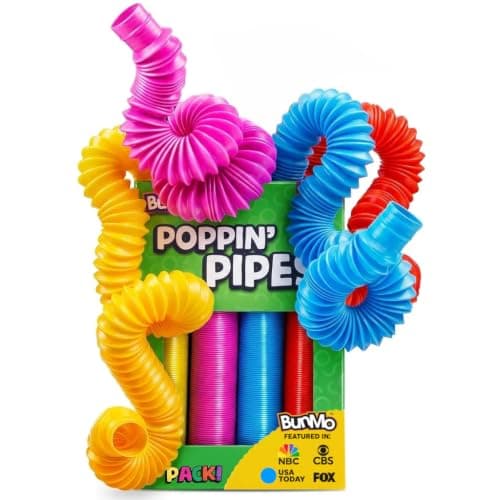
| BUNMO Pop Tubes, 4 large | 3+ (listed non-mouthable) | None. No batteries. The child makes the pop | Pulls, clicks and connects into shapes |
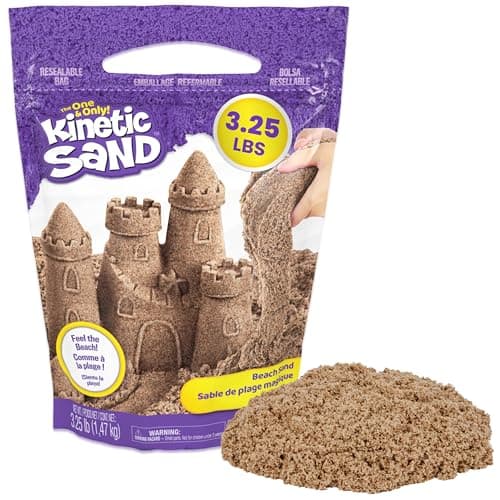
| Kinetic Sand, 3.25 lb plain | 3+ | None. No batteries | Holds a shape, then collapses when squeezed |
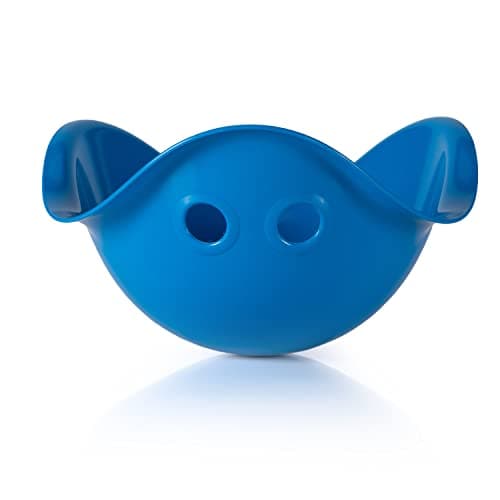
| bilibo by MOLUK | 2–4 | None. No batteries. One molded piece | A shell to sit in, spin on, rock in or fill |
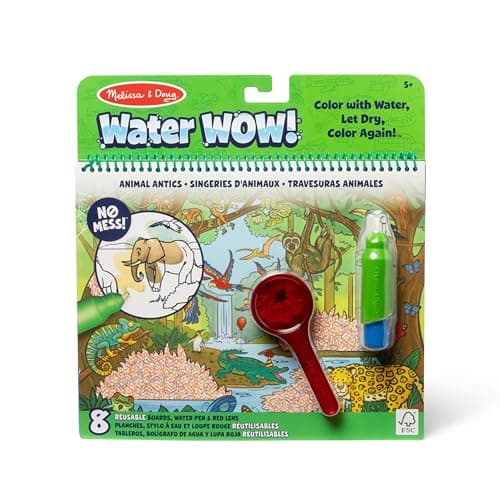
| Water Wow reusable pad | 3–7 | None. No batteries | Water reveals the picture; it fades back as it dries |
All four are silent by construction rather than by setting, all four do one thing, and none of them has a battery door, a hinge or a speaker to fail. That is the entire reason they are the four we would point at — not a claim about what they do for a child.
Two things we would be careful about
Mouthing. The Pop Tubes listing describes the product as non-mouthable, and the published grade on all four of these is 3 or over — which means they are outside the federal small-parts rule, not inside it. For a child of any age who still puts things in their mouth, the age grade on the box is the wrong guide and the choking-hazard guide is the page to read. Kinetic sand in particular is a material rather than an object and we would not hand it to a child who mouths.
Mess. Kinetic sand sweeps rather than smears, but the grains travel on clothing and across a floor, which is a real constraint in a shared room. Our mess ratings put every creative pick on the site on the same scale so this is a decision rather than a surprise.
What we would skip, and why
The “sensory kit” bundle — a plastic bag of fifteen small novelty fidgets sold as a set. Three of the fifteen will matter and twelve will not, which is the opposite of buying one thing that works, and the per-item build quality in those bundles is the worst in the category. We would also skip anything whose listing makes a therapeutic claim. A seller who tells you a toy improves focus, calms anxiety or develops social skills is making a claim no toy manufacturer is in a position to support, and it is a reliable signal about everything else on the listing. Finally, we would skip the toy with a volume switch. A switch is a promise that the sound can be managed; a toy with no speaker is a fact.
Where to go next on this site
Quiet toys and no-batteries toys are the two filtered lists that do most of the work here. Small-space toys matters if a shared bedroom is part of the brief, and how to choose a toy is the general version of the one-sentence test above. If you are buying for somebody else’s child, ask the parent what the child plays with now and buy more of that shape — it is a far better question than asking what they want.
The toys
The toys this guide is about
Every one of these carries its manufacturer’s published age grade and a live Amazon price, read October 5, 2026. Full rankings live in the roundups linked above.
Silent, one piece, no battery door
BUNMO Pop Tubes, 8 Pack
Age grade 3+
Graded 3+ and described by the maker as non-mouthable. Four large tubes that pull, click and connect — the sound is whatever the child makes, there is nothing electronic in it, and there is no hinge or battery compartment to fail under repetition. It does one thing and it does it identically every time.
A material rather than a toy, with no theme attached
Kinetic Sand 3.25 lb Beach Sand
Age grade 3+
Graded 3+, three and a quarter pounds of plain kinetic sand with no molds and no theme — which is the version we would buy, because the theme is the part a child has to work around. Completely silent. It sweeps rather than smears, but grains travel on clothing, so read the mess note before it goes in a carpeted room.
One molded piece, and nothing on it can break
Bilibo by Moluk
Age grade 2–4
Graded 2 to 4. A single molded shell with no parts, no hinges, no fasteners and nothing electronic — which makes it the most repetition-proof object in our registry. What it does is genuinely open: a seat, a spinner, a rocker, a container. Its honest limit is the published grade, which tops out at four.
Predictable, silent, and it resets itself
Melissa & Doug Water Wow Reusable Activity Pad
Age grade 3–7
Graded 3 to 7. The pen holds plain water, the picture appears, and the page fades back as it dries so tomorrow is identical to today — which is the definition of predictable. Nothing stains, nothing spills and there is no sound at all. The pen refills from a tap, so the only consumable is water.
#ad · As an Amazon Associate we earn from qualifying purchases. How this works.
Questions
Questions people actually ask
What toys are good for autistic children?
Are sensory toys worth buying?
What does indestructible actually mean on a toy listing?
How do I avoid toys that make unexpected noises?
Should I ignore the age grade for a child who is developmentally younger?
Keep reading
Related
- Quiet toys that are not boringThe filtered list that does most of the work on this page.
- Toys that need no batteriesThe fastest proxy for a toy that makes no sound by itself.
- Toys that surviveWhat actually holds up under heavy repetitive use.
- The choking-hazard guideThe page to read if mouthing is a factor at any age.
- Montessori toys explainedThe one-idea-per-object test, arrived at from a different direction.
Receipts
Sources
- American Academy of Pediatrics — “Selecting Appropriate Toys for Young Children in the Digital Era” (clinical report)
- 16 CFR Part 1501 — the federal small-parts regulation behind the “not for children under 3” warning (eCFR)
- US Consumer Product Safety Commission — Toy Safety business guidance
- ASTM F963 — Standard Consumer Safety Specification for Toy Safety
We do not run a playroom test lab and we do not pretend to. Age grades, battery requirements and assembly notes are quoted from each manufacturer’s own product listing, read on September 7, 2026; prices come live from Amazon’s API and are stamped with the date they were checked. Where a maker publishes nothing, the page says “manufacturer does not publish this” rather than guessing. Read the full method.