Guides · Guides
Non-toxic art supplies: what the labels actually certify
The words on the front of the box are chosen by the seller. The marks on the back are the ones that mean something — and there are only three of them worth learning, one of which is a warning most parents read as a reassurance.
We earn a commission if you buy through our links. It does not change the price you pay and it does not decide our picks — our method is published in full, including the part where we say we have not played with these toys. How this works.
The short version
Look for the AP seal. The Art & Creative Materials Institute certifies it for products that contain no materials in sufficient quantity to be toxic or injurious to humans, including children, and that cause no acute or chronic health problems. If instead you find a CL seal, that is not a weaker version of the same thing — it is a different claim, and ACMI’s own instruction is blunt: never give a child in sixth grade or younger a product carrying the CL seal. “Non-toxic” printed on the front of a box, with no seal anywhere, is a marketing sentence and certifies nothing.
Why art materials have their own rulebook
Toys are governed by the general toy safety standard. Art materials are governed by something separate, because the risk is different: a crayon is not a choking hazard in the way a small part is, but a pigment, a solvent or a clay dust is a chronic-exposure question — what happens with repeated use over years, not what happens in one afternoon.
The United States handles that through the Labeling of Hazardous Art Materials Act, and the standard it leans on is ASTM D-4236, the chronic hazard labeling standard for art materials. The practical effect is that a compliant art product has been reviewed for chronic health hazards by a toxicologist and labeled accordingly. Note carefully what that does and does not promise: it is a labeling standard. It guarantees that a hazard, if present, is disclosed. It does not guarantee the absence of a hazard. That is the job of the seal, not the standard.
The three marks, and what each one is actually saying
| What you see on the box | What it certifies | Who it is for |
|---|---|---|
| AP seal (ACMI, “Approved Product”) | No materials in sufficient quantities to be toxic or injurious to humans, including children; no acute or chronic health problems when used as intended | Anyone, and specifically the seal to look for on creative products for children in sixth grade or younger |
| CL seal (ACMI, “Cautionary Labeling”) | Properly labeled for known health risks, with instructions for safe use. It is a disclosure, not an all-clear | Adults, and children in seventh grade and above. ACMI says never give it to a child in sixth grade or younger |
| “Conforms to ASTM D-4236” | The product has been evaluated for chronic health hazards and labeled accordingly — the labeling is compliant | Everyone. It is the legal baseline in the US rather than a mark of distinction |
The one that trips people up is the middle row. A seal looks like an endorsement, and a parent scanning a shelf reads any circular blue mark as approval. The CL seal is the manufacturer telling you there is something here that needed saying — which is honest and useful, and it is the wrong box for a seven-year-old.
Four things to check beyond the seal
- Washable is a different claim from non-toxic. It is about your walls, not about the child. A washable marker can be both; the two words are answering separate questions and sellers use them interchangeably.
- Air-dry clay and powdered anything. Dust is the exposure route people forget. Pre-mixed and ready-to-use is the lower-dust option; a powder you mix with water is the higher one.
- The age grade still applies. A product can be perfectly non-toxic and still be graded 4+ or 6+ for small parts or for the skill it needs. The grade and the seal are answering different questions and you need both. Age grades explained covers the first.
- Wood is not automatically safer. The question on a wooden item is the finish rather than the timber — paint, lacquer and stain are the parts that get chewed. The material argument generally is on wood vs plastic blocks, which also covers why “natural” is not a safety claim.
What we would skip
Any art product with no seal and no ASTM D-4236 line anywhere on the packaging, especially an unbranded multi-pack. The absence is the finding: compliant labeling is cheap and sellers who have done the work say so. We would also skip the imported novelty slime and the scented marker multipack from a seller with no brand name — scent is an additive, additives are the thing the chronic hazard review exists for, and a listing with no labeling claim has not told you what is in it. The skip list covers the general pattern, and if a product you own turns out to be the subject of a recall, how to check a toy recall is the page.
Three in our registry that carry the labeling
The three below are the art materials we cover whose makers are long-standing participants in this labeling regime, which is a statement about the paperwork rather than a test result — we have not tested anything and we do not have a lab. If the seal matters to you, check the box in front of you, because formulations and packaging change and a page cannot be your final check. The comparison of the all-in-one cases these come from is on kids’ art sets compared.
The toys
The toys this guide is about
Every one of these carries its manufacturer’s published age grade and a live Amazon price, read October 5, 2026. Full rankings live in the roundups linked above.
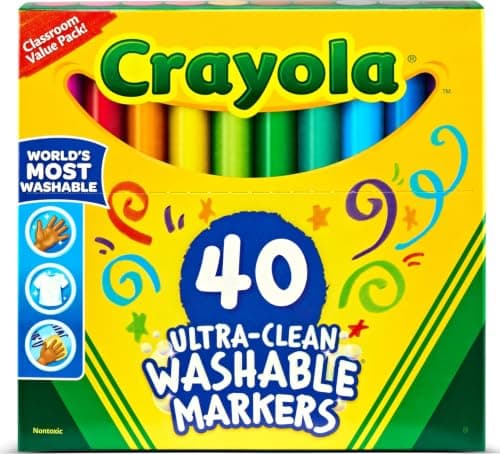
The washable claim and the labeling are separate things
Crayola Ultra Clean Washable Markers, 40 Count
Age grade 3+
Graded 3+, forty broad-line markers from the Ultra Clean line, which washes off skin, most clothing and painted walls. Worth being clear that washable is about your walls rather than about the child — check the seal on the box for the other question. Forty colors at this price is the right spec for a household with daily drawing.
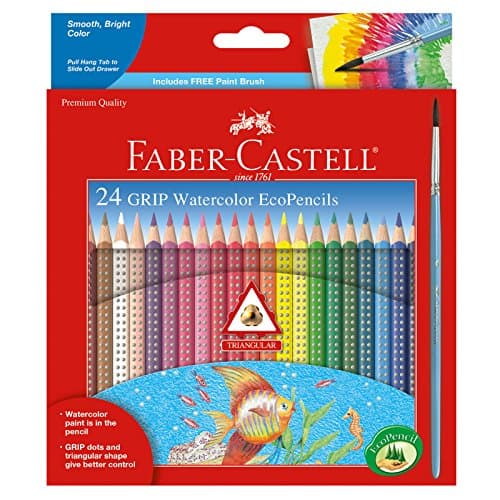
One medium, properly made, brush included
Faber-Castell Grip Watercolor EcoPencils, 24 Colors
Age grade 5+
Graded 5+, 24 watercolor pencils with a brush. A single-medium set from an established maker is the easier labeling question than a 200-piece bundle from an unbranded seller, simply because there is one formulation to account for rather than nine. It needs water and a table, so it is not a sofa activity.
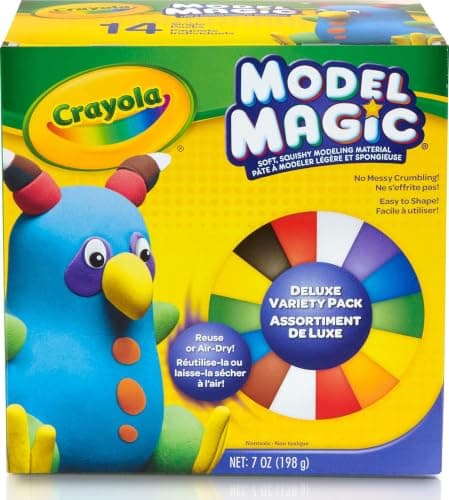
Pre-mixed, which is the lower-dust option
Crayola Model Magic Deluxe Variety Pack
Age grade 4+
Graded 4+, a fourteen-count deluxe variety pack of air-dry modeling compound. It arrives ready to use rather than as a powder you mix, which removes the dust exposure route that people forget about with clay. It air-dries permanently, so an unsealed packet is a one-way trip — that is the honest cost of the format.
#ad · As an Amazon Associate we earn from qualifying purchases. How this works.
Questions
Questions people actually ask
What does non-toxic mean on kids' art supplies?
What is the AP seal on art supplies?
Is the CL seal safe for kids?
Does ASTM D-4236 mean a product is safe?
Are wooden toys safer than plastic ones?
Keep reading
Related
- Kids' art sets comparedThe five all-in-one cases, on age grade, medium and mess.
- Toys for the artistThe whole creative category, beyond the boxed sets.
- Toy safety standards explainedASTM F963, CPSIA and what a conformance line is worth.
- How to check a toy recallWhat to do if something you already own is affected.
- Wood vs plastic blocksWhy “natural” is not a safety claim.
Receipts
Sources
- Art & Creative Materials Institute — what the AP and CL seals certify, and the sixth-grade line
- ASTM F963 — Standard Consumer Safety Specification for Toy Safety
- US Consumer Product Safety Commission — Toy Safety business guidance
- 16 CFR Part 1501 — the federal small-parts regulation behind the “not for children under 3” warning (eCFR)
We do not run a playroom test lab and we do not pretend to. Age grades, battery requirements and assembly notes are quoted from each manufacturer’s own product listing, read on September 7, 2026; prices come live from Amazon’s API and are stamped with the date they were checked. Where a maker publishes nothing, the page says “manufacturer does not publish this” rather than guessing. Read the full method.