Honest · The Honest List
The battery reality check
Batteries are the running cost nobody prints on the box. Here is what they actually cost, why the ones in the box die immediately, and the one battery type that is a genuine safety issue rather than an inconvenience.
We earn a commission if you buy through our links. It does not change the price you pay and it does not decide our picks — our method is published in full, including the part where we say we have not played with these toys. How this works.
The demonstration battery problem
A large number of battery toys arrive with cells already installed, and a large number of those are demonstration batteries: fitted so the toy works in the shop and in the first hour, not intended to run it. Many listings say so directly in the specification section, in wording along the lines of “batteries included for demonstration purposes only”.
The practical consequence is the specific Christmas-morning failure where a toy works for forty minutes and then stops, on the one day of the year when nothing is open. It is entirely avoidable by reading the battery line before wrapping, which is why we print the manufacturer’s battery line, verbatim, on every product card — and print “manufacturer does not publish a battery requirement” where they publish nothing rather than guessing.
What batteries actually cost over a year
The arithmetic is worth doing once because it is not intuitive. A toy taking four AA batteries, used regularly, will typically go through several sets in a year. At normal retail prices for alkaline cells, that is frequently a meaningful fraction of what the toy cost — and for a cheap noisy toy, it can exceed the purchase price within eighteen months.
Two things follow. First, a rechargeable set plus a charger pays for itself quickly if the household has more than one battery toy, and it removes the “we have no batteries” problem permanently. Second, for a cheap toy, the running cost is a real argument for buying the unpowered equivalent — which is usually also the better toy. See the battery-free list.
Coin cells: the part that is not about money
Button and coin cell batteries are a genuine and serious hazard. Swallowed, a coin cell can cause severe internal chemical burns within hours, and the injury pattern is well documented. The US Consumer Product Safety Commission maintains a dedicated information center on exactly this, and it is worth reading if there is a child under about six in the house.
What that means when buying:
- Any toy containing a coin cell should have a compartment secured with a screw, not a friction lid.
- A toy whose compartment no longer closes properly should be taken out of use. Tape is not a fix.
- Loose spare coin cells should be stored where a child cannot reach them, in the original packaging.
- Secondhand toys deserve a specific check here — a screw missing after a decade of use is common and easy to miss. See buying secondhand.
Where the running cost disappears
The way out of this whole arithmetic is a powered toy that charges rather than one that consumes: USB-rechargeable and solar toys have a battery line of zero dollars per year forever. They are a smaller group than they should be, and the ones worth knowing about are collected on tech toys with no screen in them.
How to read the battery line before you buy
Marketing copy omits battery information constantly; the specification table usually does not. Look for the number and the type together — “3 x AAA” is a different proposition from “3 x AA” on a Sunday evening, because most households have AA and rather fewer have AAA. Then check whether they are included, and whether inclusion means “for demonstration”.
If a listing is silent on batteries and the toy plainly makes sounds, treat it as unknown rather than as none. That is the honest reading, and it is what our own product data does.
The practical rules
- Read the type and count before wrapping. Buy the batteries in the same order.
- Buy double. The second set is the one that saves the day.
- Rechargeables for anything used daily; alkalines for anything used rarely.
- Never buy a coin cell toy whose compartment is not screwed shut.
- When choosing between two similar toys, the unpowered one is usually cheaper to own and more durable. That is not a coincidence.
The toys
The toys this guide is about
Every one of these carries its manufacturer’s published age grade and a live Amazon price, read October 24, 2026. Full rankings live in the roundups linked above.
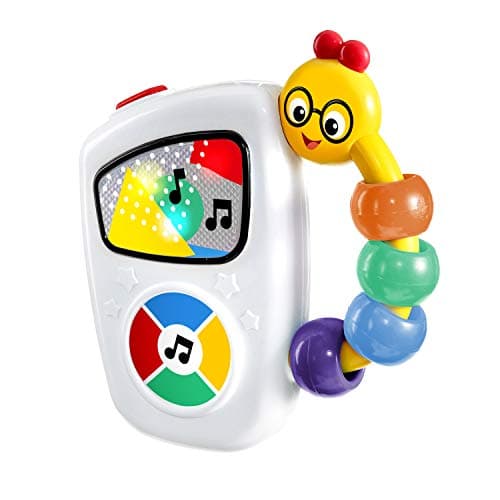
Batteries: published requirement
Baby Einstein Take Along Tunes
Age grade 3 months+
The listing states the included cells are for demonstration only — a clear example of why the battery line is worth reading before wrapping.
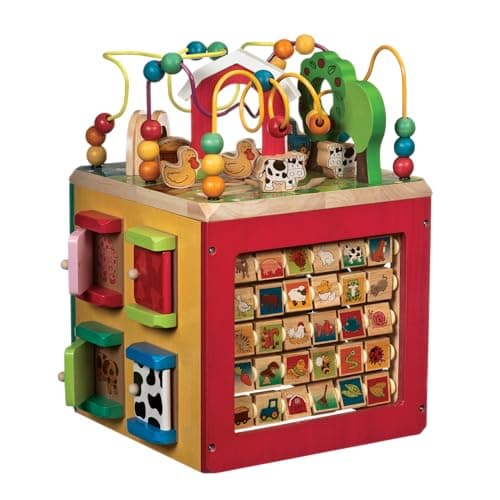
No published battery requirement
Battat Wooden Activity Cube
Age grade 12 months+
A wooden activity cube in a category where nearly everything is electronic. Nothing to run out.
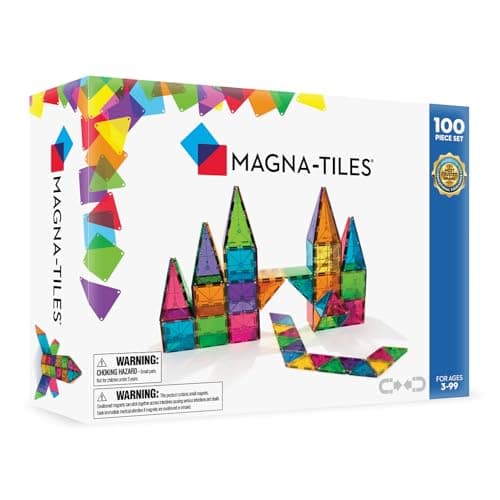
No batteries, ever
Magna-Tiles Classic 100-Piece Set
Age grade 3+
No compartment exists. Nothing to buy, nothing to replace, nothing to swallow.
#ad · As an Amazon Associate we earn from qualifying purchases. How this works.
Questions
Questions people actually ask
Why do toy batteries die so fast?
Are button batteries in toys dangerous?
Are rechargeable batteries worth it for toys?
How much do toy batteries cost per year?
How do I know how many batteries a toy needs before buying?
Keep reading
Related
Receipts
Sources
- CPSC — button cell and coin battery safety information
- US Consumer Product Safety Commission — Toy Safety business guidance
- US Consumer Product Safety Commission — recall database
We do not run a playroom test lab and we do not pretend to. Age grades, battery requirements and assembly notes are quoted from each manufacturer’s own product listing, read on September 7, 2026; prices come live from Amazon’s API and are stamped with the date they were checked. Where a maker publishes nothing, the page says “manufacturer does not publish this” rather than guessing. Read the full method.