
Skip to content
Windup & Wonder

Guides · Guides

STEM toys by age, 3 to 12

Almost every list of STEM toys is really a list of eight-year-old toys with a couple of toddler items bolted on. The age grade is the whole problem here: a circuit kit handed to a five-year-old is a tray of parts, and a shape sorter handed to a nine-year-old is an insult. This page is organised the way the purchase actually works — by the age printed on the box.

By Stephen V.Updated How we pick
#ad

We earn a commission if you buy through our links. It does not change the price you pay and it does not decide our picks — our method is published in full, including the part where we say we have not played with these toys. How this works.

The short answer

The picks, at a glance

#ToyBest forAge gradeNoisePrice
01Ages 3 to 5 — the only STEM toy that works before a child can read3+Quiet$113.11Amazon
02Ages 4 to 6 — the first toy that teaches sequence4+Quiet$39.99Amazon
03Ages 4 to 8 — physics you can see, with no instructions needed4–8Some noise$54.99Amazon
04Ages 5 to 12 — the widest useful age span in the category5–12Silent$37.99Amazon
05Ages 8 to 11 — the kit that actually explains the thing8+Some noise$32.99Amazon
06Ages 8 to 12 — the one-player option8–12Quiet$19.97Amazon
07Ages 10 to 13 — the one that reads as serious10+Silent$59.95Amazon

#ad · Prices come live from Amazon’s API and were last checked October 11, 2026. Where we have no verified live price we show none — we would rather leave a gap than print a number that has gone stale. Age grades are the manufacturer’s own; noise is our reading, not a measurement.

The short verdict

If the child is 3 to 5, buy Magna-Tiles — it is the only thing in this category that works before a child can read, and it is still in use four years later. At 4 to 6, the Code & Go Robot Mouse is the pick, because it teaches sequence with no screen and nothing to install. From 8 upwards, buy Snap Circuits Jr. and stop reading: it is the best-documented kit at the age where a child can finally follow a diagram alone. And if the child is ten or older and has already had science kits, the answer is the Chem C1000 chemistry set, which is the only thing here that does not read as a toy.

Everything on this page carries the age grade its own manufacturer publishes, printed in the table above. We never recommend below it. On a STEM toy that grade is usually a difficulty line rather than a safety line, which makes it tempting to ignore — and ignoring it is the single most common reason these things end up in a cupboard in February.

Why “STEM toy” tells you almost nothing

The label is unregulated and it is applied to four completely different purchases. Knowing which one you are buying predicts satisfaction better than any feature list.

  1. Materials. Tiles, blocks, marble runs. No instructions, no end state, no way to finish. They work from three and keep working for years because the child supplies the project.
  2. Instruments. A microscope, a telescope, a scale. These have no play pattern at all — they have a capability. They outlast everything else on a shelf because there is always another thing to look at.
  3. Systems with a manual. Circuits, chemistry, mechanical kits. These are where real explanation happens, and they are also where the age grade genuinely bites: the child has to be able to read a diagram and tolerate a failed attempt.
  4. Themed activity kits. Twelve experiments in a box with a cartoon on the lid. They are finished in one afternoon, and then they are rubbish in a cupboard. This is the group that generates the complaint that STEM toys are a scam.

There is nothing from group four on this page. That is not snobbery — it is the single highest-yield filter in the whole category, and it is checkable from the listing: count the number of advertised activities, then ask how many of them consume something.

The two failure modes, in order of how often they happen

1. Bought one to three years early

A circuit kit graded 8+ given to a five-year-old does not become an easier circuit kit. It becomes an adult sitting on the floor doing a circuit kit while a five-year-old watches, and the child learns that the box is not for them. The grade on a STEM kit encodes reading, fine motor control and frustration tolerance all at once, and none of those can be front-loaded by enthusiasm. If you are between two ages, buy the material rather than the system: tiles and marble runs have no floor.

2. Bought as a one-afternoon kit

The second failure is buying something that is structurally finishable. A kit with twelve experiments has twelve experiments in it, and five of them use the sachet of citric acid. The test is whether the box contains anything that gets used up. Our toys worth the money page runs the same arithmetic across every category, and the STEM aisle is where it is most brutal.

What we check on a STEM listing, and what nobody publishes

Four things are printed and worth reading before you buy. The age grade, which we quote verbatim. The battery requirement, including whether cells are included — more than half the disappointment on a Christmas morning in this category is a kit that needs two AA batteries nobody bought. The project count, which is only meaningful next to the consumables question above. And whether a manual is included, because a system kit without one is a parts bin.

What is almost never published: how long anything actually holds a child’s attention, whether replacement parts exist, and any noise figure. We do not have those numbers either, and we are not going to estimate them. Our noise and mess ratings are our reading of what the listing describes, and they are labelled as judgments everywhere they appear — the full method is published, including what disqualifies a toy from this site entirely.

If you only want the age band

The picks above are the shortlist; the age pages are the long list. For a complete age-filtered set — every toy on this site graded at or below a given age, not just the STEM ones — start at toys for a 5-year-old, toys for an 8-year-old or toys for a 10-year-old. If the child is already the kind who takes things apart, the STEM kid is the persona cut of the same registry and ranks on interest rather than on age.

In detail

Every pick, in full

01
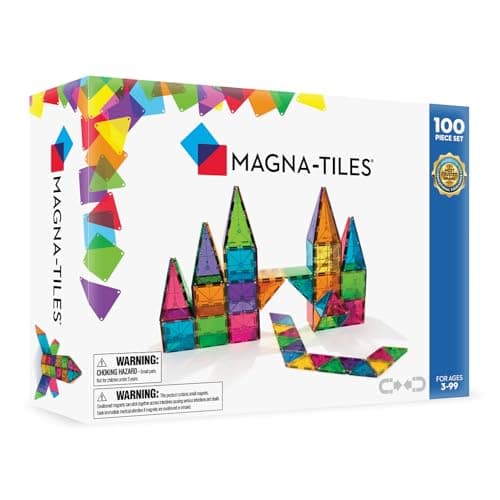
MAGNA-TILES Magna-Tiles Classic 100-Piece Set

Ages 3 to 5 — the only STEM toy that works before a child can read

Magna-Tiles Classic 100-Piece Set

MAGNA-TILES

Graded by Magna-Tiles for builders 3 and up, and it is the honest answer for the whole preschool end of this category. Real STEM at three is not a kit with a manual: it is a material with a rule the child discovers by hand, and magnets snapping only one way round is that rule. There is no reading, no sequence to follow and nothing to run out of, which is why this is still in use at seven when the themed preschool science kits are long gone. It is the most expensive thing per piece on this page; the counterweight is that it is also the only pick with a plausible five-year run.

Age grade:
3+
Batteries:
manufacturer does not publish a battery requirement
Noise:
Quiet
Mess:
Contained
Assembly:
manufacturer does not publish an assembly time
Price:
$113.11 as of October 11, 2026

Age grade, battery and assembly wording are quoted from MAGNA-TILES’s own product listing, read on September 7, 2026. The manufacturer’s exact words: “builders ages 3-99”. Noise and mess are our reading, not a measurement — we have not played with this.

What it gets right

  • Lifetime warranty against manufacturer's defects, published on the listing — almost nothing else in this price bracket carries one
  • Age grade of 3+ but the manufacturer describes the set as built for ages 3 to 99, which is the honest range: adults build with these too
  • Made from food-grade MABS plastic that the maker states is free from BPA, phthalates and latex

What it doesn’t

  • Roughly four times the price per piece of the copies, and the copies are magnetic tiles too
  • One hundred pieces sounds like a lot until two children want to build separately

How loud

Nothing electronic in the box. The loudest sound it makes is a tower coming down.

How much mess

A hundred big flat pieces. They go back in a bin in under two minutes, and none of them hurt to step on.

Skip this if…

…you are buying for a child under three. The age grade is 3+ and these are exactly the flat, swallowable-magnet shape the small-parts rule exists for — no amount of supervision makes an under-three set out of a 3+ set.

$113.11See it on Amazon

$119.996% off

Price checked October 11, 2026. Toy prices move constantly, especially in December — Amazon’s price at checkout is the one that counts.

#ad · we may earn a commission from this link to Magna-Tiles Classic 100-Piece Set

02
Learning Resources Code & Go Robot Mouse, Rechargeable

Ages 4 to 6 — the first toy that teaches sequence

Code & Go Robot Mouse, Rechargeable

Learning Resources

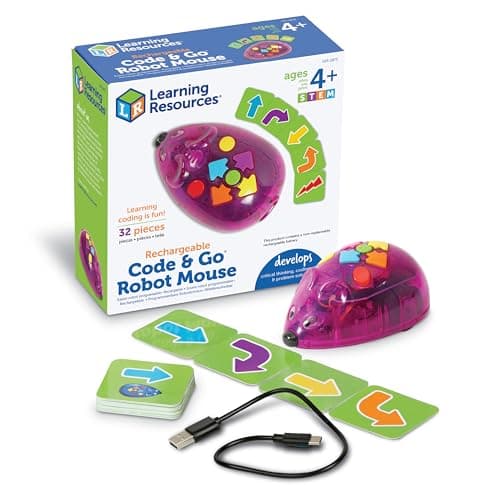
Learning Resources grades this 4+ and prints “no screens required” on its own listing, which matters because almost every other coding toy at this age is really a tablet app with a plastic accessory. The child presses direction buttons to build a sequence, lays a route with the thirty coding cards, and then watches it work or fail — and the failure is the lesson, because a wrong turn is visible and fixable. It charges over USB, so there is nothing to buy again. The honest limit: this version is the mouse and the cards, sold by the maker as an add-on to its activity sets, so there are no maze walls in the box.

Age grade:
4+
Batteries:
manufacturer does not publish a battery requirement
Noise:
Quiet
Mess:
Contained
Assembly:
manufacturer does not publish an assembly time
Price:
$39.99 as of October 11, 2026

Age grade, battery and assembly wording are quoted from Learning Resources’s own product listing, read on September 7, 2026. The manufacturer’s exact words: “Ages 4+”. Noise and mess are our reading, not a measurement — we have not played with this.

What it gets right

  • Rechargeable over a USB cord, so this is a powered toy with no AA batteries to buy, ever
  • Learning Resources states “screen-free coding fundamentals” and “no screens required” on the listing — the claim is the maker's, not ours
  • Thirty double-sided coding cards and an activity guide are in the box, which is what turns button-pressing into sequencing

What it doesn’t

  • No maze walls, tunnels or cheese wedge — the maker lists this version as a replacement or add-on for the Code & Go activity sets
  • Graded 4+, but planning a route before running it is the entire activity, so at four an adult is on the floor too

How loud

Learning Resources advertises no sound feature on this listing at all — what it advertises is screen-free coding. The noise is a small motor on a hard floor.

How much mess

One mouse, a charging cord and thirty cards. The cards are the only thing that goes missing.

Skip this if…

…you want the maze. This is the rechargeable mouse plus cards, which Learning Resources sells as an add-on or replacement for the activity sets — buy an activity set if you want walls and tunnels in the box.

$39.99See it on Amazon

$49.9920% off

Price checked October 11, 2026. Toy prices move constantly, especially in December — Amazon’s price at checkout is the one that counts.

#ad · we may earn a commission from this link to Code & Go Robot Mouse, Rechargeable

03
Marble Genius Marble Genius Marble Run Super Set, 150 Pieces

Ages 4 to 8 — physics you can see, with no instructions needed

Marble Genius Marble Run Super Set, 150 Pieces

Marble Genius

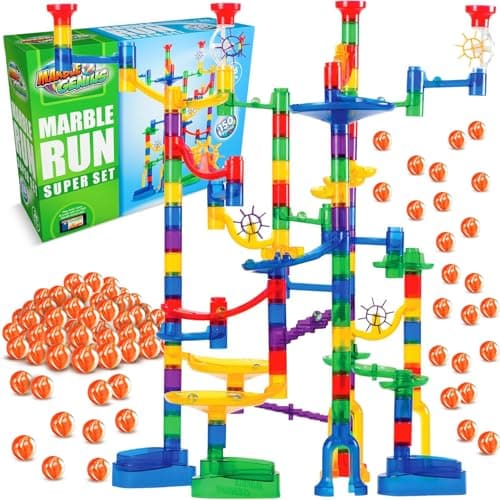
The maker designs this for 4 to 8 and ships 150 translucent pieces. A marble run is the cheapest honest physics toy there is: height becomes speed, a gap becomes a failure, and the child adjusts without anyone explaining gravity. It is also the pick on this page most likely to be played with by two children at once. Two warnings that are not on the box. It is noisy — plastic marble on plastic track on a hard floor is a constant rattle — and loose marbles spread, which makes it a poor choice for a room a crawling baby also uses.

Age grade:
4–8
Batteries:
manufacturer does not publish a battery requirement
Noise:
Some noise
Mess:
Spreads
Assembly:
manufacturer does not publish an assembly time
Price:
$54.99 as of October 11, 2026

Age grade, battery and assembly wording are quoted from Marble Genius’s own product listing, read on September 7, 2026. The manufacturer’s exact words: “designed for kids ages 4-8”. Noise and mess are our reading, not a measurement — we have not played with this.

What it gets right

  • 150 pieces builds tall, and height is what a four-year-old is actually after
  • Translucent pieces make the marble visible through the run, which is most of the fun
  • Considerably cheaper per piece than the wooden systems

What it doesn’t

  • Plastic joins loosen with repeated rebuilding
  • The published 4 to 8 window is honest — a nine-year-old is done with it

How loud

Plastic tubes amplify a marble. It is a rattle you hear from another room.

How much mess

Marbles plus small connectors. Two categories of thing that get lost, in one box.

Skip this if…

…the household includes an under-three. Same rule as every marble toy: the marbles are the hazard, and there is nowhere safe to put a half-built run.

$54.99See it on Amazon

Price checked October 11, 2026. Toy prices move constantly, especially in December — Amazon’s price at checkout is the one that counts.

#ad · we may earn a commission from this link to Marble Genius Marble Run Super Set, 150 Pieces

04
Uarzt 58-Piece Kids Microscope Kit

Ages 5 to 12 — the widest useful age span in the category

58-Piece Kids Microscope Kit

Uarzt

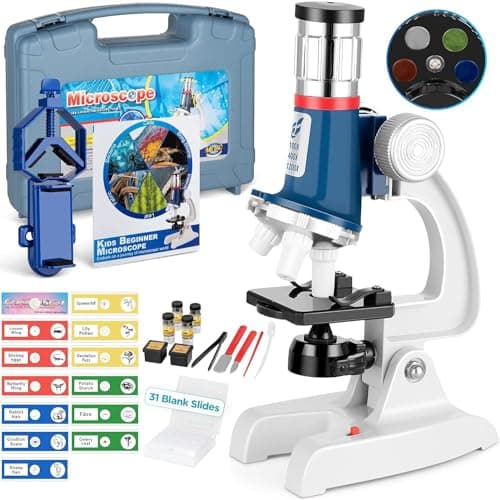
Published for 5 to 12, metal-bodied, 100x to 1200x, with LED illumination and prepared slides, on 2 AA batteries the maker does not include. This is the one instrument on this page rather than a kit, and instruments outlast kits by years because they never run out of things to look at. The metal body is the specific reason it is here instead of a plastic microscope at a similar price: focus holds when a child leans on the stage. The slides are glass, so at the young end of that published range this is a sit-down-together toy for the first few sessions.

Age grade:
5–12
Batteries:
Requires 2 AA batteries (not included)
Noise:
Silent
Mess:
Contained
Assembly:
manufacturer does not publish an assembly time
Price:
$37.99 as of October 11, 2026

Age grade, battery and assembly wording are quoted from Uarzt’s own product listing, read on September 7, 2026. The manufacturer’s exact words: “Ages 5-12”. Noise and mess are our reading, not a measurement — we have not played with this.

What it gets right

  • Metal body rather than the plastic toy microscopes at the same price, so focus actually holds
  • Prepared slides included, so there is something to look at immediately
  • Published 5 to 12 range makes it a genuinely long-lived purchase

What it doesn’t

  • Requires 2 AA batteries, not included, for the LED
  • Glass slides in a kit graded from five needs an adult present the first few times

How loud

Nothing but an LED.

How much mess

Slides and small tools in a case. The slides are glass, which is the thing to supervise.

Skip this if…

…the child is at the young end and unsupervised. Focusing a microscope is fiddly and glass slides break — five-year-olds need company for this one.

$37.99See it on Amazon

Price checked October 11, 2026. Toy prices move constantly, especially in December — Amazon’s price at checkout is the one that counts.

#ad · we may earn a commission from this link to 58-Piece Kids Microscope Kit

05
Snap Circuits Snap Circuits Jr. SC-100 Electronics Kit

Ages 8 to 11 — the kit that actually explains the thing

Snap Circuits Jr. SC-100 Electronics Kit

Snap Circuits

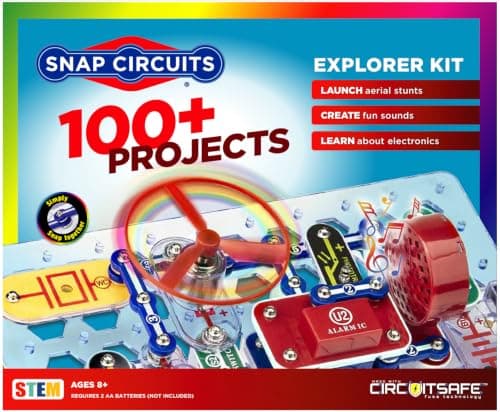
Graded 8+ with over a hundred published projects. This is the point in the age range where a child can follow a diagram alone, and Snap Circuits is the best-documented kit in our registry at that level: components snap to a grid until something lights, spins or sounds, and the manual explains why. Do not buy it younger — at six this becomes a frustrating bag of parts, and the age grade here is a difficulty line rather than a safety line. Batteries are required and not included, and the manual is essential: a lost manual turns a hundred projects into a tray of plastic.

Age grade:
8+
Batteries:
manufacturer does not publish a battery requirement
Noise:
Some noise
Mess:
Contained
Assembly:
manufacturer does not publish an assembly time
Price:
$32.99 as of October 11, 2026

Age grade, battery and assembly wording are quoted from Snap Circuits’s own product listing, read on September 7, 2026. The manufacturer’s exact words: “Ages 8+”. Noise and mess are our reading, not a measurement — we have not played with this.

What it gets right

  • Over a hundred projects with a real progression, so it is months of activity rather than an afternoon
  • No soldering, no exposed wiring — the design removes every reason an adult would say no
  • Published 8+ grade, and the projects teach actual circuit concepts rather than dressing them up

What it doesn’t

  • Batteries required and not included; check the manual before wrapping it
  • The manual is essential, and a lost manual makes the kit nearly useless

How loud

Some projects build a siren or an alarm, and those are as loud as you would expect. Most are silent. No decibel figure is published.

How much mess

Modular parts on a grid base, all of which fit in the tray. The base is the workspace.

Skip this if…

…the child will not follow a diagram. Snap Circuits is a build-from-instructions kit, and freestyling it produces nothing that works.

$32.99See it on Amazon

Price checked October 11, 2026. Toy prices move constantly, especially in December — Amazon’s price at checkout is the one that counts.

#ad · we may earn a commission from this link to Snap Circuits Jr. SC-100 Electronics Kit

06
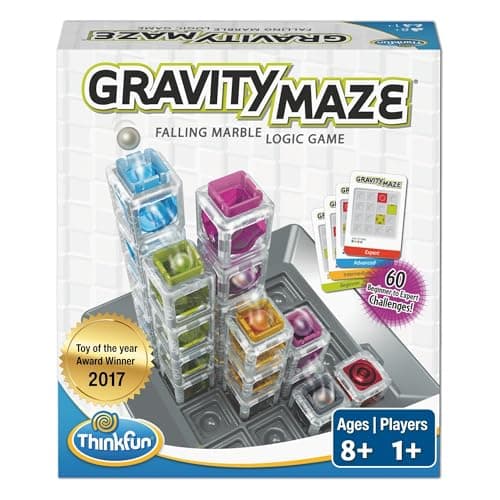
ThinkFun ThinkFun Gravity Maze Marble Logic Game

Ages 8 to 12 — the one-player option

ThinkFun Gravity Maze Marble Logic Game

ThinkFun

ThinkFun publishes 8 to 12, and it belongs on an age-sorted list because it is the rare STEM toy that needs nobody else in the room. Sixty challenge cards run from easy to genuinely hard, there is one solution per card, and the marble either reaches the target or it does not — the toy marks its own work, which is what lets a child keep going without an adult. Skip it for a child who gives up when something is hard; the cards get difficult fast and there is no way to make them easier.

Age grade:
8–12
Batteries:
manufacturer does not publish a battery requirement
Noise:
Quiet
Mess:
Contained
Assembly:
manufacturer does not publish an assembly time
Price:
$19.97 as of October 11, 2026

Age grade, battery and assembly wording are quoted from ThinkFun’s own product listing, read on September 7, 2026. The manufacturer’s exact words: “Ages 8-12”. Noise and mess are our reading, not a measurement — we have not played with this.

What it gets right

  • Sixty graded challenges with verifiable solutions — the marble arriving is the proof
  • Single-player, so it fills the same gap Rush Hour does with a completely different mechanic
  • The published upper bound of 12 to 14 is fair; the hard cards are genuinely hard

What it doesn’t

  • Marbles, in a household that may have a toddler in it
  • Finite challenge set with no expansions widely available

How loud

One marble falling through a short tower. Considerably quieter than an actual marble run.

How much mess

Towers, a grid and marbles. Only three marbles, which is a far smaller loose-marble problem than a marble run.

Skip this if…

…there is a baby crawling. Three marbles is fewer than a marble run but three is not zero.

$19.97See it on Amazon

$24.9920% off

Price checked October 11, 2026. Toy prices move constantly, especially in December — Amazon’s price at checkout is the one that counts.

#ad · we may earn a commission from this link to ThinkFun Gravity Maze Marble Logic Game

07
Thames & Kosmos Thames & Kosmos Chem C1000 Chemistry Set

Ages 10 to 13 — the one that reads as serious

Thames & Kosmos Chem C1000 Chemistry Set

Thames & Kosmos

Graded 10+, 125 experiments, an 80-page manual and safety gear in the box. By ten the problem is credibility: a child who has had four science kits knows which ones are toys, and this is the one that does not look like a toy. It is also the pick with the most adult involvement on this page, which is the honest trade — a chemistry set with a real manual needs supervision and a wipeable surface, and anyone who buys it expecting a self-contained afternoon will be disappointed. Buy it for the child who has asked a second question about something.

Age grade:
10+
Batteries:
manufacturer does not publish a battery requirement
Noise:
Silent
Mess:
Spreads
Assembly:
manufacturer does not publish an assembly time
Price:
$59.95 as of October 11, 2026

Age grade, battery and assembly wording are quoted from Thames & Kosmos’s own product listing, read on September 7, 2026. The manufacturer’s exact words: “Ages 10+”. Noise and mess are our reading, not a measurement — we have not played with this.

What it gets right

  • 125 experiments and a manual written like a textbook rather than a comic
  • Published 10+ grade is honest and should be respected — this is not a seven-year-old's kit
  • Genuinely prepares a child for school chemistry rather than just entertaining them

What it doesn’t

  • Requires adult supervision throughout, which is a real time commitment
  • Chemicals are consumed and replacements have to be sourced individually

How loud

Nothing electronic.

How much mess

Real chemicals on a real surface. This wants a bench, an adult and a wipeable table, in that order.

Skip this if…

…the child is under the published age. A chemistry set below its grade is the one item in this guide where going early is genuinely unsafe, not just disappointing.

$59.95See it on Amazon

Price checked October 11, 2026. Toy prices move constantly, especially in December — Amazon’s price at checkout is the one that counts.

#ad · we may earn a commission from this link to Thames & Kosmos Chem C1000 Chemistry Set

How we picked

Toys we claim to have played with: 0

Every toy site tells you they tested forty toys with a focus group of real children. We have not played with any of these, and we say so. Here is what we do instead: we read the manufacturer’s own listing and print its published age grade word for word, we record the battery requirement and the assembly note where the maker publishes one and say plainly when it does not, we pull the price live from Amazon so it is never a number we remembered, and we name one thing on every list we would not buy.

The noise and mess ratings are our judgment from what the listing describes — not measurements. Almost no toy manufacturer publishes a decibel figure, which is itself worth knowing. The full method is published, including what disqualifies a toy.

Questions

Questions people actually ask

What are the best STEM toys for a 5-year-old?
Materials rather than kits. Magnetic tiles (graded 3+), a marble run (graded 4 to 8) and the Code & Go Robot Mouse (graded 4+) are the three that genuinely work at five. The circuit and chemistry kits are graded 8+ and 10+ by their own makers, and buying them early does not make them easier.
Are STEM toys actually worth it?
The materials and instruments are — tiles, marble runs, a microscope with a metal body. The themed kits with twelve experiments mostly are not, because they are finishable in an afternoon and then they are over. The checkable test is whether the box contains anything that gets used up.
What is the best STEM toy for an 8-year-old?
Snap Circuits Jr., graded 8+ with over a hundred projects and a manual that explains what is happening rather than just listing steps. Eight is the age the documentation becomes usable by the child alone, which is the whole difference between a kit that gets finished and one that gets abandoned.
Do STEM toys need batteries?
Some do and the listing says so. On this page the microscope needs 2 AA cells the maker does not include, the circuit kits need cells that are not included, and the coding mouse charges over USB with nothing to buy again. The tiles, marble run and chemistry set need no power at all. Battery reality prints the count and type for every pick on this site.

Keep reading

Receipts

Sources

We do not run a playroom test lab and we do not pretend to. Age grades, battery requirements and assembly notes are quoted from each manufacturer’s own product listing, read on September 7, 2026; prices come live from Amazon’s API and are stamped with the date they were checked. Where a maker publishes nothing, the page says “manufacturer does not publish this” rather than guessing. Read the full method.