Guides · Guides
Musical toys, and the noise question underneath them
There are two completely different products in this aisle. One lets a child produce a sound by doing something; the other produces sound when a button is pressed. Only the first is a musical toy. The second is the single biggest source of regret in the whole toy shop.
We earn a commission if you buy through our links. It does not change the price you pay and it does not decide our picks — our method is published in full, including the part where we say we have not played with these toys. How this works.
The short answer
For a child under three who loves music, buy an instrument — a pound-and-tap bench with a slide-out xylophone (graded 12 months to 3 years) is the best one we carry, because the xylophone outlives the hammering. For a child of three or more who wants listening rather than playing, a card-driven audio player graded 3 to 12 is the honest answer and it is a different purchase entirely. A karaoke microphone is the right gift for exactly one kind of child and the wrong one for every other household in the building. And an infant music box graded from 3 months is a car-seat toy, which is a job worth doing and not the same as a musical toy.
Instrument or soundbox
This is the whole page in one distinction. An instrument has a causal link between what the child does and the sound that comes out: harder is louder, here is higher, stopping is silence. A soundbox plays a recording when a button is pressed — the child is operating it, not playing it, and the sound is identical on the thousandth press as on the first.
Both can be worth buying. But they satisfy different wants, and the usual complaint about musical toys — that they are maddening and get abandoned — is almost entirely about the second group. A soundbox has a fixed amount of content in it, so it is boring on a schedule. An instrument never runs out, because the content is the child.
There is a checkable test on the listing. If the sound is advertised as songs, melodies, phrases or a number of tunes, it is a soundbox. If it is advertised as keys, strings, bars, drums or notes, it is an instrument.
What no manufacturer publishes, and why it matters here
We rate noise on every pick on this site, and on this page the rating is the subject rather than a footnote — so here is the limit of what anyone can honestly tell you. Almost no toy maker publishes a decibel figure. Not for a xylophone, not for a karaoke microphone, not for an electronic toy at any price. There is no standard requiring it and no seal for it, so any page that gives you a dB number for a toy is either quoting its own measurement — which we do not take, because we do not own these toys and own no sound meter — or inventing it.
What we do instead, on this page and everywhere: we read the manufacturer’s own listing and record whether the box contains anything that produces sound by itself, whether the listing advertises volume as a feature, and whether a volume control is mentioned. That is a judgment, it is labelled as one, and our noise ratings page explains the scale in full. The absence of published figures across an entire category is itself the finding.
Two practical consequences. First, a volume control is a feature worth paying for and it is printed when it exists. Second, a quiet rating on this site often means “as loud as the child decides” rather than “soft” — a xylophone has no volume control at all, and hitting it harder is the obvious thing a two-year-old will try.
Three things to check before buying anything that makes a sound
- Is there a volume control, and can a child reach it? A toy with a switch an adult sets is a different object from one with a dial a child discovers. Both beat no control at all.
- Where does the power come from? An acoustic instrument needs none and cannot die. A soundbox on disposable cells will fail at a bad moment and is also the group most likely to keep playing at 3am in a cupboard. Battery reality prints the count and type for everything we list.
- Does the sound stop when the child stops? This is the single best proxy for whether an adult will still tolerate the toy in March. An instrument stops. A soundbox has a run-out time, and in the worst cases a demo mode that cannot be turned off.
What is not here: real instruments
We do not carry keyboards, ukuleles, recorders or practice drum pads, and for an older child who is genuinely interested in music those are the right purchase rather than anything on this page. A real instrument has a progression path, a repair path and a resale value, none of which a toy version has. Saying so costs us nothing and is more useful than pretending a plastic version is the same thing.
For a teenager who loves music, the honest answer is almost never a toy — gifts that are not toys is the page for that, and the 13-and-over page starts from the same premise. For the toddler end, the age-filtered lists at one and two are filtered against the published grade by the build itself.
The four, side by side
| Toy | Maker’s age grade | Instrument or soundbox | Volume control | Power |
|---|---|---|---|---|
| Hape Pound & Tap Bench | 12 months–3 years | Instrument | None — hitting it harder is louder | None |
| Yoto Mini | 3+ | Audio player (listening, not playing) | Yes | Rechargeable |
| Kids Karaoke Microphone | 6–8 | Soundbox — volume is the feature | Not published | Not published |
| Baby Einstein Take Along Tunes | 3 months+ | Soundbox | Not published | 2 AA, included for the demo |
Age grades and the power column are each manufacturer’s published figures, quoted as printed; “not published” means exactly that and is not a gap in our research. The instrument-or-soundbox column is our reading against the distinction at the top of this page. No decibel figure appears anywhere in this table because no manufacturer publishes one. Live prices are below with the date they were read.
Four picks, and which kind each one is
Two instruments, one audio player and one soundbox — labelled, because the label is the thing that decides whether this is the right gift.
The toys
The toys this guide is about
Every one of these carries its manufacturer’s published age grade and a live Amazon price, read October 11, 2026. Full rankings live in the roundups linked above.
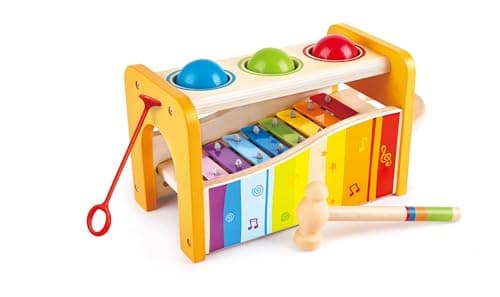
Instrument. The best musical toy for 12 months to 3 years
Hape Pound & Tap Bench with Xylophone
Age grade 12 months–3 years
Hape publishes 12 months to 3 years. Balls get hammered through the holes onto a xylophone that then slides out and becomes an instrument in its own right — two toys in one box, and the second survives the first being outgrown. It is wooden, there is nothing to break when it is thrown, and it needs no power, so it cannot fail. Now the honest part: hammering IS the toy, it is loud, and a xylophone has no volume control. If there is a sleeping baby in the next room, this is the wrong gift and we would rather say so than let the box do it.
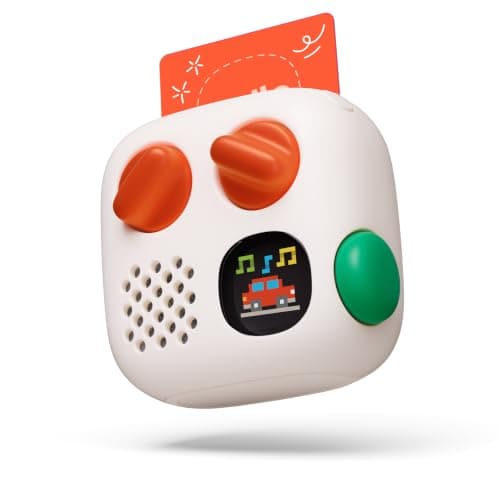
Audio player, not a musical toy — ages 3 and up
Yoto Mini Screen-Free Audio Player
Age grade 3+
Graded 3+ and published by Yoto as screen-free. This is listening rather than playing, and it is on this page because a large share of people searching for a musical toy actually want this: the child chooses a card, pushes it in, and music or a story plays. It has a volume control, which almost nothing else in this aisle does, and it fills the specific slot a tablet occupies — quiet time, the car, the twenty minutes before sleep. Two things to be clear about: it is a speaker, so it is as loud as the child sets it, and the cards are the real cost of ownership.
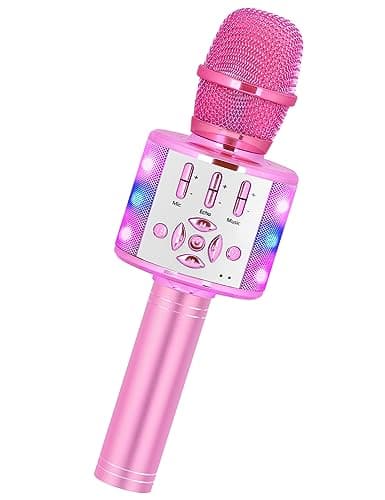
Soundbox. Right for one child, wrong for most households
Kids Karaoke Microphone
Age grade 6–8
Published for ages 6 to 8 with lights. We are including this because it is what a certain child desperately wants, and excluding it would be dishonest — but it is the loudest thing on this page by design, the volume is the feature, and there is no version of this gift that is quiet. Buy it for a child who performs, in a house with a room where that can happen. Do not buy it for a flat with thin walls, do not buy it for a shared bedroom, and do not buy it as a surprise for somebody else's child without asking.
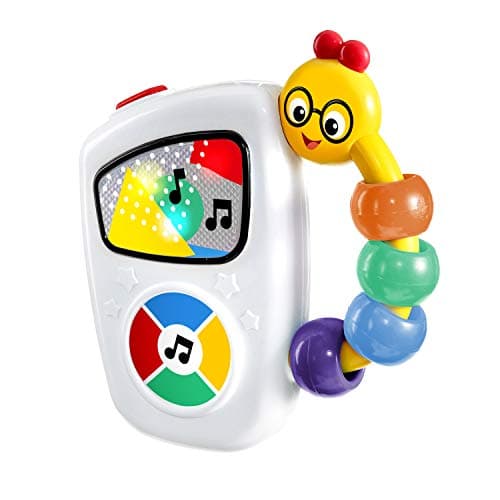
Soundbox, and the one job a soundbox does well — 3 months+
Baby Einstein Take Along Tunes
Age grade 3 months+
Graded from 3 months, with 2 AA cells included for the demo. This is a soundbox and we are not going to dress it up as music education. What it is genuinely good at is one narrow job: it clips near a car seat and it is the thing a baby can operate themselves at an age when almost nothing else qualifies. For that, it is the right purchase and it is cheap. It is loud for its size, it has a limited number of tunes, and by about eighteen months it will be ignored. Buy it for the car, not for the playroom.
#ad · As an Amazon Associate we earn from qualifying purchases. How this works.
Questions
Questions people actually ask
What are the best musical toys for a 2-year-old?
How loud are musical toys?
What is the difference between a musical toy and a sound toy?
Should I buy a real instrument instead?
Keep reading
Related
- Noise ratings, explainedThe scale behind every rating on this page, and why no decibel figures exist.
- Loud toys to avoidThe specific ones we would not buy, and what makes a toy unbearable rather than merely noisy.
- Quiet toys that are not boringIf the toy is going into a flat, a shared bedroom or a car.
- Tech toys with no screenWhere the card-driven audio player sits in the wider screen-free category.
Receipts
Sources
- NIOSH — Noise and Hearing Loss Prevention, on exposure levels and duration
- ASTM F963 — Standard Consumer Safety Specification for Toy Safety
- US Consumer Product Safety Commission — Toy Safety business guidance
We do not run a playroom test lab and we do not pretend to. Age grades, battery requirements and assembly notes are quoted from each manufacturer’s own product listing, read on September 7, 2026; prices come live from Amazon’s API and are stamped with the date they were checked. Where a maker publishes nothing, the page says “manufacturer does not publish this” rather than guessing. Read the full method.