A craft kit is not an art set. An art set is materials with no end point; a kit has a specific object in the box, a set number of them, and a moment when it is over. That difference decides which one you should buy, and it is the thing every list in this category ignores.
We earn a commission if you buy through our links. It does not change the price you pay and it does not decide our picks — our method is published in full, including the part where we say we have not played with these toys. How this works.
#ad · Prices come live from Amazon’s API and were last checked October 11, 2026. Where we have no verified live price we show none — we would rather leave a gap than print a number that has gone stale. Age grades are the manufacturer’s own; noise is our reading, not a measurement.
The short verdict
Buy Perler fuse beads if there is an adult who will do the ironing step — 4,001 beads is the longest run on this page by a wide margin, and it serves both the child who wants a pattern and the one who does not. If there is NOT, buy Aquabeads instead: it is graded 4+ and sets with water, so a child finishes it alone. For 8 to 12, the friendship bracelet loom is the pick, because the output is wearable and that is what sustains it. And for a child who has abandoned four projects in a row, buy the framed paint-by-number set — it is the least creative thing here and the most likely to be finished.
Kit or set? The question that decides this purchase
These two things are sold next to each other and they are not alternatives.
An art set is materials: pencils, paints, paper. It has no end state, it cannot be completed, and it is the right buy for a child who draws unprompted. We compare two of them properly, and everything on that page is a supply rather than a project.
A craft kit is a project: a specific object, a fixed number of them, and a finish line. It is the right buy for a child who wants to have MADE something and does not know what to draw.
Buying the wrong one of these produces two completely different disappointments. An art set given to a child who wanted a project sits unopened because a blank page is intimidating. A craft kit given to a child who draws constantly is finished in an hour and then they want their pencils.
The finishability test
Before buying any kit, answer one question: what does this kit need that is not in the box? There are only four common answers, and each predicts a specific failure.
Heat. Fuse beads need an iron and an adult at the last step — every time, not once. This is the most common reason a good kit stalls: the child finishes the creative part and the project waits three weeks for someone to find the iron.
Water or drying time. Water-set beads and air-dry compound both need a place to sit undisturbed for hours. In a house with a toddler or a cat, that place may not exist.
Refills. Thread, beads, canvases. A kit whose consumables are a separate purchase is a subscription with the first month included, and the listing rarely says so.
A grown-up for the whole thing. Some kits graded 8+ are really graded “8+ with an adult”. If the gift is meant to buy an hour of quiet, that is the opposite of what arrives.
Mess, honestly, because this is the messiest category on the site
We rate mess on every pick, and craft kits are where those ratings earn their place. The ranking on this page, worst to best: loose fuse beads go everywhere and find the gaps between floorboards; water beads spread but sweep up; air-dry compound and acrylic paints stay on the table if the table has a cover; the bracelet loom and the Spirograph leave essentially nothing. If the kit is going to be used in a rented flat or on a carpet, read that list backwards.
Two of these ratings come with a specific note worth repeating. Fuse beads are small enough to matter around an under-three sibling, and this is a real constraint rather than a disclaimer — see the choking hazard guide before buying one for a house with a baby in it. And acrylic paint, which the paint-by-number kits use, does not wash out of fabric; the kits are graded 8 to 12 partly for that reason.
For a party, a class or a rainy afternoon
A frequent version of this search is a kit for a group — a birthday party, a class activity, a wet half-term. The requirements change completely: it has to be identical for every child, it has to finish inside an hour, and it must not need an iron or a drying day. On this page only two qualify. The bracelet loom works if there is one per child, and the framed paint-by-number canvases work because each child gets one and leaves with it. Fuse beads, counter-intuitively, are the worst group option in the house.
For the gift-budget version of the same problem, our under-$25 guide is the class-party tier, and stocking stuffers is where the smallest kits live. If the child is the kind who draws without being asked, start at toys for the artist instead — that page is supplies, not projects.
In detail
Every pick, in full
01
Best for ages 4 to 6, and the cleanest kit here
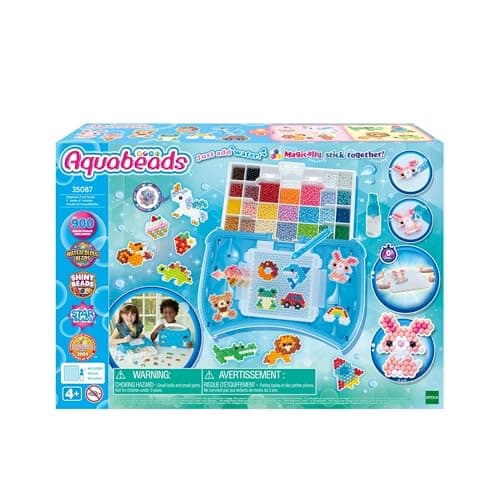
Aquabeads Beginner Craft Studio
Aquabeads
Published for 4 and up. Beads are laid on a template and set with water rather than heat, which is the entire reason this is the right first craft kit: there is no iron, no adult step at the critical moment, and nothing that can burn. A four-year-old can go from start to finished object without help, and a finished object is what a four-year-old is actually after. The honest warning is the obvious one — loose beads are tiny, they travel, and a spilled tray on a carpet is a vacuum job and the end of several designs.
Age grade:
4+
Batteries:
manufacturer does not publish a battery requirement
Noise:
Silent
Mess:
Spreads
Assembly:
manufacturer does not publish an assembly time
Price:
$22.69 as of October 11, 2026
Age grade, battery and assembly wording are quoted from Aquabeads’s own product listing, read on September 7, 2026. The manufacturer’s exact words: “for children ages 4 and older”. Noise and mess are our reading, not a measurement — we have not played with this.
What it gets right
+No iron, no adult supervision at the dangerous moment — the child can finish a project alone
+Published 4+ grade, two years earlier than fuse beads, because the heat step is removed
+The manufacturer states the under-3 exclusion explicitly, which is the kind of clarity we like to see
What it doesn’t
−Finished pieces are more fragile than ironed fuse beads and come apart if handled hard
−Refill beads are proprietary and the running cost adds up
How loud
Nothing.
How much mess
Small beads, same as fuse beads, but no iron and no scorching. The spill risk is identical; the burn risk is gone.
Skip this if…
…there is a crawling baby. The beads are small, they are designed to be spilled onto a tray, and water makes them stick to floors.
Best for a child who does not want to follow a pattern
Crayola Model Magic Deluxe Variety Pack
Crayola
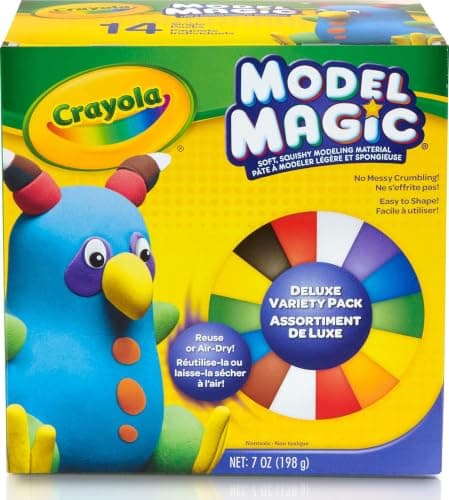
Graded 4+, fourteen packs, air-dry, and it is the one pick here with no template at all. That makes it the edge case on this page and a deliberate one: plenty of children want to make a thing without being told which thing, and modelling compound is the only craft material that allows it while still producing something keepable. It is lighter and less greasy than clay and it does not need an oven. Two real limits: once a pack is opened it dries out on a schedule you do not control, and air-dried pieces are fragile — this is not a material for a toy that gets played with afterwards.
Age grade:
4+
Batteries:
manufacturer does not publish a battery requirement
Noise:
Silent
Mess:
Contained
Assembly:
manufacturer does not publish an assembly time
Price:
$9.59 as of October 11, 2026
Age grade, battery and assembly wording are quoted from Crayola’s own product listing, read on September 7, 2026. The manufacturer’s exact words: “Ages 4+”. Noise and mess are our reading, not a measurement — we have not played with this.
What it gets right
+Air-dries, so the model survives — the finished thing is the point, not the squishing
+Lightweight and non-greasy, unlike traditional modeling clay
+Published 4+ grade, and it is far easier for small hands than proper clay
What it doesn’t
−Once a pack is opened, the clock is running — it dries out in the tub too
−Dried models are fragile and get broken within a week, which upsets the child who made them
How loud
Nothing.
How much mess
Non-greasy and does not crumb the way dough does. It does stick to fabric while wet, and it dries where it lands.
Skip this if…
…you want the reusable, endless kind. Model Magic is consumable by design; Play-Doh is the one that goes back in the pot.
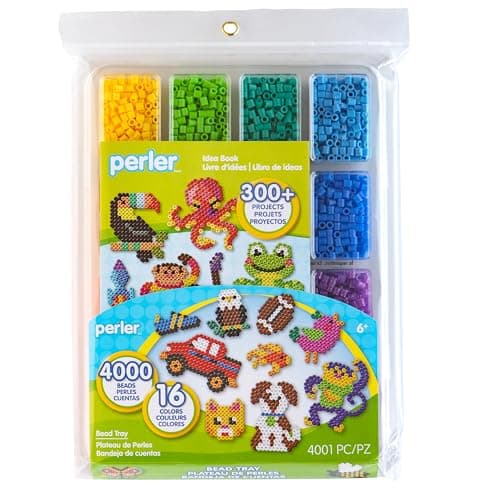
Graded 6+, with 4,001 beads, a storage tray and a pattern book. Four thousand beads is the most important number on this page: it is the difference between a kit that is finished on Boxing Day and one that is still producing things in March. The pattern book gives a child who wants instructions somewhere to start, and the loose beads give one who does not. The catch is structural and worth knowing before you buy: the final step needs an iron and an adult, every single time. If nobody in the house will do that step, buy the water-set beads above instead.
Age grade:
6+
Batteries:
manufacturer does not publish a battery requirement
Noise:
Silent
Mess:
Gets everywhere
Assembly:
manufacturer does not publish an assembly time
Price:
$14.59 as of October 11, 2026
Age grade, battery and assembly wording are quoted from Perler’s own product listing, read on September 7, 2026. The manufacturer’s exact words: “for ages 6 and up”. Noise and mess are our reading, not a measurement — we have not played with this.
What it gets right
+The finished pieces are real objects a child can give away, which is unusual for a craft kit
+Storage tray is included, and it is the only thing standing between you and the beads
+Enormously cheap per hour of activity
What it doesn’t
−Requires an adult with an iron for every single project — this is not an independent activity
−Loose beads are the definitive small part and there are thousands of them
How loud
Beads in a tub. Nothing electronic.
How much mess
The worst in this file. Thousands of loose beads with a published 6+ grade — one knocked tray and they are in the floorboards, the vents and the dog.
Skip this if…
…there is a child under three in the house or nobody has time to stand at an ironing board. Both of those disqualify it completely, and the second one is the reason most Perler kits stop being used.
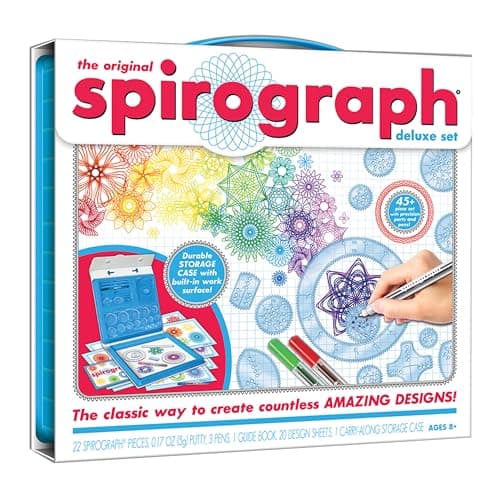
Graded 8+ and effectively unchanged in fifty years, which is itself a recommendation. The appeal is narrow and strong: the gears do the drawing, so the result looks far better than the child’s freehand ability, and that gap is extremely motivating for a child who has decided they are bad at art. Nothing is consumed except paper and pen ink. Skip it for a child who wants to make objects rather than pictures — this produces drawings, and no amount of enthusiasm turns it into something that comes off the page.
Age grade:
8+
Batteries:
manufacturer does not publish a battery requirement
Noise:
Silent
Mess:
Contained
Assembly:
manufacturer does not publish an assembly time
Price:
$25.50 as of October 11, 2026
Age grade, battery and assembly wording are quoted from Spirograph’s own product listing, read on September 7, 2026. The manufacturer’s exact words: “Ages 8+”. Noise and mess are our reading, not a measurement — we have not played with this.
What it gets right
+Produces genuinely beautiful results within the first ten minutes, which is rare for a skill toy
+The gear set is the same idea it has always been and it still works
+Published 8+ grade is honest rather than cautious — this really does need coordination
What it doesn’t
−One slip and the drawing is ruined, which is frustrating in a specific way
−Novelty runs out once the child has made a dozen; there is one trick here
How loud
Nothing.
How much mess
Pens and paper on a table. The pins that hold the rings down are the only loose parts.
Skip this if…
…the child is younger than the published grade. Spirograph below eight is a recipe for a scribbled page and a bad afternoon, whatever the gift-guide lists say.
Best for 8 to 12, and the best one for two children at once
Friendship Bracelet Making Kit with Loom
Cmiolacuna
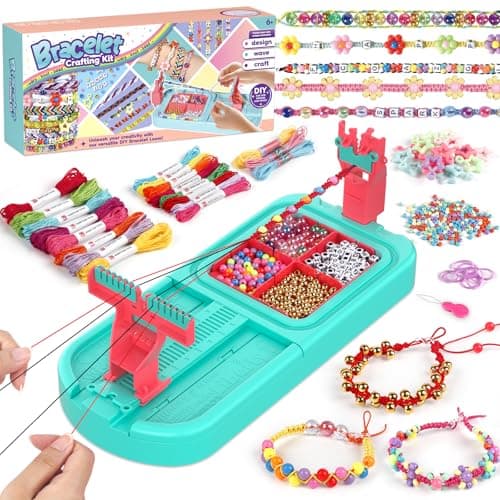
Published for 8 to 12, with a loom and enough thread for multiple bracelets. It earns a place because of something none of the others do: the output is wearable and giveable, which turns a craft into a social activity, and at this age that is most of the motivation. A loom also removes the hardest part of bracelet-making — holding the tension — which is where children usually quit. It will run out, and the honest note is that replacement thread is a separate purchase nobody warns you about.
Age grade:
8–12
Batteries:
manufacturer does not publish a battery requirement
Noise:
Silent
Mess:
Contained
Assembly:
manufacturer does not publish an assembly time
Price:
$8.49 as of October 11, 2026
Age grade, battery and assembly wording are quoted from Cmiolacuna’s own product listing, read on September 7, 2026. The manufacturer’s exact words: “Ages 8-12”. Noise and mess are our reading, not a measurement — we have not played with this.
What it gets right
+The loom makes a decent bracelet achievable on the first attempt, which is what keeps a child going
+Published 8 to 12 grade, aimed squarely at the age where making things for friends is the point
+Consumable in a good way — a full kit is many evenings
What it doesn’t
−Thread runs out and refills are not always the same quality
−Loose beads and thread ends get everywhere in a shared bedroom
How loud
Nothing.
How much mess
Thread offcuts and small beads. Annoying rather than destructive, and all of it is on the table.
Skip this if…
…the child gives up when something needs twenty minutes of repetition. Bracelet weaving is rhythmic and slow, and that is either the appeal or the dealbreaker.
Best for a child who wants a result on the first attempt
Framed Paint by Number Set, 4 Pack
CarlonLin
Graded 8 to 12, four framed 8x8 canvases with numbered acrylics. This is the most finishable thing on this page and that is the point: it is the right gift for a child who has started four craft projects and completed none, because the outcome is guaranteed and it looks like a real painting at the end. It is also, by design, the least creative item here — the picture is decided. Buy it for the child who needs a win, not for the one who wants to invent something. Four canvases is four afternoons and then it is done.
Age grade:
8–12
Batteries:
manufacturer does not publish a battery requirement
Noise:
Silent
Mess:
Contained
Assembly:
manufacturer does not publish an assembly time
Price:
$15.99 as of October 11, 2026
Age grade, battery and assembly wording are quoted from CarlonLin’s own product listing, read on September 7, 2026. The manufacturer’s exact words: “Ages 8-12”. Noise and mess are our reading, not a measurement — we have not played with this.
What it gets right
+Framed, so the finished piece has somewhere to go — and that is what makes a child do the next one
+Four canvases means the gift is not over in an afternoon
+Published 8 to 12 grade matches the patience the numbered sections actually demand
What it doesn’t
−Acrylic does not wash out of clothes; an apron or old shirt is required
−The numbered areas are small, and a child at the younger end will find them fiddly
How loud
Nothing.
How much mess
Acrylic paint in small pots. It is permanent on clothing, which is the one thing to say out loud before starting.
Skip this if…
…the child wants to invent rather than follow. Paint by numbers is a completion activity — a genuinely creative child may find it faintly insulting.
Every toy site tells you they tested forty toys with a focus group of real children. We have not played with any of these, and we say so. Here is what we do instead: we read the manufacturer’s own listing and print its published age grade word for word, we record the battery requirement and the assembly note where the maker publishes one and say plainly when it does not, we pull the price live from Amazon so it is never a number we remembered, and we name one thing on every list we would not buy.
The noise and mess ratings are our judgment from what the listing describes — not measurements. Almost no toy manufacturer publishes a decibel figure, which is itself worth knowing. The full method is published, including what disqualifies a toy.
Questions
Questions people actually ask
What is the best craft kit for a 5-year-old?+
Water-set beads (graded 4+) or air-dry modelling compound (graded 4+). Both let a child produce a finished object without an adult doing the critical step, which is the thing that matters most at five. Fuse beads are graded 6+ and need an iron, so they come later.
What is the difference between a craft kit and an art set?+
A kit contains a specific project and a finish line; a set contains materials and has no end state. Buy the kit for a child who wants to have made something and does not know what to draw. Buy the set for a child who already draws unprompted.
Which craft kits need an adult?+
Anything that fuses with heat. Perler-style beads need an iron at the final step every time, and that step is where projects stall for weeks. Water-set beads, air-dry compound, bracelet looms and paint-by-number canvases all finish without an adult.
What craft kit works for a birthday party?+
One that is identical per child, finishes inside an hour, and needs no iron or drying day. A bracelet loom per child, or a framed paint-by-number canvas each, both work. Fuse beads are the worst group choice in the house for exactly the opposite reasons.
We do not run a playroom test lab and we do not pretend to. Age grades, battery requirements and assembly notes are quoted from each manufacturer’s own product listing, read on September 7, 2026; prices come live from Amazon’s API and are stamped with the date they were checked. Where a maker publishes nothing, the page says “manufacturer does not publish this” rather than guessing. Read the full method.