Guides · Guides
Non-toxic toys, and what that word is worth
Every toy legally sold for a child in the United States already has to clear a set of rules on lead, heavy metals and small parts. Knowing which rules those are is worth more than any phrase printed on a box.
We earn a commission if you buy through our links. It does not change the price you pay and it does not decide our picks — our method is published in full, including the part where we say we have not played with these toys. How this works.
The short version
“Non-toxic” on the front of a toy box certifies nothing. No regulator or standards body issues that phrase and nobody audits it. What does exist is a stack of federal rules that every toy sold for a child in the United States has to clear already -- on lead in paint, lead in the material itself, soluble heavy metals, small parts, magnets and more. The useful move is not to hunt for a reassuring adjective; it is to know which rules apply and what the listing says about the three things they do not cover.
The rules that already apply
The CPSC’s own toy safety guidance for businesses, linked in our sources, is the clearest public summary of this and it is worth half an hour if you buy toys often. The short form:
| What it covers | The rule | What it means on a shelf |
|---|---|---|
| Toys generally | ASTM F963, made mandatory and codified at 16 CFR part 1250 | The core toy safety standard, mandatory rather than voluntary. Toys manufactured after April 20, 2024 must meet the 2023 version. |
| Lead in paint and surface coatings | 16 CFR part 1303 | Prohibits excessive lead in paint and similar coatings on a children’s product. |
| Lead in the material itself | 15 U.S.C. 1278a | Prohibits excessive lead in accessible substrates -- the plastic or wood, not just the paint. |
| Other heavy metals | Solubility limits under the toy standard | Antimony, arsenic, barium, cadmium, chromium, mercury and selenium all carry limits; small metallic components have a lower cadmium limit. |
| Small parts | 16 CFR part 1501 | The rule behind “not for children under 3”. |
| Teethers and rattles | 16 CFR part 1510 | Their own rule, because they are designed to go in a mouth. |
| Magnets | 16 CFR part 1262 | A loose magnet small enough to swallow must fall under a specified flux index -- which is why we never recommend magnet ball sets. |
One scope note worth knowing, because it catches people out: a toy intended for ages 13 and over may fall under the toy standard but does not require third-party testing or a children’s product certificate. That is one more reason the age grade on a box is the most load-bearing number on it -- toy safety standards, explained goes further into how the testing regime works.
So what is the word actually hiding?
Three things, none of which “non-toxic” tells you.
1. Whether the product is in the regime at all
The rules apply to products designed or intended primarily for children. A novelty sold as a desk gadget, an adult collectible, or an item marketed to teenagers sits in a different place, and this is where genuine problems show up -- not in the mainstream toy aisle. If a thing is intended for a child, buy the version sold as a children’s product.
2. Recalls
A toy can meet every rule at manufacture and still be recalled later. That is a live database, not a label, and checking it takes two minutes: how to check whether a toy has been recalled. For anything secondhand it is the single most useful check there is, which is why buying toys secondhand leads with it -- and older painted toys predate the current paint rule entirely.
3. Art materials, which play by other rules
Crayons, paints, markers and clays are governed by a chronic-hazard labeling standard and certified by a seal, not by the toy rules above. That distinction matters because the marks on an art box genuinely do mean something specific -- including one that is a warning most parents read as a reassurance. We have that in full on non-toxic art supplies: what the labels actually certify.
Wood, and the question people actually ask
“What wood is safe for children’s toys” is a common search and the honest answer is that the species is rarely the issue -- the surface is. A wooden toy is a piece of wood with something on it: paint, stain, lacquer, wax or nothing. Paint and surface coatings on a children’s product are covered by their own federal rule, so a compliant painted toy is a solved problem; an uncoated or oiled toy removes the question instead of answering it.
What is worth looking for on a wooden-toy listing, in order: a published age grade, a named standard rather than a vague claim, whether the finish is stated at all, and whether the thing is one solid piece or a glued assembly that a toddler can prise apart into small parts. If you are choosing between wood and plastic on principle rather than on safety, that argument is on wooden vs plastic toys, and the baby-and-toddler shortlist is on wooden toys for babies and toddlers.
The four things we check on a listing
- Is there a published age grade? If the maker does not publish one, we do not rank the toy at all. It is the only number on the box with a regulation behind it.
- Does the listing name a standard? “Meets ASTM F963” is a claim you can check. “Non-toxic materials” is not.
- Is the battery compartment screwed shut? Button cells are the one genuine chemical hazard in a modern toy box, and the fix is mechanical -- the battery reality check.
- Has it been recalled? Two minutes in the CPSC database, every time, for anything secondhand or inherited.
What we would do for a baby specifically
For a mouthing baby, the short list is washable fabric, one solid wooden piece with a stated finish, and nothing with a coin cell in it. That is less a chemistry decision than a practical one: fabric washes, solid wood has nothing to come apart, and the choking rule -- not toxicity -- is the hazard that actually sends children to hospital. The small-parts rule is explained on what “not for children under 3” actually means, and the age-by-age version starts at toys for a 6-month-old.
The toys
The toys this guide is about
Every one of these carries its manufacturer’s published age grade and a live Amazon price, read October 17, 2026. Full rankings live in the roundups linked above.
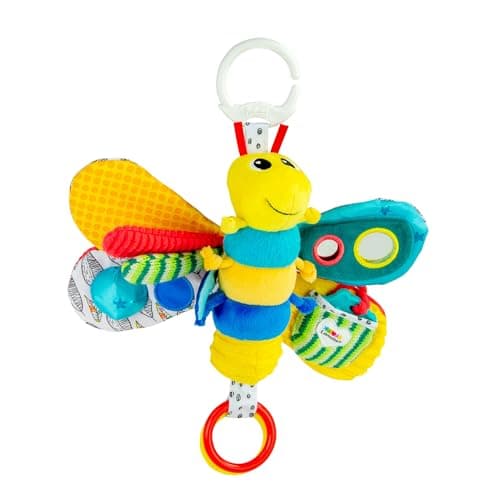
Fabric, from newborn
Lamaze Freddie the Firefly Clip-On Toy
Age grade 0 months+
Lamaze publishes this one from 0 months. For a baby who mouths everything, washable fabric sidesteps the question people are really asking when they search for non-toxic -- there is no painted surface and no coating to come off. Crinkle fabric is the only sound. If the baby is not in a car seat or stroller much, take the clip away and it is a fabric toy with a mirror, and cheaper ones exist.
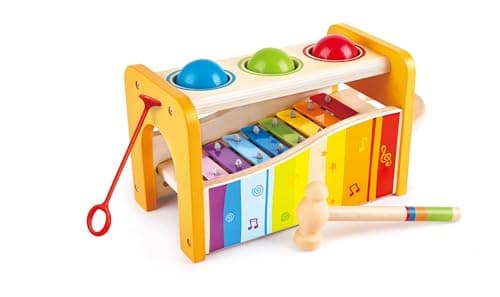
Painted wood, done properly
Hape Pound & Tap Bench with Xylophone
Age grade 12 months–3 years
Published for 12 months to 3 years. Hape is a useful example for this page because the surface is the whole question with wooden toys: paint and coatings on a children's product are covered by their own federal rule, which is why the finish matters more than the species of wood. The honest cost here is noise -- a xylophone hit by a one-year-old has no volume control, and in an apartment with neighbours below that is the deciding factor.
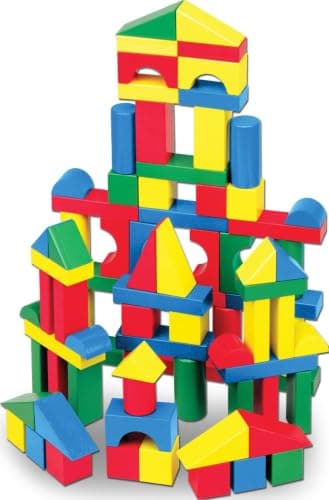
The unfinished-wood answer
Melissa & Doug Wooden Building Blocks, 100 Pieces
Age grade 2+
Graded 2+, a hundred pieces. Plain blocks are what most people have in mind when they search for non-toxic toys, and they are a reasonable instinct: no electronics, no battery compartment, no coating to wear through. Wood on a hard floor is genuinely loud and a tower coming down is the loudest thing in the house -- a rug fixes it. Blocks are also a slow burn, so a child expecting a big shiny thing will visibly deflate.
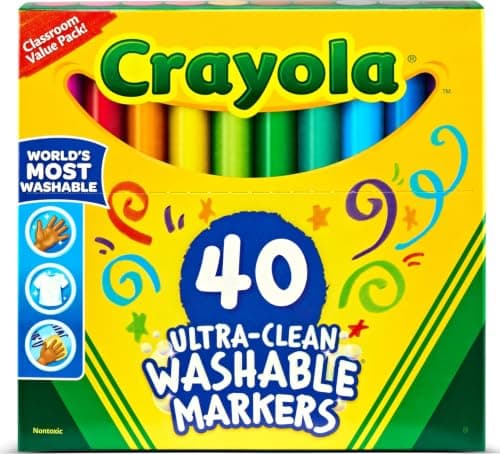
Where the OTHER rulebook applies
Crayola Ultra Clean Washable Markers, 40 Count
Age grade 3+
Graded 3+, forty markers. Art materials are governed separately from toys -- a chronic-exposure labeling standard and a certification seal, not the toy rules -- which is why they belong on this page as a contrast rather than a pick. The grade is 3+ and marker caps are a classic small part, so this is not a toy for a mouthing baby however washable the ink is.
#ad · As an Amazon Associate we earn from qualifying purchases. How this works.
Questions
Questions people actually ask
Does “non-toxic” on a toy box mean anything?
What are non-toxic toys for a baby?
What wood is safe for children's toys?
Are plastic toys toxic?
Why do you not recommend magnetic ball sets?
Are art supplies covered by the toy rules?
Keep reading
Related
- Toy safety standards, explainedWhat the testing regime behind the rules on this page actually involves.
- Non-toxic art suppliesThe other rulebook: chronic-hazard labeling and the two seals worth learning.
- What “not for children under 3” meansThe hazard that matters more than chemistry for anybody under three.
- Wooden toys for babies and toddlersThe shortlist, if the answer to this page is “wood”.
- How to check whether a toy has been recalledThe check no label can do for you, in two minutes.
Receipts
Sources
- 16 CFR Part 1501 — the federal small-parts regulation behind the “not for children under 3” warning (eCFR)
- ASTM F963 — Standard Consumer Safety Specification for Toy Safety
- US Consumer Product Safety Commission — Toy Safety business guidance
- US Consumer Product Safety Commission — recall database
- CPSC — Small Parts regulations for toys and children's products
We do not run a playroom test lab and we do not pretend to. Age grades, battery requirements and assembly notes are quoted from each manufacturer’s own product listing, read on September 7, 2026; prices come live from Amazon’s API and are stamped with the date they were checked. Where a maker publishes nothing, the page says “manufacturer does not publish this” rather than guessing. Read the full method.