Skip to content
Windup & Wonder

Guides · Guides

Best games for family game night

The test for a family game is not whether the children enjoy it. It is whether the adults would play it again without being asked, because that is what decides whether there is a second game night.

By Stephen V.Updated How we pick
#ad

We earn a commission if you buy through our links. It does not change the price you pay and it does not decide our picks — our method is published in full, including the part where we say we have not played with these toys. How this works.

Top pick

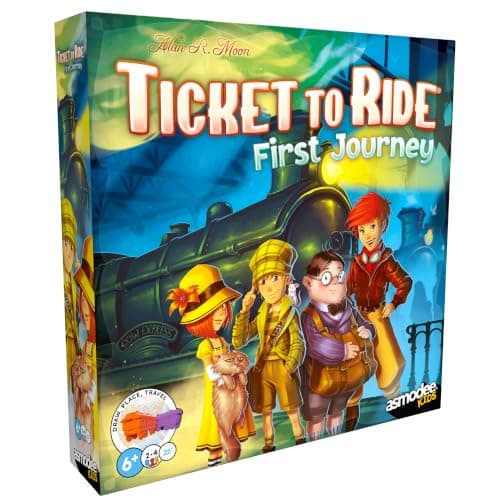
Asmodee Ticket to Ride: First Journey

Ticket to Ride: First Journey

Best overall for a mixed table, and the one adults play willingly · Asmodee grades it 6+.

Budget pick

UNO Card Game

Budget pick — the cheapest thing here that genuinely works with the whole family · Mattel Games grades it 7+.

#ad · we may earn a commission · prices come live from Amazon and were last checked November 9, 2026. Where we have no verified live price we show none.

The short answer

The picks, at a glance

#ToyBest forAge gradeNoisePrice
01Best overall for a mixed table, and the one adults play willingly6+Quiet$29.99Amazon
02Best for a child ready for a longer game, and the clearest trading game here6+Quiet$37.99Amazon
03Best for a table with a six-year-old and nobody who wants to lose6+Quiet$24.00Amazon
04Best for four players exactly, and the only one with no luck in it at all7+Quiet$17.46Amazon
05Best short game for an older table, and the one a ten-year-old suggests7+Some noise$19.82Amazon
06
Hasbro Gaming Jenga Classic
Jenga Classic

Hasbro Gaming

Best for a table with a very wide age gap, and the one with no rules to explain6+Loud$14.97Amazon
07
Mattel Games UNO Card Game
UNO Card Game

Mattel Games

Budget pick — the cheapest thing here that genuinely works with the whole family7+Some noise$11.55Amazon

#ad · Prices come live from Amazon’s API and were last checked November 9, 2026. Where we have no verified live price we show none — we would rather leave a gap than print a number that has gone stale. Age grades are the manufacturer’s own; noise is our reading, not a measurement.

The verdict: the top pick is Ticket to Ride First Journey, and it is for a family with a child between about six and nine who want a real game rather than a children’s one — route-building with a decision every turn, finished in half an hour, and adults play it without being asked twice. The budget pick is UNO, the cheapest game in our registry that takes more than four players: everybody knows it, a newcomer learns it in a minute, and ten people can sit down to it.

Every age grade is the publisher’s own published wording, and the prices come live from the price layer with the date printed beneath the table above. Our method is published in full, including the part where we say we have not run these at a test table.

The four questions, in the order that actually matters

1. How many people are at the table, every time?

Not the maximum — the usual number. This eliminates more games than anything else and it is almost never the first thing anybody checks. Ticket to Ride First Journey, Outfoxed! and CATAN Junior cap at four. Blokus wants exactly four and sags at three. Exploding Kittens takes five, UNO takes ten, and Spot It! takes eight. A family of five who buys a four-player game has bought a game that cannot be played on a normal evening.

2. What is the age of the youngest player?

The youngest person sets the game, not the average. A table with a five-year-old is a different purchase from one with an eight-year-old, and splitting the difference produces a game that is simultaneously too hard and too dull. If the gap is very wide, the honest answer is often a game with no strategy at all — Jenga rather than a compromise.

3. Does somebody have to lose?

This is the question that decides whether there is a second game night. A competitive game with a sensitive six-year-old at seven in the evening can end the whole idea. Outfoxed! is the structural fix: the table plays against the board, everybody still has to think, and nobody loses to anybody.

4. Will the adults play it again?

The hidden variable. A game the adults are enduring quietly disappears in the next cupboard reshuffle, and nobody admits why. Blokus, Ticket to Ride and Exploding Kittens are on this page specifically because adults ask for them.

Round length is the real constraint on a school night

Box times are written for adults who already know the rules. With a seven-year-old at the table, add roughly half again for the first few plays, plus five minutes of setup and ten minutes of negotiation about who goes first.

In practice that means a thirty-minute game is an hour on a Tuesday. The games on this page run from about five minutes to about thirty-five for exactly that reason, and the shorter ones are not lesser choices — a fifteen-minute game played three times in a row beats a ninety-minute game abandoned at the halfway point, every time.

Building an evening rather than buying one game

The households where game night survives tend to own three things rather than one good thing:

  • A filler — five to ten minutes, no setup, no rules explanation. Jenga or Spot It!. This is what gets played while somebody finishes the washing up, and it is what starts the evening.
  • A main game — twenty to thirty-five minutes, real decisions. Ticket to Ride, CATAN Junior, Outfoxed!.
  • A reset — something fast and funny for when the main game went badly. UNO or Exploding Kittens.

That is roughly the structure of a good evening, and it is also why a single purchase often disappoints: one game has to be all three, and no game is.

Why we have not ranked any adult game with a children’s edition

There is a category of game sold as family-friendly which is really an adult game with the interesting decisions removed. They are easy to spot — the box shows a family, the rules show a three-page reference sheet — and they tend to produce an evening in which the adults play a game while the children move pieces.

The games on this page go the other way: they are designed for the younger player and carry enough real decision-making that an adult is playing rather than supervising. CATAN Junior is the clearest example, because it is a genuine simplification rather than a rebranding. The wider argument about when a game is the better present than a toy is on toys vs games, and the per-year version is on board games by age.

What we would skip

Trivia games with a family edition. The adult questions are too hard and the children’s questions are too easy, so nobody is playing the same game.

Anything that takes over an hour. It will be finished once, in the holidays, and then it will be a box.

Games requiring an app. The point of the evening was the table. More on the general pattern is on the skip list.
In detail

Every pick, in full

01
Asmodee Ticket to Ride: First Journey

Best overall for a mixed table, and the one adults play willingly

Ticket to Ride: First Journey

Asmodee

Asmodee publishes Ticket to Ride First Journey for ages 6+. It is the top pick because it is a real game that happens to be playable by a six-year-old, rather than a children's game adults are enduring. Players collect coloured train cards and claim routes between cities to complete tickets, and every turn presents an actual decision — take the card you need or the one you can see somebody else wants. It finishes in about half an hour, which is the right length for a school night, and the map does the teaching: children learn where places are without anybody mentioning geography. Honest limits: it is the most expensive thing on this page and sits above a $25 budget; and it caps at four players, so a family of five needs something else.

Age grade:
6+
Batteries:
manufacturer does not publish a battery requirement
Noise:
Quiet
Mess:
Contained
Assembly:
manufacturer does not publish an assembly time
Price:
$29.99 as of November 9, 2026

Age grade, battery and assembly wording are quoted from Asmodee’s own product listing, read on September 7, 2026. The manufacturer’s exact words: “ages 6+”. Noise and mess are our reading, not a measurement — we have not played with this.

What it gets right

  • A genuine gateway game — a child who likes this will play the adult version at nine
  • Chunky pieces and a simplified map make the published 6+ grade honest
  • Adults do not have to endure it, which is the real test of a family game

What it doesn’t

  • Small train pieces at floor level; a full set is required to play
  • Shorter and simpler than the full game, so it is outgrown within a couple of years

How loud

Plastic trains on a board. Nothing electronic.

How much mess

Small plastic trains. There are a lot of them and they are the pieces that go missing.

Skip this if…

…the family already owns full Ticket to Ride. First Journey is a stepping stone, and owning both is redundant.

$29.99See it on Amazon

Price checked November 9, 2026. Toy prices move constantly, especially in December — Amazon’s price at checkout is the one that counts.

#ad · we may earn a commission from this link to Ticket to Ride: First Journey

02
CATAN CATAN Junior

Best for a child ready for a longer game, and the clearest trading game here

CATAN Junior

CATAN

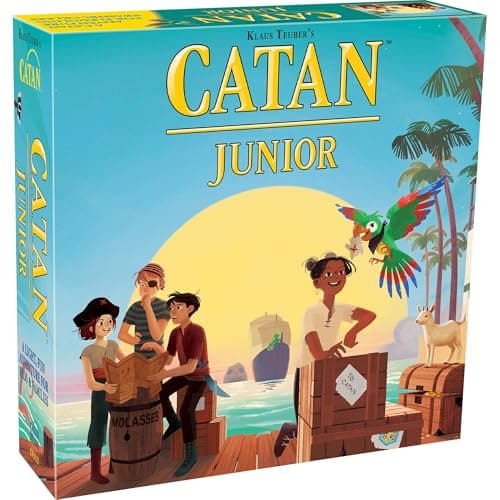
CATAN Studio publishes CATAN Junior for ages 6+, 2 to 4 players, around thirty minutes. It is here because trading is the family-game mechanic that produces conversation: a child who has to persuade an adult to swap a resource is negotiating, and negotiating with a seven-year-old is genuinely entertaining in a way that rolling dice is not. The pirate theme carries it, and the rules are a real simplification of the adult game rather than a different game wearing its name. Honest limits: half an hour is optimistic with a six-year-old at the table for the first few plays; and the resource-collection phase is dice-driven, so a run of bad rolls can leave a child doing very little for several turns, which is the moment the evening wobbles.

Age grade:
6+
Batteries:
manufacturer does not publish a battery requirement
Noise:
Quiet
Mess:
Contained
Assembly:
manufacturer does not publish an assembly time
Price:
$37.99 as of November 9, 2026

Age grade, battery and assembly wording are quoted from CATAN’s own product listing, read on September 7, 2026. The manufacturer’s exact words: “Ages 6+”. Noise and mess are our reading, not a measurement — we have not played with this.

What it gets right

  • Real resource management at six, which is genuinely unusual
  • Thirty-minute published playtime, so it fits an evening rather than consuming one
  • The pirate theme carries children who would bounce off the original's settlements

What it doesn’t

  • Setup takes longer than a six-year-old's patience allows without help
  • Two-player games are notably weaker than three or four

How loud

Dice and cardboard.

How much mess

Many small wooden and cardboard pieces, all with a place in the insert.

Skip this if…

…you only ever have two players. Catan Junior needs a table of three or four to work, and as a two-player game it is thin.

$37.99See it on Amazon

Price checked November 9, 2026. Toy prices move constantly, especially in December — Amazon’s price at checkout is the one that counts.

#ad · we may earn a commission from this link to CATAN Junior

03
Gamewright Outfoxed! Cooperative Whodunit Game

Best for a table with a six-year-old and nobody who wants to lose

Outfoxed! Cooperative Whodunit Game

Gamewright

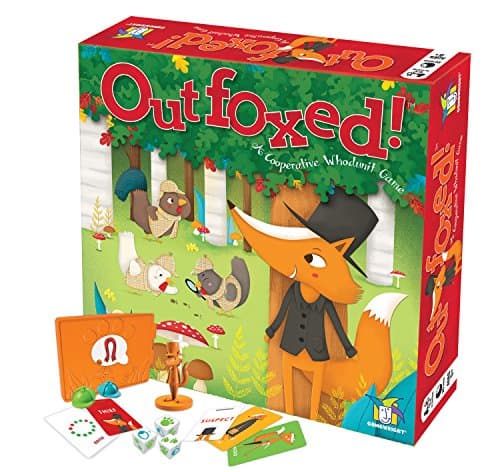
Gamewright publishes Outfoxed! for ages 6 and up, up to four players. It is the cooperative pick, and on a mixed-age table that structure is worth more than depth: everybody plays against the board, so the six-year-old is not losing to the ten-year-old and the evening does not end in a sulk. Underneath the cooperation it is a real deduction game — gather clues, eliminate suspects, decide whether you have enough to accuse — and adults do have to think. It is the game we would buy first for a household where competitive games have gone badly. Honest limits: the plastic decoder does the elimination step for you, which an older child will spot as doing half the work; and by about nine the deduction is no longer a challenge.

Age grade:
6+
Batteries:
manufacturer does not publish a battery requirement
Noise:
Quiet
Mess:
Contained
Assembly:
manufacturer does not publish an assembly time
Price:
$24.00 as of November 9, 2026

Age grade, battery and assembly wording are quoted from Gamewright’s own product listing, read on September 7, 2026. The manufacturer’s exact words: “ages 6 and up”. Noise and mess are our reading, not a measurement — we have not played with this.

What it gets right

  • Cooperative structure means nobody is knocked out and nobody sulks
  • Real deduction — the child is genuinely reasoning, not just moving a counter
  • Published 6+ grade is accurate, and adults do not have to pretend to enjoy it

What it doesn’t

  • Games run twenty minutes and the difficulty does not scale much once the mechanic is understood
  • Losing the plastic decoder ends the game permanently

How loud

Dice and discussion. Nothing electronic.

How much mess

Cardboard tiles and a decoder. The decoder is the one piece you cannot play without.

Skip this if…

…the family wants competition. Outfoxed is deliberately non-competitive, and a household that enjoys beating each other will find it flat.

$24.00See it on Amazon

Price checked November 9, 2026. Toy prices move constantly, especially in December — Amazon’s price at checkout is the one that counts.

#ad · we may earn a commission from this link to Outfoxed! Cooperative Whodunit Game

04
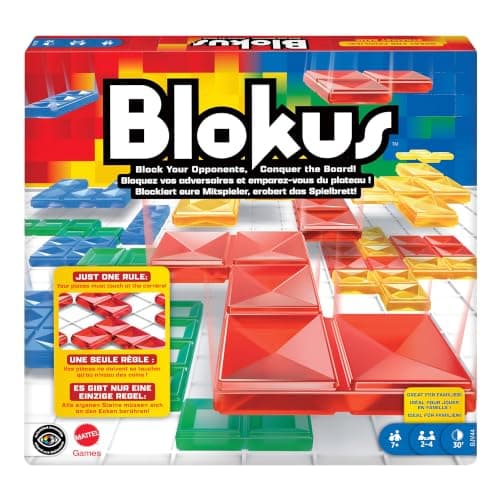
Mattel Games Blokus Strategy Board Game

Best for four players exactly, and the only one with no luck in it at all

Blokus Strategy Board Game

Mattel Games

Mattel publishes Blokus for 7 years and older, with colour-blind accessible pieces. One rule — your pieces may only touch your own colour at the corners — and from it a tense, entirely skill-based game with no text on any component, which means it works across a language barrier and across a wide age gap at the same table. It is also fast: ten to twenty minutes, so a family can play three. Honest limits, and they are the sharpest on this page. With no luck at all, an adult playing properly beats a seven-year-old every single time, and deciding how much to hold back is a judgment you have to make rather than one the game makes for you; and it really wants four players, because a three-player game leaves a quadrant uncontested.

Age grade:
7+
Batteries:
manufacturer does not publish a battery requirement
Noise:
Quiet
Mess:
Contained
Assembly:
manufacturer does not publish an assembly time
Price:
$17.46 as of November 9, 2026

Age grade, battery and assembly wording are quoted from Mattel Games’s own product listing, read on September 7, 2026. The manufacturer’s exact words: “7 years and older”. Noise and mess are our reading, not a measurement — we have not played with this.

What it gets right

  • No reading and no luck, so a child competes on genuine ability rather than dice
  • Games run under half an hour and the board looks different every time
  • Four players, which is unusually well suited to a family of four

What it doesn’t

  • Small tiles, and a complete set matters — this is not a game you can play with pieces missing
  • Two-player games use a house rule and are much less interesting

How loud

Plastic tiles on a plastic board.

How much mess

Eighty-four small tiles across four colors. Losing one is noticeable; losing four ruins it.

Skip this if…

…you need a game for two. Blokus is designed around four colors and the two-player variant is a shadow of it.

$17.46See it on Amazon

$19.9913% off

Price checked November 9, 2026. Toy prices move constantly, especially in December — Amazon’s price at checkout is the one that counts.

#ad · we may earn a commission from this link to Blokus Strategy Board Game

05
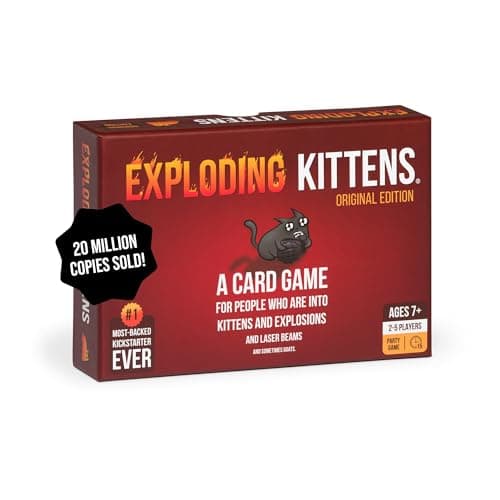
Exploding Kittens Exploding Kittens Original Edition

Best short game for an older table, and the one a ten-year-old suggests

Exploding Kittens Original Edition

Exploding Kittens

Exploding Kittens publishes this original edition for ages 7+, 2 to 5 players, around fifteen minutes. It earns a spot because of a social fact rather than a mechanical one: somewhere around nine or ten, children stop proposing family games and start finding them babyish, and this is the game they propose instead. Push your luck, a genuine decision each turn, and humour that is actually funny. It takes five players, which several things on this page do not. Honest limits: it eliminates players, so somebody knocked out in round two watches the rest; and the artwork is mildly rude in a way some households will want to look at before game night rather than during it.

Age grade:
7+
Batteries:
manufacturer does not publish a battery requirement
Noise:
Some noise
Mess:
No mess
Assembly:
manufacturer does not publish an assembly time
Price:
$19.82 as of November 9, 2026

Age grade, battery and assembly wording are quoted from Exploding Kittens’s own product listing, read on September 7, 2026. The manufacturer’s exact words: “Ages 7+”. Noise and mess are our reading, not a measurement — we have not played with this.

What it gets right

  • Fast — a full game is under fifteen minutes, which suits a short attention span
  • The artwork does the heavy lifting with children who think board games are for younger kids
  • Published 7+ grade and the rules are genuinely simple

What it doesn’t

  • Player elimination: the first person out sits and watches, and at seven that is a long wait
  • Humour is deliberately gross and not every household wants it

How loud

Cards, plus shouting. No electronics.

How much mess

A deck in a box.

Skip this if…

…you want a game nobody gets knocked out of. Elimination is the core mechanic and there is no variant that fixes it.

$19.82See it on Amazon

Price checked November 9, 2026. Toy prices move constantly, especially in December — Amazon’s price at checkout is the one that counts.

#ad · we may earn a commission from this link to Exploding Kittens Original Edition

06
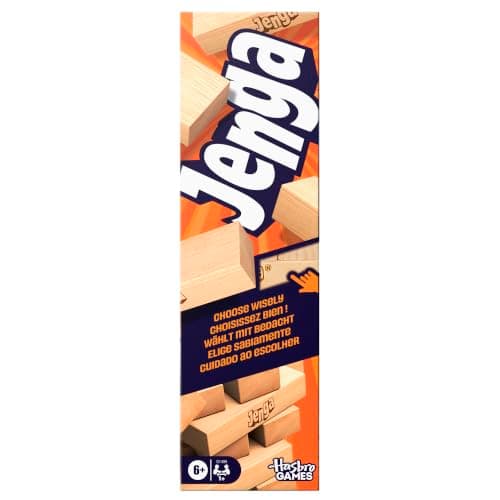
Hasbro Gaming Jenga Classic

Best for a table with a very wide age gap, and the one with no rules to explain

Jenga Classic

Hasbro Gaming

Hasbro publishes Jenga for ages 6+, one player and up, 54 hardwood blocks. It is on the list for the hardest case: a four-year-old, a twelve-year-old and two adults, all at one table, none of whom will sit through a rules explanation. Jenga needs none — pull a block, put it on top, do not knock it over — and it is genuinely tense for everyone present regardless of age. There is no strategy to be outmatched at, which is exactly why it works across the gap. Honest limits: it is loud, which matters if a baby is asleep; and it is over in a few minutes, so it is a filler between other games rather than the evening itself.

Age grade:
6+
Batteries:
manufacturer does not publish a battery requirement
Noise:
Loud
Mess:
Contained
Assembly:
manufacturer does not publish an assembly time
Price:
$14.97 as of November 9, 2026

Age grade, battery and assembly wording are quoted from Hasbro Gaming’s own product listing, read on September 7, 2026. The manufacturer’s exact words: “Ages 6+”. Noise and mess are our reading, not a measurement — we have not played with this.

What it gets right

  • Works for any number of players, any age from six upward, in any language
  • Solid hardwood blocks that survive being dropped several thousand times
  • No setup beyond stacking, which takes a minute

What it doesn’t

  • The collapse is loud, and in an apartment at 8pm that matters
  • Blocks warp with humidity and a warped set plays badly

How loud

Fifty-four hardwood blocks hitting a table at once. That is the game's punchline and it is genuinely loud. No published sound level — nobody publishes one for a box of wood.

How much mess

Blocks on a floor after every round. They do not go anywhere, they just need picking up.

Skip this if…

…the game is going in a shared building or a room next to a sleeping baby. The crash is not optional.

$14.97See it on Amazon

Price checked November 9, 2026. Toy prices move constantly, especially in December — Amazon’s price at checkout is the one that counts.

#ad · we may earn a commission from this link to Jenga Classic

07
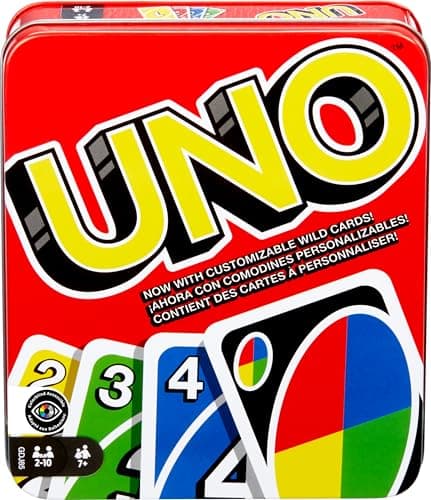
Mattel Games UNO Card Game

Budget pick — the cheapest thing here that genuinely works with the whole family

UNO Card Game

Mattel Games

Mattel publishes UNO for ages 7 years and older, two to ten players, with the current edition made colour-blind accessible. It is the budget pick on a specific test: the cheapest game in our registry that takes more than four players. Connect 4 costs less and is two players only, which is no use on a family night. Everybody already knows UNO, a newcomer learns it in a minute, and ten people can play, which no board game on this page manages. Honest limits: it is mostly luck, so a child looking to be good at something will not find it here; and every household plays different house rules, which is why the current box ships with blank cards — settle them before the first hand, not during it.

Age grade:
7+
Batteries:
manufacturer does not publish a battery requirement
Noise:
Some noise
Mess:
No mess
Assembly:
manufacturer does not publish an assembly time
Price:
$11.55 as of November 9, 2026

Age grade, battery and assembly wording are quoted from Mattel Games’s own product listing, read on September 7, 2026. The manufacturer’s exact words: “ages 7 years and older”. Noise and mess are our reading, not a measurement — we have not played with this.

What it gets right

  • Two to ten players, which no other game here matches
  • Everybody already knows the rules, so it needs no teaching at a family gathering
  • Costs less than a takeaway coffee and lasts years

What it doesn’t

  • Draw-four cards produce genuine family arguments and always have
  • Paper cards wear fast in young hands

How loud

Cards are silent. The 'UNO' shouting is not, and it is a required part of the rules.

How much mess

One deck of cards.

Skip this if…

…there is a child who cannot yet take being targeted. UNO is a game about attacking whoever is winning, and at seven that is not always fun.

$11.55See it on Amazon

Price checked November 9, 2026. Toy prices move constantly, especially in December — Amazon’s price at checkout is the one that counts.

#ad · we may earn a commission from this link to UNO Card Game

The toys

The toys this guide is about

Every one of these carries its manufacturer’s published age grade and a live Amazon price, read November 9, 2026. Full rankings live in the roundups linked above.

  • Asmodee Spot It! Classic Card Game

    For the ten minutes before dinner

    Spot It! Classic Card Game

    Age grade 6+

    Asmodee publishes Spot It! for ages 6+, two to eight players, in a tin that fits a pocket. It takes eight players, which almost nothing else does, and it needs no table. The best filler game we know of at any price.

  • Hasbro Gaming Connect 4 (2025 Edition)

    When it is one adult and one child

    Connect 4 (2025 Edition)

    Age grade 6+

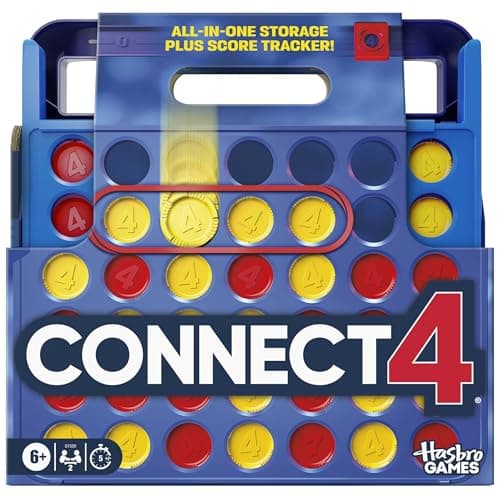
    Hasbro publishes Connect 4 for ages 6+, two players. Three minutes a round and a genuine strategy underneath — the double-threat trap is a real idea, and watching a seven-year-old discover it is the best thing about owning it.

#ad · As an Amazon Associate we earn from qualifying purchases. How this works.

How we picked

Toys we claim to have played with: 0

Every toy site tells you they tested forty toys with a focus group of real children. We have not played with any of these, and we say so. Here is what we do instead: we read the manufacturer’s own listing and print its published age grade word for word, we record the battery requirement and the assembly note where the maker publishes one and say plainly when it does not, we pull the price live from Amazon so it is never a number we remembered, and we name one thing on every list we would not buy.

The noise and mess ratings are our judgment from what the listing describes — not measurements. Almost no toy manufacturer publishes a decibel figure, which is itself worth knowing. The full method is published, including what disqualifies a toy.

Questions

Questions people actually ask

What is the best family game night game with young kids?
Ticket to Ride First Journey for a table with a six to nine-year-old, because adults play it willingly and it finishes in about half an hour. If losing is the problem, Outfoxed! instead — the whole table plays against the board.
What game works with a big age gap between the kids?
Something with no strategy to be outmatched at. Jenga is the honest answer for a table spanning four to twelve, and a cooperative game is the next best.
What family games take more than four players?
UNO takes ten, Spot It! takes eight and Exploding Kittens takes five. Most children’s board games cap at four, which is worth checking before you buy.
How long should a family game take?
Twenty to thirty-five minutes for the main game on a school night, and add half again for the first few plays with a young child. A short game played three times beats a long one abandoned halfway.

Keep reading

Receipts

Sources

We do not run a playroom test lab and we do not pretend to. Age grades, battery requirements and assembly notes are quoted from each manufacturer’s own product listing, read on September 7, 2026; prices come live from Amazon’s API and are stamped with the date they were checked. Where a maker publishes nothing, the page says “manufacturer does not publish this” rather than guessing. Read the full method.