The short answer
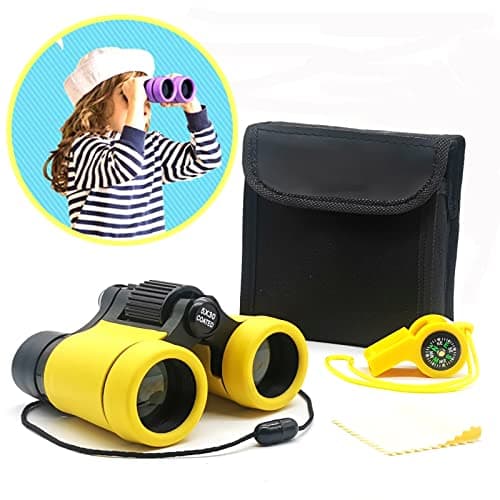
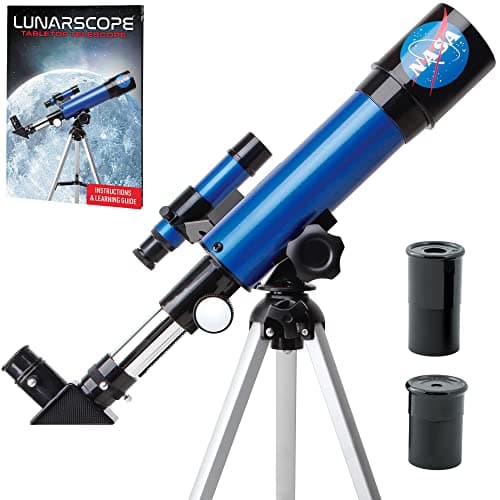
Under eight: buy binoculars. Not a compromise — the genuinely better optic for that age, and a fraction of the price. Eight or over, first telescope: buy the lunar scope with a finder scope included, because aiming is the whole problem and the Moon is the one target that always delivers. Eight or over, and you want the best view: buy the 80mm, as long as there is a table or wall outside to stand it on. Mixed ages in the house: buy the 70mm with the full-height tripod and the 5-to-12 grade. Not sure the interest is real: buy the 50mm and find out cheaply.
Every age grade on this page is the manufacturer’s own published wording, and this site never recommends a toy below the grade its maker set. We have not used these telescopes; our method is published in full.
Aperture, not magnification
This is the only specification lesson on the page and it decides every purchase in the category. Aperture is the diameter of the front lens or mirror — 50mm, 70mm, 80mm. It is how much light the telescope collects, and light is the only thing that becomes detail. Magnification is just the eyepiece you screw in, and you can fit an eyepiece that gives any number you like.
That is why “150x” and “100x” are printed on boxes in large type. They cost the manufacturer nothing. Past roughly twice the aperture in millimeters, extra magnification makes the image bigger and dimmer and blurrier at the same time — so on a 50mm tube, useful viewing finishes somewhere around 100x and the honest working range is well below it. Every scope on this page prints a top number its optics cannot support. We have said so on each one rather than quietly repeating the claim.
Practical consequence: compare the apertures, ignore the magnifications, and judge a telescope by its lowest-power eyepiece, because that is the one that will actually be used.
The second thing that decides it: can the child point it?
A telescope at 40x shows a patch of sky roughly the width of the Moon. Finding anything in a patch that small, by eye, through a tube, in the dark, is genuinely difficult — and it is where almost every abandoned kids telescope is abandoned.
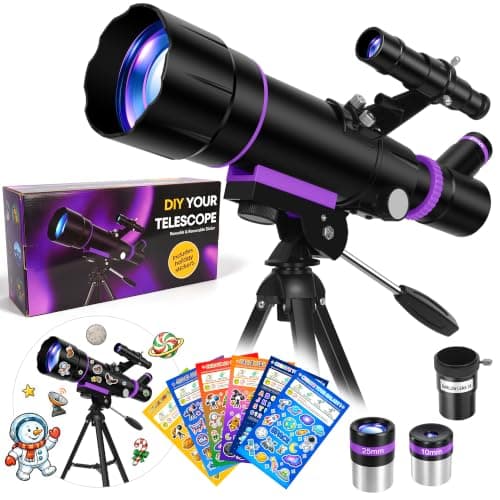
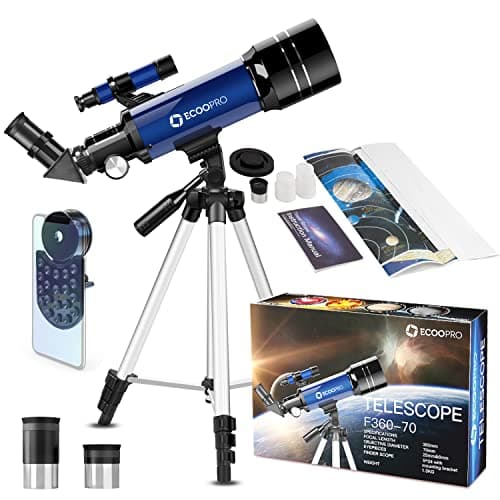
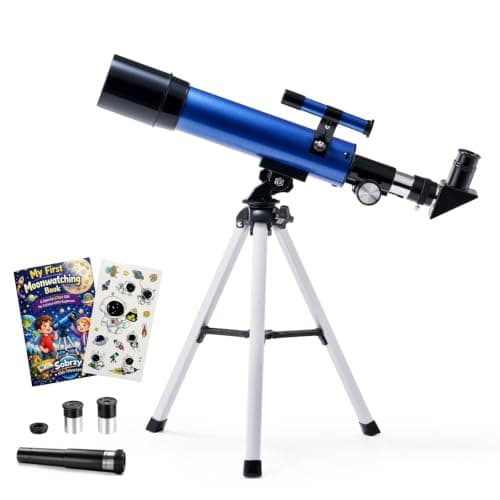
Two features address it, and both are worth more than optical quality at this level. A finder scope is a small low-power sight on top that shows a wide patch of sky with crosshairs, so the child aims with that and then looks through the main tube. Every telescope ranked above has one, which was a filter rather than a coincidence. And a steady mount: a tabletop base on a solid surface beats a lightweight full-height tripod almost every time, because at any real magnification a wobble is the whole image.
What a child will actually see, with no pictures from a space agency involved
The honest expectation-setting that this category badly needs. Through any telescope on this page, in a backyard, a child will see:
The Moon, genuinely spectacularly. Craters, mountain shadows along the terminator, mare edges. It is better than the photographs suggest, because it moves and it is real and they found it. This alone justifies the purchase.
Jupiter as a small bright disc with up to four dots beside it. Those dots are moons, they move between nights, and explaining that is a better evening than the view itself.
Saturn as a tiny oval, with the rings as a bulge rather than a gap. Still a genuine moment at 40x on a 70mm or 80mm tube.
Star clusters as more stars than the naked eye shows. The Pleiades is the reliable one.
No galaxies, no nebula colors, no rings with daylight between them. Those images are long-exposure photographs through large instruments. A child told in advance is delighted by the Moon; a child shown the box art is disappointed by everything.
The three telescopes we could not rank, and why
Worth saying plainly, because this page is a shorter list than the category deserves. In researching it we resolved three further live, in-stock, well-reviewed instruments with better optics than some of the picks above — a 70mm travel refractor from a well-known optics brand, a 50mm National Geographic refractor, and a tabletop Dobsonian from a telescope manufacturer that has been in business since 1960.
None of them is ranked here, for one reason: their makers publish no age grade anywhere in the listing. “Great for beginners” and “for kids beginners” are marketing copy, not grades. This site refuses to rank a toy whose maker will not state an age — the rule is enforced by the build, not by a writer remembering it — and on a telescope page that rule has a real cost, which is this paragraph. If you shop outside this list, that is the gap you are stepping into, and the thing to check yourself is the aperture and whether a finder scope is in the box.
What else you need, and what it costs
Nothing on this page needs batteries, which is unusual for the price bracket and worth knowing on Christmas morning — see toys that need no batteries for the rest of that shortlist. Nothing here makes a sound either, which makes a telescope one of the few genuinely silent gifts in this registry.
What it does need is an adult willing to stand outside in the cold. Astronomy at eight is a two-person hobby and it dies without the second person, which is the single most predictive thing about whether a telescope gets used. It also needs somewhere dark-ish, something to stand a tabletop scope on, and a star chart or an app on an adult’s phone. Those are free.
One safety line that matters more than any other on this page: never point any of these at the Sun, with or without the little solar filter some kits include. Permanent eye damage happens in under a second, and the finder scope is as dangerous as the main tube. If a child is interested in the Sun, that needs purpose-built equipment and an adult who knows how to use it.
Where this sits next to the rest of the science shelf
A telescope is the highest-risk science gift in this registry: the ceiling on what it can show is set by physics and the price, and the weather gets a vote. A microscope works on a wet Tuesday indoors, a chemistry set works at a kitchen table, and both have far lower abandonment rates. If you are buying for a child with a general science interest rather than a specific space obsession, the honest recommendation is often one of those — see kids science kits compared and STEM toys by age.
If the obsession is specifically space, buy the telescope, set the expectations, and plan the first night around the Moon rather than the planets.
Check the age grade first, then the aperture
Four of the five picks here are graded 8+ and the fifth is graded from 3. There is nothing between those for a six- or seven-year-old except the 5-to-12 refractor, which at the bottom of its range is an adult-operated instrument. We never recommend below a published grade — the reasoning is in age grades explained.
Insist on a finder scope
A telescope without one is close to unusable for a child, and it is the cheapest feature on the box. If a listing does not mention it, assume it is not there.
Decide where it will stand before you buy
Tabletop scopes have steadier mounts and worse logistics: they need a table, a wall or a car roof outside. A full-height tripod works on grass and wobbles more. This is a bigger practical difference than the optics between any two picks here.
Buy the lowest-power eyepiece you will actually use
The wide eyepiece is the one that finds things and the one that gives the good views. Treat the 3x Barlow lens as an occasional extra, not as the point of the purchase.
Set the expectations out loud, before it is unwrapped
“We will see the Moon properly and Jupiter’s moons as dots” produces a thrilled child. Box art produces a disappointed one. This costs nothing and it is the highest-leverage thing on this page.