Skip to content
Windup & Wonder

Head to head · Compare

Toys vs video games

Treat this as a spending decision rather than a moral one. A full-price console game and a serious toy cost about the same, and the honest differences between them are who else gets to join in, what happens when the novelty dies, and what is left in two years.

By Stephen V.Updated How we pick
#ad

We earn a commission if you buy through our links. It does not change the price you pay and it does not decide our picks — our method is published in full, including the part where we say we have not played with these toys. How this works.

The short answer

The picks, at a glance

#ToyBest forAge gradeNoisePrice
01Buy this if the child already loves one specific game8+Silent$23.99Amazon
02Buy this if you want the thing a game cannot do — a result in the room8+Some noise$66.98Amazon
03Buy this if the child plays alone and that is fine8–12Quiet$19.97Amazon
04
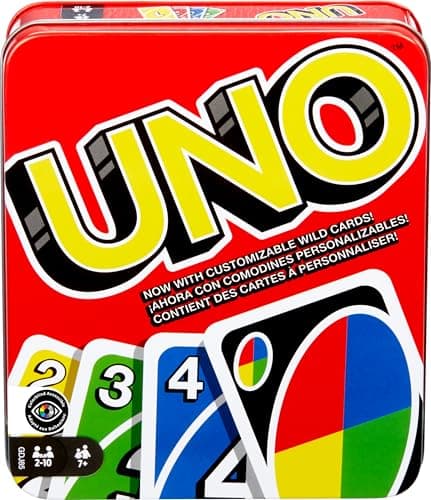
Mattel Games UNO Card Game
UNO Card Game

Mattel Games

Buy this if the actual complaint is that everyone is on a separate screen7+Some noise$11.54Amazon
05Buy this if what the child actually wants is competition with other people8+Some noise$13.98Amazon
06Buy this if the real goal is hours outside, and you only want to spend once8+Quiet$124.49Amazon

#ad · Prices come live from Amazon’s API and were last checked November 3, 2026. Where we have no verified live price we show none — we would rather leave a gap than print a number that has gone stale. Age grades are the manufacturer’s own; noise is our reading, not a measurement.

The short answer

If the child already loves one specific game, buy the physical version of that world rather than fighting it. If you want the thing a screen genuinely cannot do, buy a kit with a result in the room — circuits, chemistry, electronics. If the complaint is four people on four screens, the fix costs less than a coffee and it is a deck of cards, not a console. If the goal is hours outdoors, buy the wheels and buy them once, properly. And if the child is eleven, has friends who all play the same game online, and that is how they see those friends — buy the game. Pretending otherwise is how gift-buying adults lose credibility.

We sell neither games nor consoles and earn nothing either way on that part of the decision, so there is no position to defend here. Every age grade on this page is the manufacturer’s own published wording. We have not played with these toys; our method is published in full.

What a video game is actually good at

Any comparison that will not say this is not worth reading. Games are extraordinarily good at four things, and most toys are bad at all four.

They have a difficulty curve. A game meets the child exactly where they are and moves the bar as they improve. Almost no toy does this; it is why a toy is thrilling for a week and a game is absorbing for a year.

They give feedback instantly. Right or wrong, every few seconds, with no adult needed to adjudicate.

They are social at a distance. For a child over about nine, a multiplayer game is frequently the main way they actually see their friends. A board game cannot substitute for that, and a parent who implies it can is not being listened to.

They require nothing of the adult. This is the one nobody says out loud, and it is a real feature, not a failing of the parent.

What a toy buys that a game does not

Four things, and they are the reason this page has picks on it rather than a shrug.

It is still there in two years, and it has a resale value

Hardware ages out, storefronts close, accounts move and online servers for older titles get switched off. A circuit kit, a scooter and a deck of cards do not depend on anybody else continuing to run a service. Physical toys also have a second-hand market, which is worth knowing both ways — it is how you buy well below retail and how the thing holds some value when the child is done with it. More on that in buying toys secondhand.

Anybody in the room can join without a controller

Two-player used to mean two people on one sofa. Now it usually means two accounts, often in two rooms. The toys on this page that are worth the money are the ones a sibling, cousin or visiting friend can join in thirty seconds with no setup — which is why three blasters beats one, and ten-player card games are underrated.

It produces something, and the something is the point

A finished build, a polished stone, a working radio, a photograph. Games produce progress that is real to the child and invisible to everyone else, which is exactly why adults undervalue it — but a child who wants to be able to show someone what they did is telling you something about what to buy them.

It costs nothing to run

The ongoing costs on the toy side of this page are batteries, darts and grit. The ongoing costs on the other side are subscriptions, in-game currency and the next release. Over a couple of years that difference is usually larger than the purchase price either way.

Price brackets, honestly

A new full-price console release and a serious toy sit in the same bracket, which is what makes this a real comparison rather than a rhetorical one. Within that bracket the toy side divides into three tiers, and we show live prices on every pick rather than printing a number that will be wrong next month.

Under the price of a card game: a deck of cards, which is genuinely the highest hours-per-dollar purchase on this entire site. About half a new release: a single-player logic game, a licensed building set, a blaster pack. About one to two new releases: a three-hundred-project electronics kit or a scooter with a nine-year run in it. The last tier is where toys win the arithmetic outright, because nothing in it is finished in a weekend. Our general approach to what a gift should cost is in how much to spend on a kid’s gift.

When to buy the game instead

Three cases, and in all three the toy is the wrong purchase.

The friends are in the game. For a child from about nine upward, one specific multiplayer title is often the venue where their friendships happen. Buying a puzzle instead does not relocate the friendship, it just removes the child from it.

They asked for it specifically and you asked them what they wanted. A substitute gift that visibly misses the point teaches a child that saying what they want is pointless. That is a worse outcome than an afternoon of screen time.

The child is ill, in a cast, or otherwise stuck. A difficulty curve and instant feedback are exactly what three weeks on a sofa calls for. This is not a compromise, it is the correct tool.

The combination that actually works

In practice the households that complain least about screen time are not the ones that bought the best toy. They are the ones where something physical is on the table, already set up, at the moment the child is bored — a half-finished build, a puzzle in progress, a circuit laid out. A toy in a box in a cupboard loses to a console every time, because the console is always ready and the toy requires a decision. That has nothing to do with which is better and everything to do with friction.

Which is the practical case for the two cheapest picks on this page. A deck of cards on the kitchen table and a story player by the bed are both zero-setup, and they do more against screen time than any single expensive purchase we could recommend. If you want the full screen-free shortlist, it is on toys for the screen-free kid, and the tech toys that work without a display are on tech toys without screens.

In detail

Every pick, in full

01
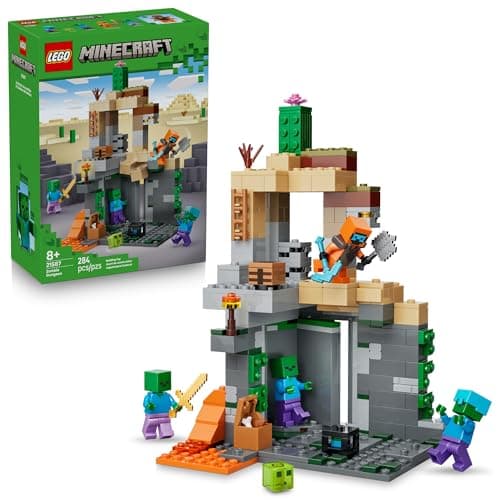
LEGO LEGO Minecraft Zombie Dungeon

Buy this if the child already loves one specific game

LEGO Minecraft Zombie Dungeon

LEGO

Graded 8+, and LEGO's own listing calls it a video game playset, which is an unusually honest piece of packaging. This is the pick for the situation most people in this comparison are actually in: the child is deep in one game, and you would rather the enthusiasm went somewhere physical than buy the next DLC. A child who knows Minecraft walks into this box already invested — they know what a creeper is, what the dungeon is for, and what to build next, so none of the usual activation energy is needed. That is the whole case for a licensed set. Two honest drawbacks, and they are the same drawback twice: the license is most of what you are paying for, so the piece count is low for the money, and the set means nothing at all to a child who has never played the game. Stripped of the reference it is a small, dark set with a skeleton in it.

Age grade:
8+
Batteries:
manufacturer does not publish a battery requirement
Noise:
Silent
Mess:
Contained
Assembly:
manufacturer does not publish an assembly time
Price:
$23.99 as of November 3, 2026

Age grade, battery and assembly wording are quoted from LEGO’s own product listing, read on September 7, 2026. The manufacturer’s exact words: “Ages 8+”. Noise and mess are our reading, not a measurement — we have not played with this.

What it gets right

  • Trades on knowledge the child already has, so the build starts with them already invested
  • Small enough to be an add-on gift without feeling like an afterthought
  • The figures work with every other Minecraft set, which is how these get collected

What it doesn’t

  • Means nothing at all to a child who does not play the game
  • Very small piece count for the price — you are paying for the license

How loud

Nothing electronic. This is the quiet version of the thing they normally do with headphones on.

How much mess

Small set, small footprint. The pieces are tiny but there are not many of them.

Skip this if…

…the child has never played Minecraft. Stripped of the reference this is a small, dark-colored set with a skeleton in it, and it will not carry itself.

$23.99See it on Amazon

$29.9920% off

Price checked November 3, 2026. Toy prices move constantly, especially in December — Amazon’s price at checkout is the one that counts.

#ad · we may earn a commission from this link to LEGO Minecraft Zombie Dungeon

02
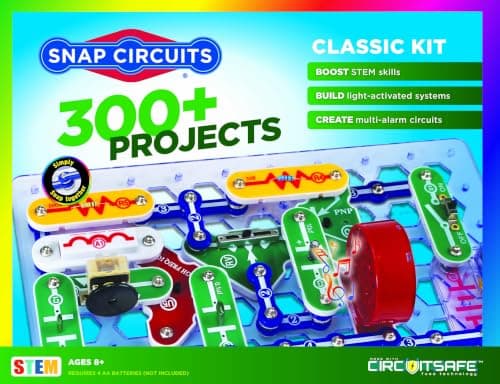
Snap Circuits Snap Circuits Classic SC-300 Electronics Kit

Buy this if you want the thing a game cannot do — a result in the room

Snap Circuits Classic SC-300 Electronics Kit

Snap Circuits

Graded 8+ with over three hundred published projects, and it is the strongest pick on this page for hours per dollar. The reason it belongs in a video-game comparison is specific: a game gives a child a system to master and immediate feedback on whether they got it right, and that combination is exactly why games hold attention. A circuit kit is the only toy category that reproduces it honestly. Snap a layout together, flip the switch, and either the siren goes off or it does not — same loop, with the result in the room instead of on a screen. Three hundred projects is a multi-year kit rather than a Christmas afternoon, and the AM radio build is the one children remember. Two real costs: it is roughly double the price of the Jr. set, and the first fifty projects overlap with it, so check which one the house already owns. It needs batteries the maker does not supply.

Age grade:
8+
Batteries:
manufacturer does not publish a battery requirement
Noise:
Some noise
Mess:
Contained
Assembly:
manufacturer does not publish an assembly time
Price:
$66.98 as of November 3, 2026

Age grade, battery and assembly wording are quoted from Snap Circuits’s own product listing, read on September 7, 2026. The manufacturer’s exact words: “Ages 8+”. Noise and mess are our reading, not a measurement — we have not played with this.

What it gets right

  • Three hundred-plus projects is a genuine multi-year kit rather than a Christmas afternoon
  • Backwards compatible with the Jr. parts, so the earlier kit is not wasted
  • Includes an AM radio build, which is the project children remember

What it doesn’t

  • Roughly double the price of the Jr. kit, and the first fifty projects overlap
  • Batteries again required and again not supplied

How loud

The project list includes sirens, alarms and an AM radio, so some builds make noise on purpose. No published sound level.

How much mess

More parts than the Jr. kit but the same tray-based storage.

Skip this if…

…you are buying the child's first electronics kit. Start with the Jr. set — if they finish it, this upgrade is earned and welcome.

$66.98See it on Amazon

$88.4924% off

Price checked November 3, 2026. Toy prices move constantly, especially in December — Amazon’s price at checkout is the one that counts.

#ad · we may earn a commission from this link to Snap Circuits Classic SC-300 Electronics Kit

03
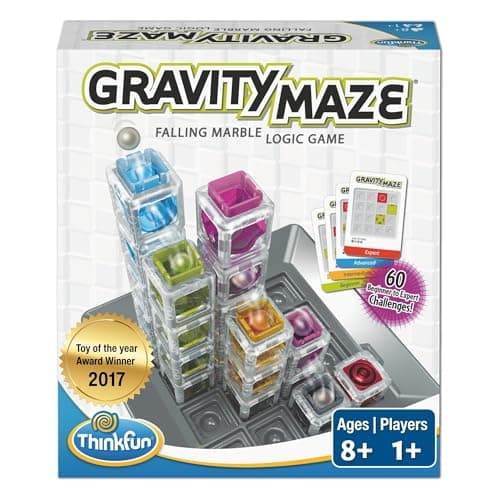
ThinkFun ThinkFun Gravity Maze Marble Logic Game

Buy this if the child plays alone and that is fine

ThinkFun Gravity Maze Marble Logic Game

ThinkFun

Graded 8 to 12, with the listing also naming 8 to 14, and it is the closest structural analogue to a video game in this entire registry: sixty numbered challenges, a single correct solution to each, a difficulty curve that actually curves, and a marble that either arrives or does not. A child who likes levels gets levels. Crucially it is genuinely single-player, which matters because the honest objection to most anti-screen gift advice is that it quietly assumes an adult is free to play too. Nobody has to be free for this. The two drawbacks are both real. It is finite — sixty cards, no widely available expansions, and a determined child finishes them in a few weeks rather than a year. And it uses marbles, which decides it instantly in a house with a crawling baby.

Age grade:
8–12
Batteries:
manufacturer does not publish a battery requirement
Noise:
Quiet
Mess:
Contained
Assembly:
manufacturer does not publish an assembly time
Price:
$19.97 as of November 3, 2026

Age grade, battery and assembly wording are quoted from ThinkFun’s own product listing, read on September 7, 2026. The manufacturer’s exact words: “Ages 8-12”. Noise and mess are our reading, not a measurement — we have not played with this.

What it gets right

  • Sixty graded challenges with verifiable solutions — the marble arriving is the proof
  • Single-player, so it fills the same gap Rush Hour does with a completely different mechanic
  • The published upper bound of 12 to 14 is fair; the hard cards are genuinely hard

What it doesn’t

  • Marbles, in a household that may have a toddler in it
  • Finite challenge set with no expansions widely available

How loud

One marble falling through a short tower. Considerably quieter than an actual marble run.

How much mess

Towers, a grid and marbles. Only three marbles, which is a far smaller loose-marble problem than a marble run.

Skip this if…

…there is a baby crawling. Three marbles is fewer than a marble run but three is not zero.

$19.97See it on Amazon

$24.9920% off

Price checked November 3, 2026. Toy prices move constantly, especially in December — Amazon’s price at checkout is the one that counts.

#ad · we may earn a commission from this link to ThinkFun Gravity Maze Marble Logic Game

04
Mattel Games UNO Card Game

Buy this if the actual complaint is that everyone is on a separate screen

UNO Card Game

Mattel Games

Graded 7+, two to ten players, and it costs less than a takeaway coffee. It is on a page about a hundred-dollar decision because for a lot of households the hundred dollars is not the problem — the problem is that four people are in one room looking at four different things, and nothing in a console box fixes that. Ten-player capacity is something no other game in this registry matches, nobody needs the rules explained, and it works at a family gathering where a new board game would not get opened. Buy it as the cheap thing alongside whatever else you buy, not instead of it. Two honest warnings: paper cards wear out fast in young hands, and UNO is structurally a game about attacking whoever is winning, which at seven is not always fun for the child being attacked.

Age grade:
7+
Batteries:
manufacturer does not publish a battery requirement
Noise:
Some noise
Mess:
No mess
Assembly:
manufacturer does not publish an assembly time
Price:
$11.54 as of November 3, 2026

Age grade, battery and assembly wording are quoted from Mattel Games’s own product listing, read on September 7, 2026. The manufacturer’s exact words: “ages 7 years and older”. Noise and mess are our reading, not a measurement — we have not played with this.

What it gets right

  • Two to ten players, which no other game here matches
  • Everybody already knows the rules, so it needs no teaching at a family gathering
  • Costs less than a takeaway coffee and lasts years

What it doesn’t

  • Draw-four cards produce genuine family arguments and always have
  • Paper cards wear fast in young hands

How loud

Cards are silent. The 'UNO' shouting is not, and it is a required part of the rules.

How much mess

One deck of cards.

Skip this if…

…there is a child who cannot yet take being targeted. UNO is a game about attacking whoever is winning, and at seven that is not always fun.

$11.54See it on Amazon

Price checked November 3, 2026. Toy prices move constantly, especially in December — Amazon’s price at checkout is the one that counts.

#ad · we may earn a commission from this link to UNO Card Game

05
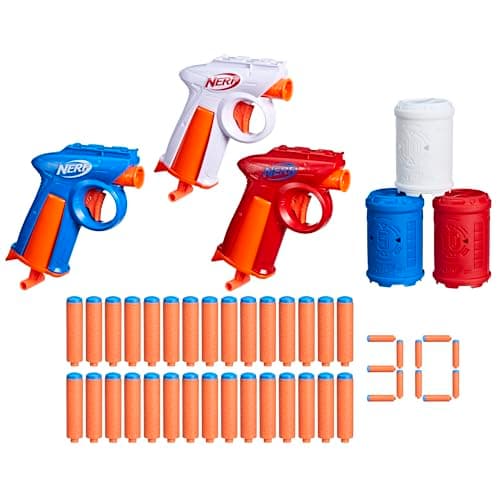
Nerf Nerf N Series Backyard Triple Pack

Buy this if what the child actually wants is competition with other people

Nerf N Series Backyard Triple Pack

Nerf

Graded 8+, three blasters, three targets and thirty darts in one box. Be honest about what a lot of gaming is for at this age: it is competitive, loud, multiplayer and social, and a quiet wooden puzzle is not a substitute for any of that however good it is. This is the pick that competes on the same ground. Three blasters is the specification that matters, because the standard failure of a blaster gift is buying one and creating an argument; three makes it a game everybody joins. Spring-powered, so no batteries and nothing to charge. The drawbacks are the obvious ones honestly stated: darts are consumable and half of them vanish behind furniture in the first month, and the eye-protection conversation has to happen every single time. Ask the parents first if the house is not yours — plenty of households have a no-blaster rule and a gift is a poor way to argue with it.

Age grade:
8+
Batteries:
manufacturer does not publish a battery requirement
Noise:
Some noise
Mess:
Spreads
Assembly:
manufacturer does not publish an assembly time
Price:
$13.98 as of November 3, 2026

Age grade, battery and assembly wording are quoted from Nerf’s own product listing, read on September 7, 2026. The manufacturer’s exact words: “Ages 8+”. Noise and mess are our reading, not a measurement — we have not played with this.

What it gets right

  • Three blasters means nobody is left out, which is the usual failure of a single Nerf gift
  • Targets included, so there is a game rather than just an argument
  • No batteries, spring-powered — nothing to charge or replace

What it doesn’t

  • Darts are consumable and half of them disappear in the first month
  • The eye-protection conversation has to be had, every time

How loud

Spring-powered thunk plus shouting. No electronics and no batteries.

How much mess

Darts. Thirty of them, and they end up behind every piece of furniture in the house.

Skip this if…

…the household has a no-blaster rule. That rule exists for a reason in a lot of families and a gift is a poor way to argue with it — ask the parents first.

$13.98See it on Amazon

$17.9922% off

Price checked November 3, 2026. Toy prices move constantly, especially in December — Amazon’s price at checkout is the one that counts.

#ad · we may earn a commission from this link to Nerf N Series Backyard Triple Pack

06
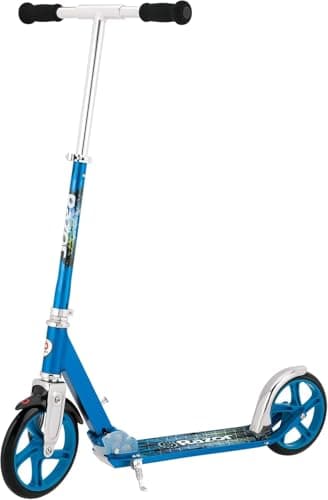
Razor Razor A5 Lux Kick Scooter

Buy this if the real goal is hours outside, and you only want to spend once

Razor A5 Lux Kick Scooter

Razor

Graded 8+, 8-inch urethane wheels, anodized aluminum deck with an adult weight rating. If the thing you are actually buying is time outdoors, this is the best value on the page and the only pick here with a nine-year run in it. The big wheels are the entire product: they roll over the pavement cracks and lips that stop a small-wheeled scooter dead, which is the difference between a scooter used for a summer and one used until the child is a teenager. It folds, which decides whether it lives in the hall or in the shed, and the shed is where unused scooters go. Two honest limits. It is heavy for a smaller eight-year-old to carry up a flight of steps. And the published 8+ grade is not a formality — the deck height and the brake force are both set for a bigger child, so a six-year-old on this is a fall waiting to happen.

Age grade:
8+
Batteries:
manufacturer does not publish a battery requirement
Noise:
Quiet
Mess:
No mess
Assembly:
manufacturer does not publish an assembly time
Price:
$124.49 as of November 3, 2026

Age grade, battery and assembly wording are quoted from Razor’s own product listing, read on September 7, 2026. The manufacturer’s exact words: “Ages 8+”. Noise and mess are our reading, not a measurement — we have not played with this.

What it gets right

  • 8-inch wheels handle real pavement rather than only smooth driveways
  • Aluminum frame with an adult weight rating, so it does not get outgrown at eleven
  • Folds, which is the difference between a scooter kept in the hall and one kept in the shed

What it doesn’t

  • Heavy for a smaller eight-year-old to carry up steps
  • Rear fender brake needs a firm foot and takes practice to use well

How loud

Urethane wheels are the quiet ones. Nothing electronic anywhere on it.

How much mess

Folds and leans against a wall.

Skip this if…

…the child is under the published 8+ grade. The deck height and the brake force are both set for a bigger child, and a six-year-old on this scooter is a fall waiting to happen.

$124.49See it on Amazon

Price checked November 3, 2026. Toy prices move constantly, especially in December — Amazon’s price at checkout is the one that counts.

#ad · we may earn a commission from this link to Razor A5 Lux Kick Scooter

Start from what the game is giving them

Building? Buy a building system. Competing with people? Buy something multiplayer and loud. Solving puzzles alone? Buy a graded single-player logic game. Winding down? Buy audio. Matching the function beats matching the price, and it is the difference between a gift that gets used and a gift that proves a point.

Check the age grade before the reviews

Most of this page is graded 8+, and on the active picks that number is load-bearing rather than cautious — deck heights and brake forces are set for a particular size of child. We never recommend below a published grade. See age grades explained.

Buy the cheap thing as well as, not instead of

The card game is not a serious alternative to a console and nobody should pretend it is. It is the thing that gets played on a Tuesday, and it costs almost nothing, so buy it in addition to whatever the real present is.

Count the running costs on both sides

Darts, batteries and refill grit against subscriptions, currency and sequels. Over two years the running costs usually dwarf the purchase, and they are the part of this decision nobody budgets for.

Do not buy a toy to make a point

The least successful gift in this whole category is the educational toy bought specifically to replace a game the child asked for. It arrives pre-loaded with an argument and the child knows exactly what it is. If you want the screen time down, the lever is friction and what is already set up on the table — not the gift.
The toys

The toys this guide is about

Every one of these carries its manufacturer’s published age grade and a live Amazon price, read November 3, 2026. Full rankings live in the roundups linked above.

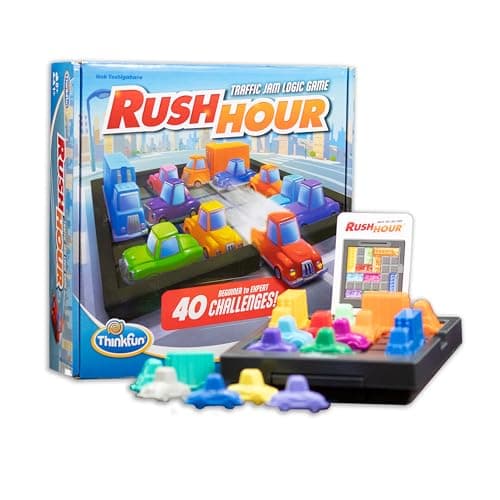
  • ThinkFun ThinkFun Rush Hour Traffic Jam Logic Game

    The cheaper single-player logic option

    ThinkFun Rush Hour Traffic Jam Logic Game

    Age grade 8+

    Published for age 8 and up, forty graded challenges, and the whole thing packs into its own board. It fills the same gap as the marble logic game for less money and with no loose marbles, which matters in a house with a toddler. Finite in the same way: once the forty cards are solved it waits for the expansion packs.

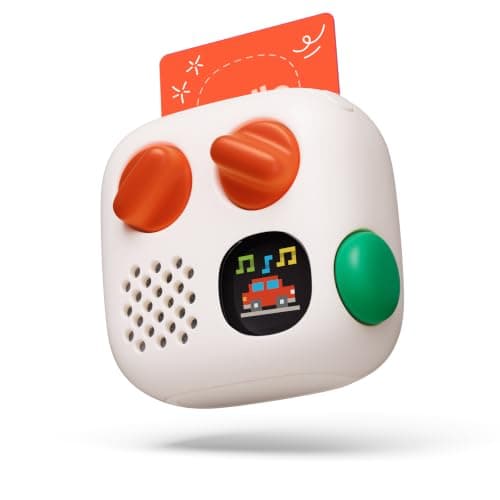
  • YOTO Yoto Mini Screen-Free Audio Player

    The honest answer when the screen is really about downtime

    Yoto Mini Screen-Free Audio Player

    Age grade 3+

    Graded 3+ and explicitly screen-free: a card goes in and a story plays, with no feed, no autoplay and no recommendation engine. It is the best thing in this registry for the hour before bed, which is when most households actually lose the screen-time argument. The player is the cheap part — the card library is the real cost of ownership.

#ad · As an Amazon Associate we earn from qualifying purchases. How this works.

How we picked

Toys we claim to have played with: 0

Every toy site tells you they tested forty toys with a focus group of real children. We have not played with any of these, and we say so. Here is what we do instead: we read the manufacturer’s own listing and print its published age grade word for word, we record the battery requirement and the assembly note where the maker publishes one and say plainly when it does not, we pull the price live from Amazon so it is never a number we remembered, and we name one thing on every list we would not buy.

The noise and mess ratings are our judgment from what the listing describes — not measurements. Almost no toy manufacturer publishes a decibel figure, which is itself worth knowing. The full method is published, including what disqualifies a toy.

Questions

Questions people actually ask

Are toys better than video games for kids?
Not inherently, and any page that says so is selling you something. Games are better at difficulty curves, instant feedback and keeping a child connected to friends who play the same thing. Toys are better at including whoever is in the room, costing nothing to run, producing something the child can show you, and still existing in two years. The useful question is not which is better but which of those properties you are short of right now.
What can I buy instead of a video game for the same money?
In the same bracket as a new full-price release: a three-hundred-project electronics kit, a scooter with real wheels, a graded single-player logic game plus a deck of cards, or a licensed building set from the game they already play. The electronics kit and the scooter are the two with the longest runs in them. Live prices on every pick are at the top of this page.
My child only wants the game their friends play. Should I buy a toy instead?
No. If one specific multiplayer title is where a child over about nine actually sees their friends, a substitute gift does not relocate the friendship — it removes them from it, and they will correctly read the gift as a lecture. Buy the game, and buy the cheap physical thing alongside it. Being trusted on this is worth more than winning the purchase.
Which toys hold a child's attention like a game does?
The ones with a difficulty curve and a verifiable result, because those are the two properties games are built on. In practice that means graded logic games with numbered challenges, and construction or electronics kits where the thing either works or does not. Open-ended toys are excellent for other reasons but they do not compete on this axis — see open-ended play for what they are good at instead.
Is this the same as comparing toys and board games?
No, and the answers come out differently. A board game needs other people and a block of time, which is its strength and its limit. A video game needs neither, which is why it wins on a wet Tuesday. The board-game version of this decision is on toys vs games, and the age-by-age board game shortlist is on board games by age.
Do any of these picks need batteries or a subscription?
One needs batteries the maker does not supply — the electronics kit. The blaster pack is spring-powered, the logic game and the card game need nothing, and the scooter needs nothing. The audio player is rechargeable but its card library is an ongoing cost, which is the closest thing to a subscription on this page and we say so on the card. The battery-free shortlist across the whole site is on toys that need no batteries.
What about tech toys — are they a middle ground?
Some genuinely are, and the ones worth buying have a physical result rather than a small screen bolted on. A screen-free coding robot and a card-based story player both do the thing a tablet does without the feed attached. A handheld with a display is not a middle ground, it is a smaller console. The shortlist is on tech toys without screens.
How do I get a child to use the toy once the game is in the house?
Reduce the friction rather than the screen time. A toy in a box in a cupboard loses every time, because the console is always ready and the toy needs a decision first. Leave the build half-finished on the table, the circuit laid out, the cards out of the box. Toy rotation is the systematic version of this and it is on toy rotation.

Keep reading

Receipts

Sources

We do not run a playroom test lab and we do not pretend to. Age grades, battery requirements and assembly notes are quoted from each manufacturer’s own product listing, read on September 7, 2026; prices come live from Amazon’s API and are stamped with the date they were checked. Where a maker publishes nothing, the page says “manufacturer does not publish this” rather than guessing. Read the full method.