The short answer
If the child is pulling up and cruising along furniture but not yet stepping, buy the weighted wooden push wagon with resistance clickers — speed control is the only feature in this entire category that changes outcomes. If they already walk a few steps unaided, a wooden push toy is cheaper and does more for the practice. If your floors are carpeted, the cheaper plastic push-and-pull wagon is the better buy and it goes outside as well. And whatever else you buy, put something at standing height in the room, because standing still is most of what a new walker is practicing.
Every age grade on this page is the manufacturer’s own published wording, and this site never recommends a toy below the grade its maker set. We have not played with these toys; our method is published in full.
A push wagon is not a baby walker, and the difference is regulated
This is the single most important thing on the page, because the two products share a word and nothing else. A seated infant walker is the wheeled frame a baby sits inside, with their feet on the floor. It is a distinct regulated product category in the United States, covered by its own mandatory federal standard — 16 CFR Part 1216 — which exists because the CPSC spent two decades documenting babies riding them down stairs. The commission still issues warnings about imported models that fail it.
Everything ranked on this page is a push toy: the child stands on their own feet, behind or beside the object, holding on. Their weight is on their legs, their balance is their own problem to solve, and they can stop by letting go. That is the opposite arrangement, and it is why none of these is a 1216 product. We do not rank seated infant walkers on this site at any age, and the registry contains none.
One useful consequence: because a push toy does not hold the child up, it does not hide what they can and cannot do. If a child cannot take weight on their legs yet, a push wagon simply will not be used, which is better information than a seat that masks it.
What actually matters when a child is learning to walk
Four criteria decide this category, and the first one is the only one the packaging never mentions.
1. Speed control, not stability
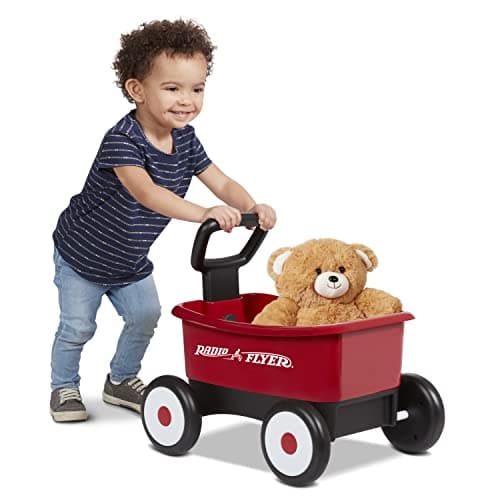
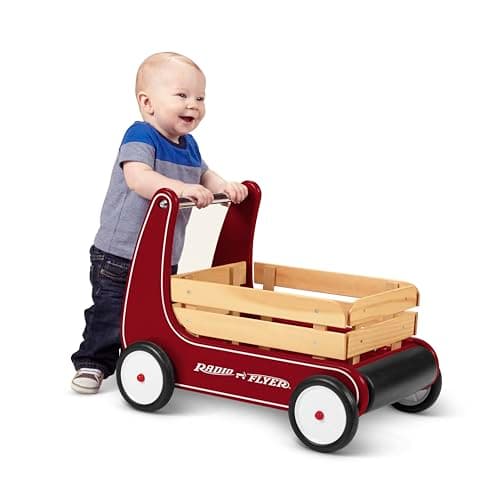
Everyone shopping for a push toy looks for a wide, stable base. Width is easy, and nearly every product has it. What almost nothing has is any mechanism to stop the toy accelerating away from a child who is leaning on it. On hardwood, tile or laminate, an unweighted wagon with free-spinning wheels is a skateboard: the child pushes, it goes, and they end up flat with the wagon four feet away. Resistance clickers — a mechanical drag on the axle — are the fix, and the Radio Flyer Classic Walker Wagon is the only toy in this registry whose maker advertises them. If you buy one thing from this page on one specification, buy that.
2. Handle height and whether it locks
A new walker holds on at roughly chest height, standing upright. A toy with a handle at waist height makes them stoop, which wrecks the posture the whole exercise is building. A locking handle matters for a different reason: unlocked handles fold under weight, and a handle that folds while being leaned on is the failure mode you are trying to avoid.
3. Weight, in both directions
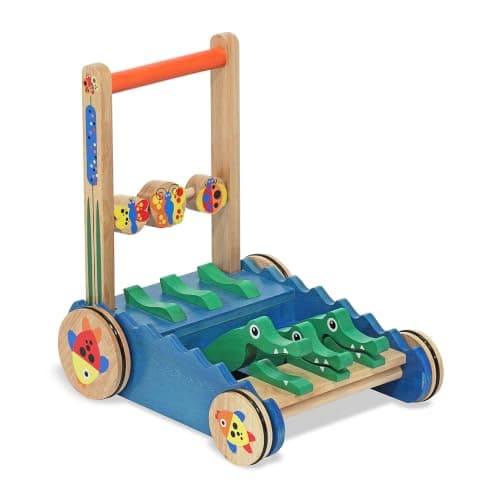
Heavy is good for a wagon — the mass is what resists the lean. Heavy is bad for a push toy with no handle, because the child has to overcome it to get any feedback. This is why the wagon and the wooden alligator are not substitutes for each other: one is for a child who needs support and the other is for a child who has stopped needing it.
4. Something at standing height that is not a walking toy at all
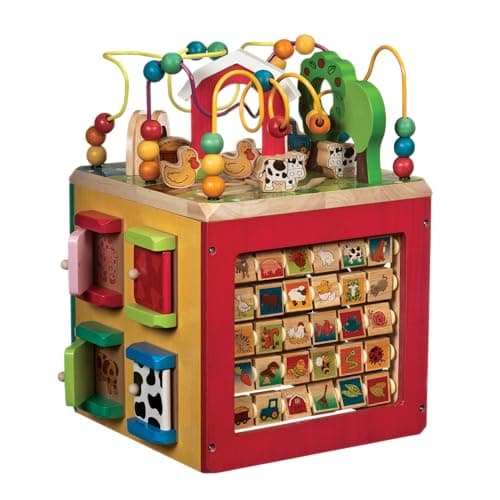
Half of learning to walk is static balance — staying upright with the hands occupied. A standing-height play surface does that for twenty minutes at a time without the child noticing, and it is the cheapest, least-marketed intervention in this whole category. An activity cube, a sturdy low table or even a sofa cushion with toys on it does the job.
Why the age grades are tight here, and why we do not bend them
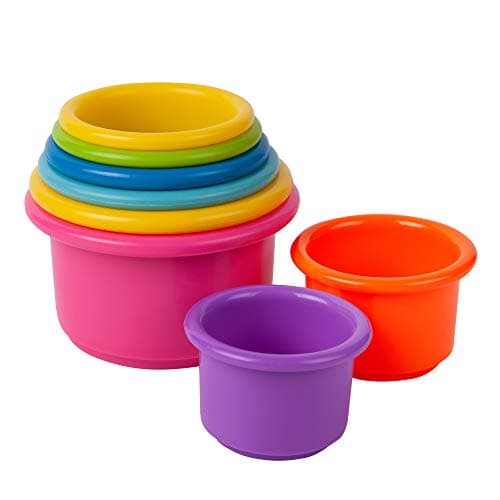
Most of this page is graded 1+ or 1 to 4, and that is not a coincidence. Twelve months is where the toy industry puts the boundary between an infant product and a toddler one, and it is set against the federal small-parts rule as much as against any developmental milestone. Below it the available products change entirely — which is why the two also-considers above exist, and why a 9-month-old is better served by nesting cups than by a wagon bought early and stored.
The practical point for a gift-buyer: walking starts anywhere from about 9 to about 17 months, and the published grade will not match the child in front of you. We will never recommend below a maker’s published grade — the build fails if a page tries — so if the baby is 10 months old and already cruising, you are shopping a month or two early and the honest move is to buy the wagon and accept it sits in the hall for a few weeks. More on what those numbers are set against is in age grades explained, and the under-three hazard rules are in the choking hazard guide.
What to skip
Three categories come up constantly in this search and none of them is on the list above.
Seated infant walkers. Covered above. A regulated category with its own federal standard and a recall history, and not something we rank.
Electronic walkers with a detachable play panel. The most popular product in this entire category is one of these, and it is not on this page for a mundane reason rather than a safety one: the manufacturer publishes no age grade anywhere in the listing. Our registry refuses a product without one, so it cannot be ranked here. If you buy one anyway, the thing to check is the same as everywhere else — whether the wheels have any drag on them, and whether the panel detaching leaves a handle at a useful height.
Shoes. Not a toy, but it comes up in the same search. The current guidance across pediatric sources is that new walkers do better barefoot indoors, because the feedback through the sole is part of how the balance is learned. Soft-soled shoes are for outside and for cold floors, not for practice.
Noise, mess and batteries, printed
Everything ranked on this page runs on no batteries at all, which is rare for the baby aisle and is the direct consequence of choosing push toys over electronic ones. The noise is entirely mechanical: wooden clacking, plastic wheels on a hard floor, and the clicker drag. None of it is advertised as a feature on any of these listings, which is the distinction this site draws between a toy that makes noise and a toy whose purpose is noise — the full argument is on how we rate noise, and the battery-free shortlist across every age is on toys that need no batteries.
On mess: a wagon is the only category of toy that reduces it. A box on wheels is a toy box the child moves, and for about a year it is the only tidying mechanism in the house that they operate voluntarily.
Buy the wagon if the child is not yet walking unaided
Weight plus speed control is the combination that helps a cruiser, and nothing else on this page offers it. Pay the extra for the clickers if your floors are hard; buy the cheaper plastic wagon if they are carpeted, because carpet already provides the drag.
Buy the wooden push toy if they already take steps
Once the child can stand and step unaided, support is no longer what they need — a reason to keep going is. A toy that visibly reacts to being pushed is the cheapest version of that, and a tenth of the cost of a wagon.
Buy something at standing height regardless
This is the pick most people shopping this category never consider and the one with the best hours-per-dollar on the page. It does not have to be the activity cube; it has to be sturdy, non-tippable and at the child’s chest height.
Buy the balance bike early if you were going to buy one anyway
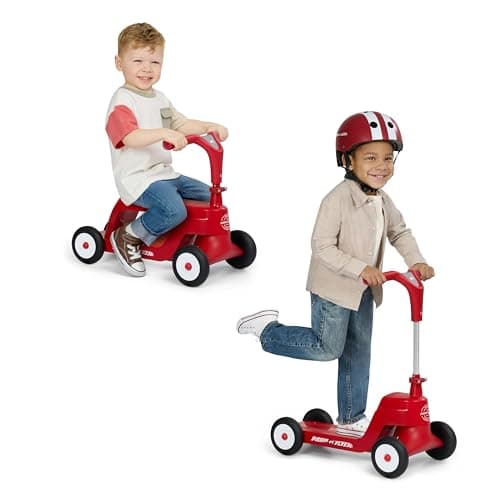
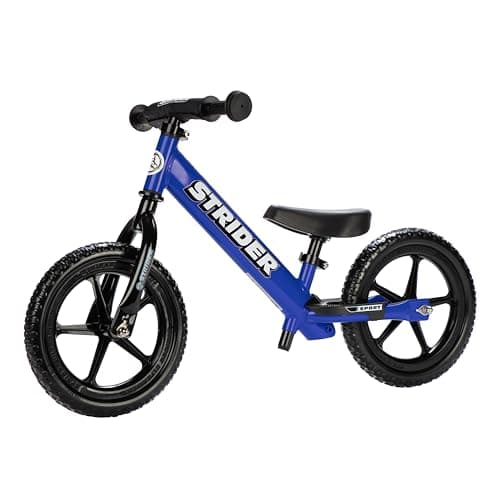
Published from 12 months, and it works as a walking aid first and a bike second. Bought at one it runs to three and a half; bought at three it runs to four. Same money, double the use.
What not to spend money on
Anything with a seat the child sits inside. Anything whose wheels spin freely on a hard floor. And anything whose age grade you cannot find printed by the manufacturer — in this one category, where the product is load-bearing, that absence tells you something.