Puzzles are the one category on this site where a $25 ceiling costs you nothing. There is no premium tier worth paying for — the best jigsaw and the best logic puzzle we hold both sit comfortably under the line.
We earn a commission if you buy through our links. It does not change the price you pay and it does not decide our picks — our method is published in full, including the part where we say we have not played with these toys. How this works.
Top pick
Ravensburger 100-Piece XXL Jigsaw Puzzle
Best jigsaw under $25, graded 6+, and the one with XXL pieces · Ravensburger grades it 6+.
#ad · we may earn a commission · prices come live from Amazon and were last checked November 25, 2026. Where we have no verified live price we show none.
#ad · Prices come live from Amazon’s API and were last checked November 25, 2026. Where we have no verified live price we show none — we would rather leave a gap than print a number that has gone stale. Age grades are the manufacturer’s own; noise is our reading, not a measurement.
The verdict: the top pick is the Ravensburger 100-piece XXL jigsaw, graded 6+ — large pieces with a definite fit, which is what makes a hundred-piece puzzle finishable in one sitting rather than swept back into the box half-done. The budget pick is the four-pack of wooden peg puzzles, graded 2 to 4: the cheapest thing here, and four boards rather than one.
Every age grade is the manufacturer’s own published wording, and every price comes live from the price layer with the date it was checked printed under the table. Our method is published in full.
The budget costs you nothing here, and that is unusual
On most of this site a price ceiling means a compromise. Under $25 in building toys means a smaller set; under $50 in outdoor toys means you are not buying the scooter. Puzzles do not work like that. Every puzzle in our registry sits under $25, and that is not a limitation of what we hold — it is what the category costs.
The reason is that there is no premium tier doing anything different. A puzzle priced well above this line is either a much larger piece count aimed at an adult, a wooden novelty cut, or a licensed image. None of those is a better puzzle for a child. What you pay for in this category is cut quality and board thickness, and both are available at well under the line from Ravensburger and Melissa & Doug. The honest advice for a parent with $25 and a child who likes puzzles is to buy two of them rather than one expensive one, because the thing that limits a puzzle is that it gets finished.
The three things we checked
A published age grade, printed as the maker wrote it. Puzzle grades are almost always small-parts judgments — a 100-piece jigsaw is 100 small parts — rather than a statement about difficulty. That is why a bright three-year-old still should not have the 6+ jigsaw with a toddler in the house. The choking-hazard guide covers the rule behind the number.
Whether a missing piece kills it. This is the question that decides a puzzle’s real lifespan and nobody prints it. On the jigsaw, one missing piece ends the puzzle. On the logic games, a missing piece breaks specific numbered challenges but not the box. On the peg puzzles and the sorting cube, a missing piece is a gap and nothing more. Storage matters in exactly that order.
Whether it is solved or re-playable. Three picks here have a fixed end — the jigsaw gets completed, the two challenge decks get finished. Three do not, because a sorting cube and a peg puzzle are practice rather than a problem. Neither is wrong, but a child given a solved box in January is bored in February.
Matching the puzzle to the age
Two to three: peg puzzles, because a knob can be lifted long before an edge can. Four boards beat one board every time at this age.
Two to four: the twelve-shape sorting cube. Three-shape sorters are finished in a fortnight.
Four to six: the self-correcting alphabet set, which is phonics done by hand and gives feedback without an adult.
Six to eight: the XXL jigsaw, and then another one. This is the band where the buy-two advice matters most.
Eight and over: the two logic games, with the sliding-car grid first and the three-dimensional marble puzzle for a child who has already beaten it. More at this level on puzzles for kids.
What we would not buy under $25
A 1000-piece puzzle for a child under about ten, however keen they are. It is not a harder version of a 100-piece puzzle, it is a multi-day project that needs a table nobody else wants, and the usual outcome is a board left out for a fortnight and then swept up.
A licensed-character jigsaw as the main present. The image is why the child wants it and the image is also why it gets done once — a puzzle of something they love is a poster they assembled, and it goes back in the box for good. If the character is the point, buy it as the cheap second puzzle rather than the first.
And a cardboard puzzle for anyone under three. Toddlers chew edges and bend tabs, and a chewed cardboard puzzle is both ruined and a hazard. Wood at that age, every time — the whole wood-against-plastic-and-card argument is on wood against plastic blocks.
In detail
Every pick, in full
01
Best jigsaw under $25, graded 6+, and the one with XXL pieces
Ravensburger 100-Piece XXL Jigsaw Puzzle
Ravensburger
Ravensburger publishes this 100-piece XXL jigsaw for ages 6+, and the XXL in the name is the whole reason it leads. Large pieces on a 100-piece puzzle are not a concession to small children — they are what makes the puzzle finishable on a kitchen table in one sitting, which is the difference between a puzzle that gets completed and a puzzle that gets swept into the box half-done. Ravensburger's cut and board quality is the reason people buy the brand twice: the pieces have a definite fit, so a six-year-old knows when a piece is right rather than forcing it. Honest limits: a hundred pieces is a single evening for a confident seven-year-old, so this is a buy-several category rather than a buy-one; and a jigsaw with one piece missing is a jigsaw nobody does again.
Age grade:
6+
Batteries:
manufacturer does not publish a battery requirement
Noise:
Silent
Mess:
Contained
Assembly:
manufacturer does not publish an assembly time
Price:
$8.49 as of November 25, 2026
Age grade, battery and assembly wording are quoted from Ravensburger’s own product listing, read on September 7, 2026. The manufacturer’s exact words: “Ages 6+”. Noise and mess are our reading, not a measurement — we have not played with this.
What it gets right
+XXL pieces suit six-year-old hands without making the puzzle babyish
+Ravensburger's board and cut quality genuinely outlast the supermarket brands
+Cheap enough to give two or three at once
What it doesn’t
−One missing piece ruins the whole thing, permanently
−A hundred pieces is one afternoon for a confident eight-year-old
How loud
Cardboard.
How much mess
A hundred pieces on a table. It occupies a surface for a day and then goes back in the box.
Skip this if…
…the household has no table that can be left occupied. A hundred-piece puzzle needs a surface for longer than dinner allows.
Best single-player logic puzzle, graded 8+, and it travels
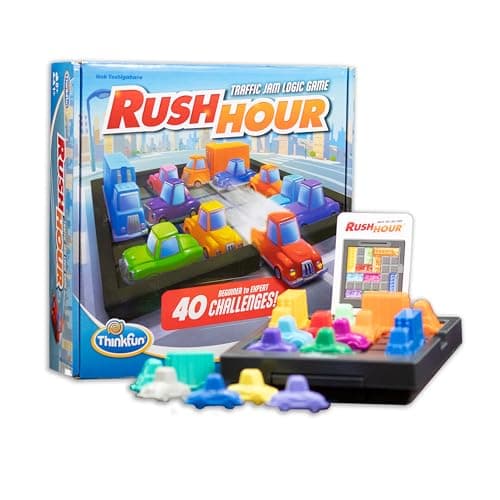
ThinkFun Rush Hour Traffic Jam Logic Game
ThinkFun
ThinkFun publishes Rush Hour for kids age 8 and up: a grid, sliding cars, and a deck of challenge cards running from beginner to genuinely hard. It belongs on a puzzle page rather than a games page because there is no opponent and no luck — every challenge has exactly one solution, and finding it is a search problem the child performs in their head. No batteries, no setup, no second player, and it fits in a bag, which is why it gets used on a weeknight rather than only on a free afternoon. Honest limits: it is finite, and a determined eight-year-old solves the whole deck in a few weeks unless an expansion gets bought; and losing one of the small cars breaks specific numbered challenges rather than the whole game, which is somehow more irritating.
Age grade:
8+
Batteries:
manufacturer does not publish a battery requirement
Noise:
Silent
Mess:
Contained
Assembly:
manufacturer does not publish an assembly time
Price:
$13.99 as of November 25, 2026
Age grade, battery and assembly wording are quoted from ThinkFun’s own product listing, read on September 7, 2026. The manufacturer’s exact words: “for Kids Age 8 and Up”. Noise and mess are our reading, not a measurement — we have not played with this.
What it gets right
+Genuinely single-player, so it works when no adult is available
+Forty challenges with a real difficulty curve — the last ones defeat adults
+The whole thing packs into its own board for travel
What it doesn’t
−Finite. Once the forty cards are solved, it is done until the expansion packs
−The published 8+ grade is honest; a six-year-old will stall around challenge ten
How loud
Plastic cars sliding on a plastic grid.
How much mess
A grid, sixteen vehicles and a card deck, all of which fit in the tray.
Skip this if…
…you want something the family plays together. Rush Hour is solitary by design and does not convert into a group game.
Best three-dimensional puzzle, graded 8+, and the hardest thing here
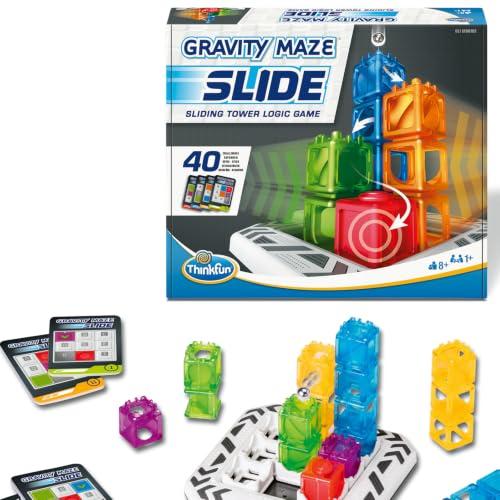
ThinkFun Gravity Maze Slide Marble Logic Game
ThinkFun
ThinkFun publishes Gravity Maze Slide for ages 8+ with 40 logic challenges. A card sets the starting tower and the target, and the player places transparent towers so a marble released at the top arrives at the bottom in the right place — which means holding a three-dimensional path in your head before touching anything. That is a real step up from grid puzzles and it is the one thing on this page that a capable ten-year-old will not walk through. It sits at the very top of this page's budget, so the live price in the table is worth checking before you commit. Honest limits: forty challenges is a few weeks of serious attention and then the box is solved; and losing a single tower breaks specific numbered challenges rather than the set as a whole.
Age grade:
8+
Batteries:
manufacturer does not publish a battery requirement
Noise:
Quiet
Mess:
Contained
Assembly:
manufacturer does not publish an assembly time
Price:
$24.99 as of November 25, 2026
Age grade, battery and assembly wording are quoted from ThinkFun’s own product listing, read on September 7, 2026. The manufacturer’s exact words: “Ages 8+”. Noise and mess are our reading, not a measurement — we have not played with this.
What it gets right
+Forty graded challenges with verifiable solutions — the marble arriving is the proof
+Plays solo, so it fills the same gap Rush Hour does with a completely different mechanic
+Published 8 and up with no upper bound, and the maker's own framing is kids and adults alike — the expert end earns that
What it doesn’t
−Marbles, in a household that may have a toddler in it
−Forty challenges and no expansions widely available — a determined child finishes the set
How loud
One marble falling through a short tower. Considerably quieter than an actual marble run.
How much mess
Towers, a grid and marbles. Only three marbles, which is a far smaller loose-marble problem than a marble run.
Skip this if…
…there is a baby crawling. Three marbles is fewer than a marble run but three is not zero.
Best letters puzzle, graded 4+, and it corrects itself
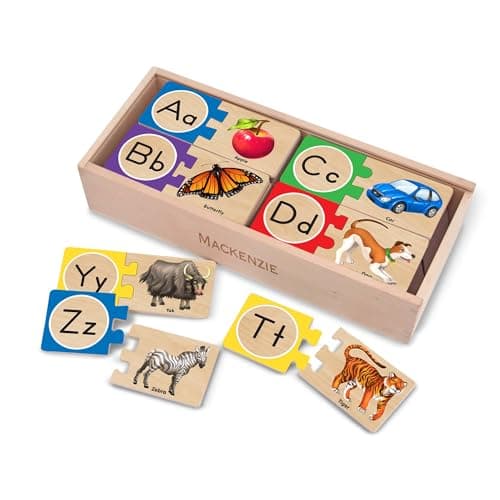
Melissa & Doug Self-Correcting Alphabet Puzzles
Melissa & Doug
Melissa & Doug publishes this self-correcting alphabet puzzle set for ages 4+ — 52 pieces in a wooden storage box, each letter pairing with a picture that only fits the right letter. The self-correcting cut is the feature worth paying for: a four-year-old working alone gets immediate feedback without an adult confirming anything, which is the difference between a learning toy and a worksheet. Pairing a letter with a picture of a thing that starts with it is phonics done by hand rather than by drill. Honest limits: it is outgrown decisively rather than gradually — once the alphabet is known the puzzle has no second use, and that is usually inside a year; and the storage box is the only thing keeping 52 small wooden pieces together.
Age grade:
4+
Batteries:
manufacturer does not publish a battery requirement
Noise:
Silent
Mess:
Contained
Assembly:
manufacturer does not publish an assembly time
Price:
$10.96 as of November 25, 2026
Age grade, battery and assembly wording are quoted from Melissa & Doug’s own product listing, read on September 7, 2026. The manufacturer’s exact words: “Ages 4+”. Noise and mess are our reading, not a measurement — we have not played with this.
What it gets right
+Self-correcting cut means the child gets feedback from the puzzle, not from a grown-up
+Storage box included, and it is wooden rather than a cardboard sleeve that splits
+Published 4+ grade lines up with when letter recognition is genuinely starting
What it doesn’t
−Fifty-two small wooden pieces; a missing letter is very visible
−Single-purpose — once the alphabet is known, the puzzle is finished
How loud
Wooden pieces.
How much mess
Fifty-two pieces and a wooden storage box that they actually fit in.
Skip this if…
…the child already reads. This is a letter-recognition toy and it has no second act.
Price checked November 25, 2026. Toy prices move constantly, especially in December — Amazon’s price at checkout is the one that counts.
#ad · we may earn a commission from this link to Melissa & Doug Self-Correcting Alphabet Puzzles
05
Best first puzzle, graded 2 to 4, and twelve shapes rather than three
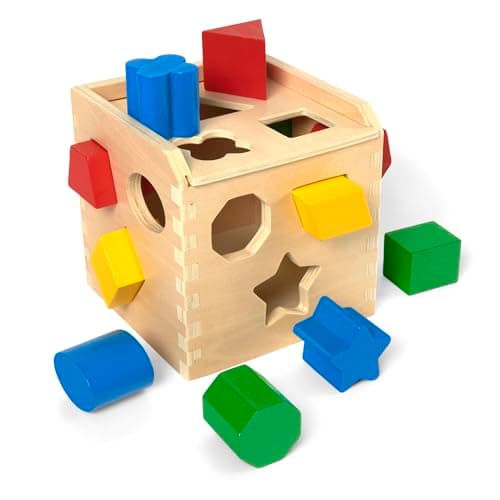
Melissa & Doug Shape Sorting Cube
Melissa & Doug
Melissa & Doug publishes this classic wooden shape sorting cube for ages 2 to 4, with twelve shapes. Twelve is the number that matters: most sorters ship with three or four, which a two-year-old masters in a fortnight, while twelve includes shapes a child has to study — hexagons, crosses, half-circles — so the toy stays slightly ahead of them for a year or more. Wooden rather than plastic, which means it survives being thrown and does not clatter. Honest limits: the lid comes off, which is how a sorting cube turns into a box for unrelated objects within a week; and the pieces are genuinely small-parts sized for anything younger than the printed grade, so it is not a toy for a crawling sibling to share.
Age grade:
2–4
Batteries:
manufacturer does not publish a battery requirement
Noise:
Quiet
Mess:
Contained
Assembly:
manufacturer does not publish an assembly time
Price:
$16.01 as of November 25, 2026
Age grade, battery and assembly wording are quoted from Melissa & Doug’s own product listing, read on September 7, 2026. The manufacturer’s exact words: “AGES 2 TO 4”. Noise and mess are our reading, not a measurement — we have not played with this.
What it gets right
+Twelve shapes gives it real headroom over the standard six-shape sorters
+Wooden, self-storing, and there is nothing to break
+Published 2 to 4 grade, which is a longer run than most sorters get
What it doesn’t
−Twelve blocks is twelve things to lose, and it shows when three are gone
−The lid needs to come off to empty it, which a two-year-old cannot do alone
How loud
Wood on wood.
How much mess
Twelve blocks that store inside the cube. Self-contained by design.
Skip this if…
…the child is under two. The grade is 2+ and twelve small wooden shapes at eighteen months is the wrong side of the small-parts line.
Budget pick — cheapest here, graded 2 to 4, and four puzzles in the pack
Wooden Peg Puzzles for Toddlers, 4 Pack
Slotic
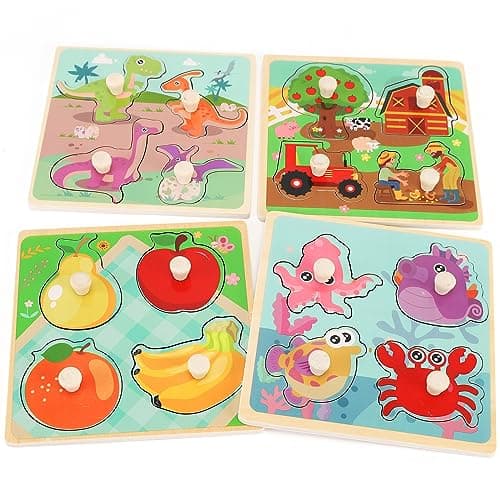
Slotic publishes this set of four wooden peg puzzles for ages 2 to 4 — farm, dinosaur, fruit and marine animals. It is the budget pick and it earns the slot on count rather than on price alone: four boards means a two-year-old who has finished one still has three they have not, which is the single biggest determinant of whether a toddler puzzle gets used more than twice. The pegs are the other reason it works, because a two-year-old can lift a piece by a knob long before they can lift one by its edge. Honest limits: peg puzzles are outgrown fast, usually by three and a half; and four boards of loose pieces live in four places unless somebody keeps them stacked, at which point the pieces migrate between boards.
Age grade:
2–4
Batteries:
manufacturer does not publish a battery requirement
Noise:
Quiet
Mess:
Contained
Assembly:
manufacturer does not publish an assembly time
Price:
$8.89 as of November 25, 2026
Age grade, battery and assembly wording are quoted from Slotic’s own product listing, read on September 7, 2026. The manufacturer’s exact words: “ages 2-4”. Noise and mess are our reading, not a measurement — we have not played with this.
What it gets right
+Four puzzles rather than one, so there is variety without four purchases
+Pegs make them genuinely doable at two, where a flat-piece puzzle is not
+Wooden boards survive being stood on
What it doesn’t
−Pieces are board-specific and mixing four sets creates a sorting job
−Outgrown quickly — the published range tops out at four for a reason
How loud
Wood on wood.
How much mess
Four boards and their pieces. The pieces belong to specific boards, which is the thing to know before mixing them.
Skip this if…
…the child is already doing jigsaw puzzles. Peg puzzles are a stepping stone and a three-year-old who has moved past them will not go back.
Every one of these carries its manufacturer’s published age grade and a live Amazon price, read November 25, 2026. Full rankings live in the roundups linked above.
If the puzzle should be built rather than solved
National Geographic Glow-in-the-Dark Marble Run
Age grade 8–12
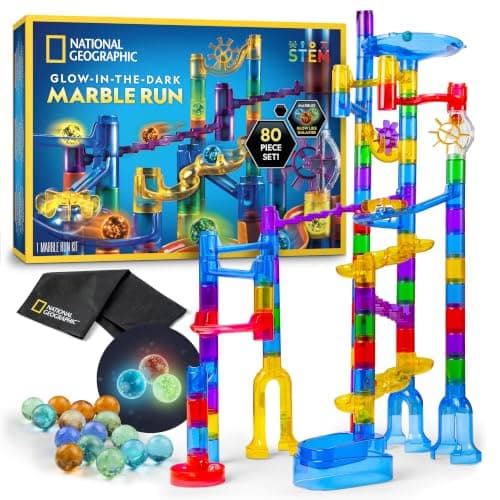
Blue Marble publishes this National Geographic glow-in-the-dark marble run for ages 8 to 12. It is over this page's budget and it is the thing to look at for a child who likes the three-dimensional pick above: same spatial thinking, no fixed solution, and the path glows with the lights off.
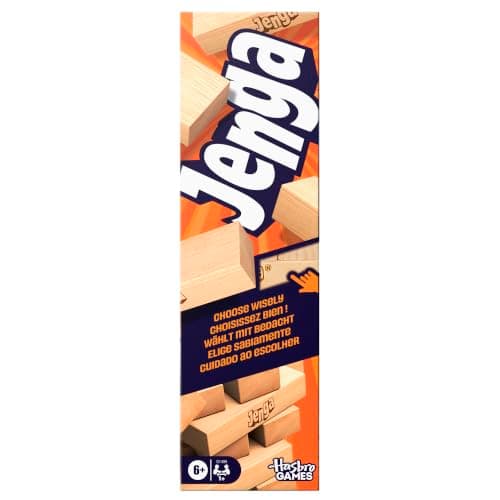
Hasbro publishes Jenga for ages 6+. It is a physical puzzle rather than a logic one — the question is which block can come out without the tower moving — and unlike everything ranked above it does not get solved, because the tower is different every time.
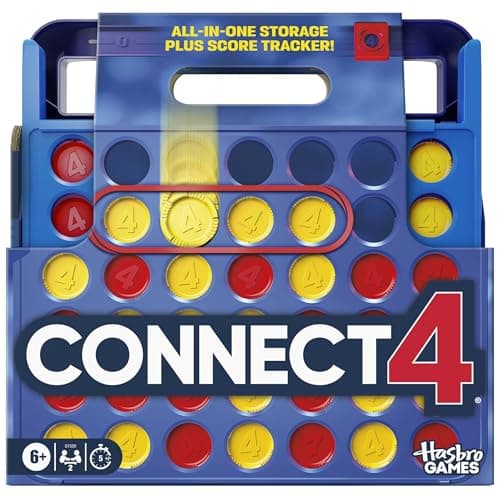
Hasbro publishes Connect 4 for ages 6+, two players, with all-in-one storage. It is the cheapest genuinely strategic two-player game we hold: simple enough for a six-year-old and deep enough that an adult has to concentrate, which is rarer than it sounds.
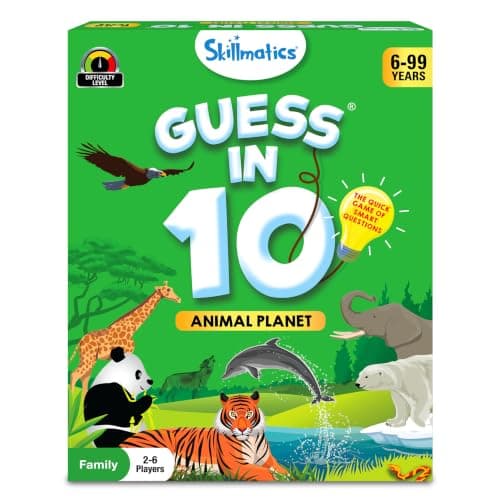
Skillmatics Guess in 10 Travel Game, Animal Planet
Age grade 6+
Skillmatics publishes this Guess in 10 travel game for ages 6 and up. Card-based deduction rather than a physical puzzle, with nothing to lose on a back seat and no board to balance — the one thing here that genuinely works in a moving vehicle.
#ad · As an Amazon Associate we earn from qualifying purchases. How this works.
How we picked
Toys we claim to have played with: 0
Every toy site tells you they tested forty toys with a focus group of real children. We have not played with any of these, and we say so. Here is what we do instead: we read the manufacturer’s own listing and print its published age grade word for word, we record the battery requirement and the assembly note where the maker publishes one and say plainly when it does not, we pull the price live from Amazon so it is never a number we remembered, and we name one thing on every list we would not buy.
The noise and mess ratings are our judgment from what the listing describes — not measurements. Almost no toy manufacturer publishes a decibel figure, which is itself worth knowing. The full method is published, including what disqualifies a toy.
Questions
Questions people actually ask
What is the best puzzle under $25?+
The Ravensburger 100-piece XXL jigsaw, graded 6+. The oversized pieces are what make a hundred-piece puzzle finishable in a single sitting, and Ravensburger’s cut gives a piece a definite fit, so a six-year-old knows when it is right rather than forcing it.
Are expensive puzzles better?+
Not for children. Above $25 you are buying a much larger piece count aimed at adults, a novelty cut, or a licensed image — none of which is a better puzzle for a child. Cut quality and board thickness, which are the things that actually matter, are available well under the line.
What puzzle is right for a 2-year-old?+
A wooden peg puzzle, graded 2 to 4. A two-year-old can lift a piece by a knob long before they can lift one by its edge, and a four-board pack means there is always one they have not finished.
How many pieces should a 6-year-old puzzle have?+
Around a hundred, with large pieces. That is roughly one sitting at a kitchen table, which is the length that gets a puzzle finished. A thousand pieces is a multi-day project rather than a harder puzzle, and it usually ends up swept into the box.
We do not run a playroom test lab and we do not pretend to. Age grades, battery requirements and assembly notes are quoted from each manufacturer’s own product listing, read on September 7, 2026; prices come live from Amazon’s API and are stamped with the date they were checked. Where a maker publishes nothing, the page says “manufacturer does not publish this” rather than guessing. Read the full method.