Skip to content
Windup & Wonder

Guides · Guides

Best STEM toys for 9-year-olds

At nine the question stops being which toy and starts being which version. Almost everything a nine-year-old wants exists in a small version and a serious one, and the serious one is usually still graded 8+ — so the upgrade is available, and the cheap version is the trap.

By Stephen V.Updated How we pick
#ad

We earn a commission if you buy through our links. It does not change the price you pay and it does not decide our picks — our method is published in full, including the part where we say we have not played with these toys. How this works.

Top pick

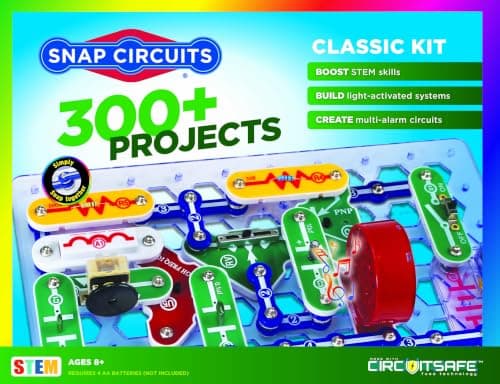
Snap Circuits Snap Circuits Classic SC-300 Electronics Kit

Snap Circuits Classic SC-300 Electronics Kit

Best overall at nine, and the version with a second year in it · Snap Circuits grades it 8+.

Budget pick

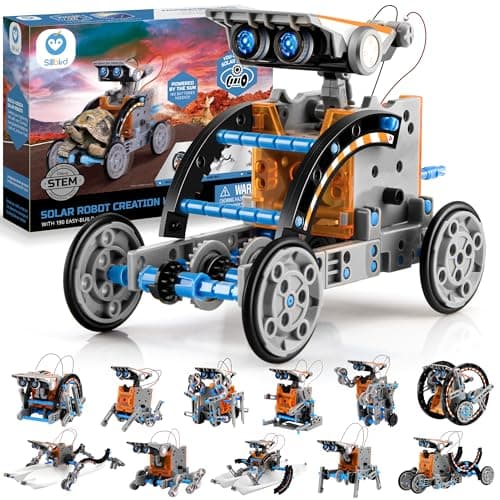
12-in-1 Solar Robot Building Kit

Budget pick — cheapest here, graded 8 to 13, the only one still rated at thirteen · Sillbird grades it 8–13.

#ad · we may earn a commission · prices come live from Amazon and were last checked November 25, 2026. Where we have no verified live price we show none.

The short answer

The picks, at a glance

#ToyBest forAge gradeNoisePrice
01Best overall at nine, and the version with a second year in it8+Some noise$42.99Amazon
02Best optics, graded 8 to 12, and the aperture that ends the disappointment8–12Silent$34.99Amazon
03Best biology, graded 5 to 12, and the year the records start5–12Silent$29.87Amazon
04Best logic game, graded 8+, and genuinely hard at the top end8+Quiet$24.99Amazon
05Best long project, graded 8+, and four weeks of waiting8+Loud$48.99Amazon
06Best physics build, graded 8 to 12, and it works with the lights off8–12Some noise$30.49Amazon
07Best open-ended system, graded 7+, and the one with no ceiling7+Quiet$37.43Amazon
08Budget pick — cheapest here, graded 8 to 13, the only one still rated at thirteen8–13Quiet$14.22Amazon

#ad · Prices come live from Amazon’s API and were last checked November 25, 2026. Where we have no verified live price we show none — we would rather leave a gap than print a number that has gone stale. Age grades are the manufacturer’s own; noise is our reading, not a measurement.

The verdict: the top pick is Snap Circuits Classic SC-300, graded 8+ with 300 or more projects — the larger version of the set we recommend at eight, because nine is the year a child starts modifying circuits instead of copying them and a hundred-project box runs out. The budget pick is the 12-in-1 solar robot kit, graded 8 to 13: the cheapest thing on this page, and the only one the maker still grades for a thirteen-year-old.

Every age grade is the manufacturer’s own published wording, and every price comes from the price layer with the date it was checked printed under the table. We own none of these and have tested none of them — the method is published in full.

Nine is a version question, not a toy question

The eight-year-old shelf and the nine-year-old shelf are, on paper, the same shelf: almost everything here carries a published grade of 8+. That is why a nine-year-old page written as a list of what is available would be the eight-year-old page with a different number on it, and it is not what a parent buying at nine actually needs.

What changes at nine is which version is correct. A microscope is a surprise at five, an instrument at seven and a record-keeping tool at nine. An electronics set is a hundred projects at eight and three hundred at nine. A telescope is 50mm and findable at eight, and 80mm and worth the cold at nine. In almost every case the serious version is still graded 8+, which means it is available — and the cheap version, bought because the child is “only nine”, is the version that gets outgrown inside a year and teaches them the subject was boring.

The second thing that changes is the horizon. Ten is the next grading cliff — chemistry sets, LEGO Technic and the crystal-growing kits all start there — so a present bought at nine has about eighteen months before the whole next shelf opens. The 10-to-12 page is what arrives next, and it is worth reading before you spend at nine, because two of the things on it are worth a short wait rather than a near-miss now.

The three things we checked

  • A published grade the nine-year-old is inside, printed as the maker wrote it. Every ranked pick carries one. Nothing graded 10+ is ranked on this page, however tempting. The 10+ shelf — chemistry sets, LEGO Technic, the crystal-growing kits — is next year’s purchase and is set out on the 10-to-12 page.
  • Whether the bigger version is the better buy. On four of these eight it is, and we have said which smaller version it replaces and why. On the telescope that is a real optical specification; on the electronics set it is parts you actually need.
  • What it costs to keep running. Three picks here consume something — grit for the tumbler, AA cells for the electronics and the microscope. The rest consume nothing at all. That is the difference between a present and a subscription, and it is in the battery reality page for everything on the site.

What we would not buy at nine

A chemistry set graded 10+, a year early. It is the single most common nine-year-old mistake we see, and the grade is about the contents of the tubes rather than the difficulty of the instructions. The honest options are to wait, or to buy the 8+ experiment kit on the eight-year-old page and treat it as the warm-up it is.

A “my first” anything. At nine this is an insult in a box, and the child reads the box. If the budget only reaches the beginner version of something, the better buy is the serious version of a cheaper subject — a proper gear kit beats a toy telescope every time.

And a monthly project subscription, as a default. They are genuinely good at this age and they are also the most expensive way to buy a few hours of activity; what they are really selling is somebody else choosing. The honest comparison, with the one-box alternatives beside it, is on alternatives to KiwiCo.

In detail

Every pick, in full

01
Snap Circuits Snap Circuits Classic SC-300 Electronics Kit

Best overall at nine, and the version with a second year in it

Snap Circuits Classic SC-300 Electronics Kit

Snap Circuits

Snap Circuits publishes the Classic SC-300 for ages 8+ with 300 or more projects. At eight we recommend the smaller Jr. set, because a child meeting electronics for the first time needs ninety seconds to a working circuit and not a bigger parts bin. At nine that calculation inverts: a nine-year-old reads the schematic conventions, follows a three-page build and — the part that matters — starts modifying circuits rather than copying them, which is precisely when a hundred-project set runs out. The extra components here are the ones that make modification possible rather than just more of the same. Honest limits: it runs on AA batteries that are not included and a flat set ends the evening; and the parts tray is the only thing standing between this and a jumble, which means an adult has to care about the tray for the first month.

Age grade:
8+
Batteries:
manufacturer does not publish a battery requirement
Noise:
Some noise
Mess:
Contained
Assembly:
manufacturer does not publish an assembly time
Price:
$42.99 as of November 25, 2026

Age grade, battery and assembly wording are quoted from Snap Circuits’s own product listing, read on September 7, 2026. The manufacturer’s exact words: “Ages 8+”. Noise and mess are our reading, not a measurement — we have not played with this.

What it gets right

  • Three hundred-plus projects is a genuine multi-year kit rather than a Christmas afternoon
  • Backwards compatible with the Jr. parts, so the earlier kit is not wasted
  • Includes an AM radio build, which is the project children remember

What it doesn’t

  • Roughly double the price of the Jr. kit, and the first fifty projects overlap
  • Batteries again required and again not supplied

How loud

The project list includes sirens, alarms and an AM radio, so some builds make noise on purpose. No published sound level.

How much mess

More parts than the Jr. kit but the same tray-based storage.

Skip this if…

…you are buying the child's first electronics kit. Start with the Jr. set — if they finish it, this upgrade is earned and welcome.

$42.99See it on Amazon

$88.4951% off

Price checked November 25, 2026. Toy prices move constantly, especially in December — Amazon’s price at checkout is the one that counts.

#ad · we may earn a commission from this link to Snap Circuits Classic SC-300 Electronics Kit
02
Feicosky FEICOSKY 80mm Refractor Telescope for Kids

Best optics, graded 8 to 12, and the aperture that ends the disappointment

FEICOSKY 80mm Refractor Telescope for Kids

Feicosky

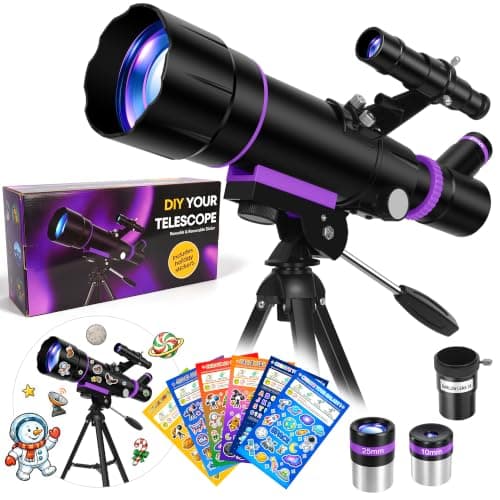
Feicosky publishes this 80mm refractor for kids 8 to 12 and adults, with a 400mm tube and what the maker describes as simple assembly and easy everyday use. Aperture is the only telescope specification that cannot be marketed around — it is how much light the instrument collects — and 80mm against the 50mm starter scopes is the difference between the moon being impressive and the moon plus more of what is behind it being visible on a good night. Nine is the age that pays off, because a nine-year-old can be taught to find an object with the finder and keep it in the eyepiece as it drifts. Honest limits: it is big enough that it has to live somewhere, and a telescope stored in a wardrobe is a telescope used twice; and the mount on every scope at this price is the weak link — every touch wobbles the view.

Age grade:
8–12
Batteries:
manufacturer does not publish a battery requirement
Noise:
Silent
Mess:
No mess
Assembly:
Simple assembly and easy everyday use
Price:
$34.99 as of November 25, 2026

Age grade, battery and assembly wording are quoted from Feicosky’s own product listing, read on September 7, 2026. The manufacturer’s exact words: “ages 8-12”. Noise and mess are our reading, not a measurement — we have not played with this.

What it gets right

  • 80mm aperture gathers meaningfully more light than the 50mm and 70mm tubes it sits beside, and the listing makes that comparison itself rather than leading with magnification
  • Four published magnifications — 16x, 40x, 48x and 120x — from two eyepieces and a 3x Barlow, so there is a sensible low-power setting to find things with
  • Tabletop design means it does not depend on a flimsy full-height tripod to stay still
  • Six sticker sets in the box, which sounds like filler and is the reason an eight-year-old treats it as theirs

What it doesn’t

  • Tabletop mounting needs a table outside — on grass with no garden furniture there is nowhere to put it
  • The 120x setting is the one a child will reach for first and it is the blurriest; the useful views are at 16x and 40x
  • Newest listing of the three telescopes here, so there is the least track record behind it

How loud

An optical tube. Nothing in it can make a sound.

How much mess

One tube, two eyepieces, a Barlow lens and a tripod. The eyepieces are the thing that gets lost.

Skip this if…

…you are buying it for a child who wants to look at things on the ground. At 400mm focal length with a star diagonal in the path, terrestrial views come out reversed — a pair of binoculars is the right purchase for birds and neighbors.

$34.99See it on Amazon

$68.9949% off

Price checked November 25, 2026. Toy prices move constantly, especially in December — Amazon’s price at checkout is the one that counts.

#ad · we may earn a commission from this link to FEICOSKY 80mm Refractor Telescope for Kids

03
Uarzt 58-Piece Kids Microscope Kit

Best biology, graded 5 to 12, and the year the records start

58-Piece Kids Microscope Kit

Uarzt

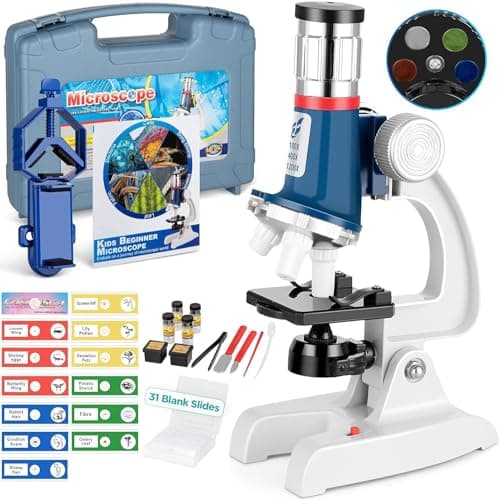
Uarzt publishes this 58-piece kit for ages 5 to 12 — 100x to 1200x, metal body, LED stage light, prepared slides and the tools to make new ones. It appears on our five-, seven- and nine-year-old pages and it is a different instrument at each. At nine the child prepares their own slides from pond water, an onion skin or a leaf, writes down the magnification, and compares one sample with another — which is not playing with a microscope, it is using one, and nine is roughly when that switch happens unprompted. The metal body matters by this age, because the thing gets handled properly. Honest limits: 2 AA batteries, not included, for the stage light; and the top of the magnification range is the least useful part of it, because depth of field at 1200x is thinner than a nine-year-old's patience.

Age grade:
5–12
Batteries:
Requires 2 AA batteries (not included)
Noise:
Silent
Mess:
Contained
Assembly:
manufacturer does not publish an assembly time
Price:
$29.87 as of November 25, 2026

Age grade, battery and assembly wording are quoted from Uarzt’s own product listing, read on September 7, 2026. The manufacturer’s exact words: “Ages 5-12”. Noise and mess are our reading, not a measurement — we have not played with this.

What it gets right

  • Metal body rather than the plastic toy microscopes at the same price, so focus actually holds
  • Prepared slides included, so there is something to look at immediately
  • Published 5 to 12 range makes it a genuinely long-lived purchase

What it doesn’t

  • Requires 2 AA batteries, not included, for the LED
  • Glass slides in a kit graded from five needs an adult present the first few times

How loud

Nothing but an LED.

How much mess

Slides and small tools in a case. The slides are glass, which is the thing to supervise.

Skip this if…

…the child is at the young end and unsupervised. Focusing a microscope is fiddly and glass slides break — five-year-olds need company for this one.

$29.87See it on Amazon

$39.9925% off

Price checked November 25, 2026. Toy prices move constantly, especially in December — Amazon’s price at checkout is the one that counts.

#ad · we may earn a commission from this link to 58-Piece Kids Microscope Kit

04
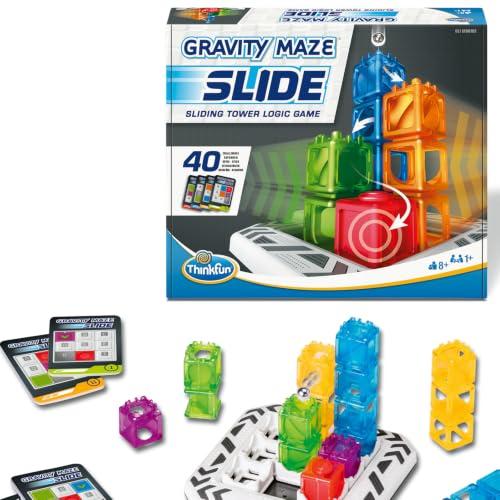
ThinkFun ThinkFun Gravity Maze Slide Marble Logic Game

Best logic game, graded 8+, and genuinely hard at the top end

ThinkFun Gravity Maze Slide Marble Logic Game

ThinkFun

ThinkFun publishes Gravity Maze Slide for ages 8+ with 40 logic challenges. It is a single-player spatial puzzle: a card sets the starting tower and the target, and the player places transparent towers so that a marble released at the top arrives at the bottom in the right place. The reason it ranks at nine rather than eight is the back of the card deck — the expert challenges require holding a three-dimensional path in your head before placing anything, which is a real step up from grid-based logic games and exactly the step a nine-year-old is ready for. Honest limits: it is finite, so a child who takes it seriously finishes all forty in a few weeks; and losing one tower breaks specific numbered challenges rather than the whole box, which is somehow more annoying.

Age grade:
8+
Batteries:
manufacturer does not publish a battery requirement
Noise:
Quiet
Mess:
Contained
Assembly:
manufacturer does not publish an assembly time
Price:
$24.99 as of November 25, 2026

Age grade, battery and assembly wording are quoted from ThinkFun’s own product listing, read on September 7, 2026. The manufacturer’s exact words: “Ages 8+”. Noise and mess are our reading, not a measurement — we have not played with this.

What it gets right

  • Forty graded challenges with verifiable solutions — the marble arriving is the proof
  • Plays solo, so it fills the same gap Rush Hour does with a completely different mechanic
  • Published 8 and up with no upper bound, and the maker's own framing is kids and adults alike — the expert end earns that

What it doesn’t

  • Marbles, in a household that may have a toddler in it
  • Forty challenges and no expansions widely available — a determined child finishes the set

How loud

One marble falling through a short tower. Considerably quieter than an actual marble run.

How much mess

Towers, a grid and marbles. Only three marbles, which is a far smaller loose-marble problem than a marble run.

Skip this if…

…there is a baby crawling. Three marbles is fewer than a marble run but three is not zero.

$24.99See it on Amazon

Price checked November 25, 2026. Toy prices move constantly, especially in December — Amazon’s price at checkout is the one that counts.

#ad · we may earn a commission from this link to ThinkFun Gravity Maze Slide Marble Logic Game

05
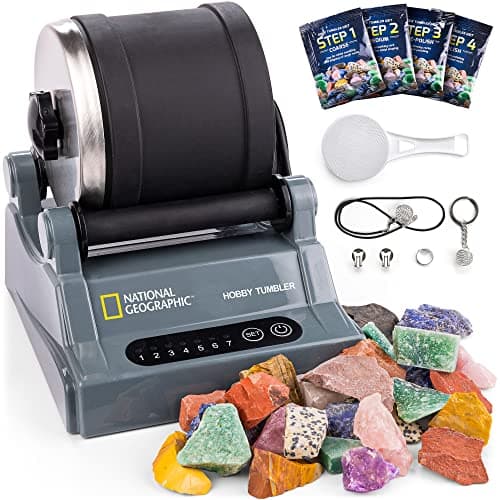
Blue Marble National Geographic Hobby Rock Tumbler Kit

Best long project, graded 8+, and four weeks of waiting

National Geographic Hobby Rock Tumbler Kit

Blue Marble

Blue Marble publishes this hobby rock tumbler for kids and adults ages 8+. At nine it stops being a novelty and becomes a project the child runs: rough grind, medium, fine, polish, each stage days long, with a decision at every change about whether a stone is ready. A nine-year-old can keep that schedule themselves, which an eight-year-old mostly cannot, and the reward is a jar of stones that get given away at school for years. It is also the only pick here that produces an object rather than an experience. Honest limits, and they decide whether to buy it: the motor hums continuously for the whole cycle, so it belongs in a garage, shed or utility room and never in a bedroom; and the grit is consumable, so the second batch costs money the box does not mention.

Age grade:
8+
Batteries:
manufacturer does not publish a battery requirement
Noise:
Loud
Mess:
Contained
Assembly:
manufacturer does not publish an assembly time
Price:
$48.99 as of November 25, 2026

Age grade, battery and assembly wording are quoted from Blue Marble’s own product listing, read on September 7, 2026. The manufacturer’s exact words: “Ages 8+”. Noise and mess are our reading, not a measurement — we have not played with this.

What it gets right

  • The result is genuinely impressive — polished stones a child made themselves
  • Teaches patience in a way very few toys manage, because the machine enforces it
  • Published 8+ grade and the process is safe once the barrel is sealed

What it doesn’t

  • Runs for days and hums the entire time; it cannot live in a bedroom
  • Grit is consumable and a full four-stage batch uses a lot of it

How loud

The barrel runs continuously for days per stage. It is a constant low rumble, not a burst. No decibel figure is published, and the usual advice is a garage or a basement.

How much mess

Grit and slurry at each stage change. Messy for ten minutes, four times per batch.

Skip this if…

…you live in an apartment with thin walls or the child's room is the only place for it. The noise is continuous and the run time is measured in weeks.

$48.99See it on Amazon

$58.0016% off

Price checked November 25, 2026. Toy prices move constantly, especially in December — Amazon’s price at checkout is the one that counts.

#ad · we may earn a commission from this link to National Geographic Hobby Rock Tumbler Kit

06
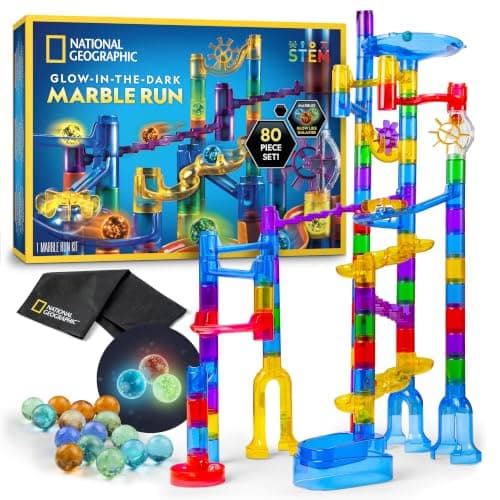
Blue Marble National Geographic Glow-in-the-Dark Marble Run

Best physics build, graded 8 to 12, and it works with the lights off

National Geographic Glow-in-the-Dark Marble Run

Blue Marble

Blue Marble publishes this National Geographic glow-in-the-dark marble run for ages 8 to 12. A marble run at nine is only interesting if the child is designing rather than following a picture, and the glow pieces are the reason this one holds: with the lights off, the path is the only visible thing in the room, which turns an ordinary gravity build into something worth photographing and rebuilding. The published range to twelve is honest rather than optimistic for a construction set at this level. Honest limits: glow pieces need charging under a light before each session, which a child forgets and then concludes the set is faulty; and loose marbles rule it out entirely in a house with a toddler, because a half-built run cannot be put out of reach.

Age grade:
8–12
Batteries:
manufacturer does not publish a battery requirement
Noise:
Some noise
Mess:
Spreads
Assembly:
manufacturer does not publish an assembly time
Price:
$30.49 as of November 25, 2026

Age grade, battery and assembly wording are quoted from Blue Marble’s own product listing, read on September 7, 2026. The manufacturer’s exact words: “Ages 8-12”. Noise and mess are our reading, not a measurement — we have not played with this.

What it gets right

  • Glow pieces give it a second life at bedtime, which is a genuinely different play session
  • Published 8 to 12 grade — the rare construction toy aimed at a tween rather than a preschooler
  • Builds high enough to be worth photographing, which is how these end up on a shelf rather than in a bin

What it doesn’t

  • The glow needs charging under a light and fades within minutes
  • An eight-year-old who wanted a challenge will finish the hardest published build in an evening

How loud

Marble on plastic. Constant while in use, silent the rest of the time.

How much mess

Marbles roll. Everything about a marble run is a small-parts story.

Skip this if…

…there is a toddler or a dog in the house. Marbles on a floor is the one failure mode this toy cannot design around.

$30.49See it on Amazon

$37.9920% off

Price checked November 25, 2026. Toy prices move constantly, especially in December — Amazon’s price at checkout is the one that counts.

#ad · we may earn a commission from this link to National Geographic Glow-in-the-Dark Marble Run

07
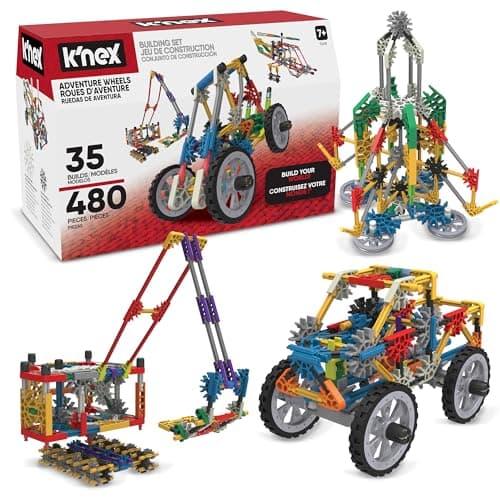
K'NEX K'NEX Adventure Wheels Building Set, 480 Pieces

Best open-ended system, graded 7+, and the one with no ceiling

K'NEX Adventure Wheels Building Set, 480 Pieces

K'NEX

K'NEX publishes this 480-piece Adventure Wheels set as ideal for kids ages 7 and above. It is graded two years below this page and it is ranked anyway, because rod-and-connector building is one of the few construction systems whose difficulty is set by the builder rather than the box: a seven-year-old makes a cart, and a nine-year-old makes a chassis with a steering linkage and then wonders why it binds. That question is mechanical engineering, and 480 pieces is enough to answer it without buying a second set. Honest limits: the instructions cover a handful of models and after that the child is on their own, which suits some nine-year-olds and strands others; and the pieces are small, loud in a tub and unkind underfoot.

Age grade:
7+
Batteries:
manufacturer does not publish a battery requirement
Noise:
Quiet
Mess:
Spreads
Assembly:
manufacturer does not publish an assembly time
Price:
$37.43 as of November 25, 2026

Age grade, battery and assembly wording are quoted from K'NEX’s own product listing, read on September 7, 2026. The manufacturer’s exact words: “ideal for kids ages 7 and above”. Noise and mess are our reading, not a measurement — we have not played with this.

What it gets right

  • 480 pieces means real builds, not a demonstration model
  • Rod-and-connector geometry makes vehicles and structures a brick set genuinely cannot
  • Published 7+ grade, and the pieces are big enough that it is an honest 7 rather than a cautious one

What it doesn’t

  • Rods under a sofa, forever
  • Does not combine with anything else the child owns — it is its own island

How loud

Wheels on a hard floor, and the click of connectors. Nothing electronic.

How much mess

Rods roll. That is the whole problem with rod-and-connector systems and there is no fixing it.

Skip this if…

…storage is already the problem. K'NEX needs a deep bin of its own and does not tidy into a shared toy box in any useful way.

$37.43See it on Amazon

$39.996% off

Price checked November 25, 2026. Toy prices move constantly, especially in December — Amazon’s price at checkout is the one that counts.

#ad · we may earn a commission from this link to K'NEX Adventure Wheels Building Set, 480 Pieces

08
Sillbird 12-in-1 Solar Robot Building Kit

Budget pick — cheapest here, graded 8 to 13, the only one still rated at thirteen

12-in-1 Solar Robot Building Kit

Sillbird

Sillbird publishes this 12-in-1 solar robot kit for ages 8 to 13, which is the widest published range of anything on this page and the reason it is the budget pick rather than just the cheap one: it is the only thing here the maker still grades for a thirteen-year-old, so it has the most runway left. Twelve machines from one parts bin, driven by a solar cell, so there is nothing to charge and no battery to buy — and the fact that it stops in shade and restarts in sun is a lesson about power delivered by the hardware rather than a booklet. Honest limits: it genuinely needs direct sun or a bright lamp, so a dark winter week kills it; and the small plastic tabs are easy to over-tighten and snap, usually on the first build.

Age grade:
8–13
Batteries:
manufacturer does not publish a battery requirement
Noise:
Quiet
Mess:
Contained
Assembly:
manufacturer does not publish an assembly time
Price:
$14.22 as of November 25, 2026

Age grade, battery and assembly wording are quoted from Sillbird’s own product listing, read on September 7, 2026. The manufacturer’s exact words: “Ages 8-13”. Noise and mess are our reading, not a measurement — we have not played with this.

What it gets right

  • Solar-powered, so there is no battery cost and nothing to run out on Christmas afternoon
  • Twelve published builds from one parts set, which is real rebuild value
  • Published 8 to 13 grade with genuine assembly difficulty at the top end

What it doesn’t

  • Needs actual direct sunlight; on an overcast January day it does nothing at all
  • Small plastic parts that snap off if a build is forced

How loud

Small motor whirring. There is no speaker and no sound feature.

How much mess

Many small plastic parts during assembly. They belong in the box and the box has compartments.

Skip this if…

…you are giving it in midwinter in a dark climate. A solar robot that will not move is a bad first impression that the toy may never recover from.

$14.22See it on Amazon

$24.9943% off

Price checked November 25, 2026. Toy prices move constantly, especially in December — Amazon’s price at checkout is the one that counts.

#ad · we may earn a commission from this link to 12-in-1 Solar Robot Building Kit

The toys

The toys this guide is about

Every one of these carries its manufacturer’s published age grade and a live Amazon price, read November 25, 2026. Full rankings live in the roundups linked above.

  • Snap Circuits Snap Circuits Jr. SC-100 Electronics Kit

    If electronics are a guess rather than a known interest

    Snap Circuits Jr. SC-100 Electronics Kit

    Age grade 8+

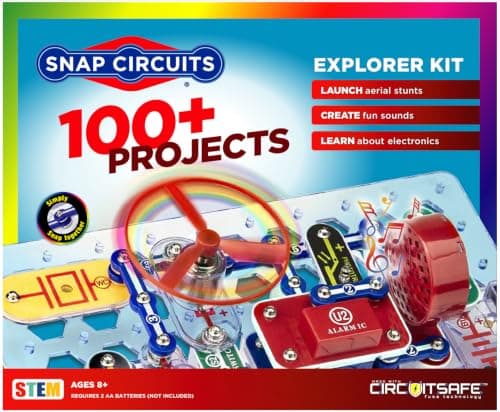
    Snap Circuits publishes the Jr. SC-100 for ages 8+ with 100+ projects — the same system as the ranked Classic set at roughly half the project count. The honest sequence for an uncertain buy is this one first, and the bigger set only if it gets used.

  • Blue Marble NASA Lunar Telescope for Kids

    If the telescope has to be findable rather than powerful

    NASA Lunar Telescope for Kids

    Age grade 8–12

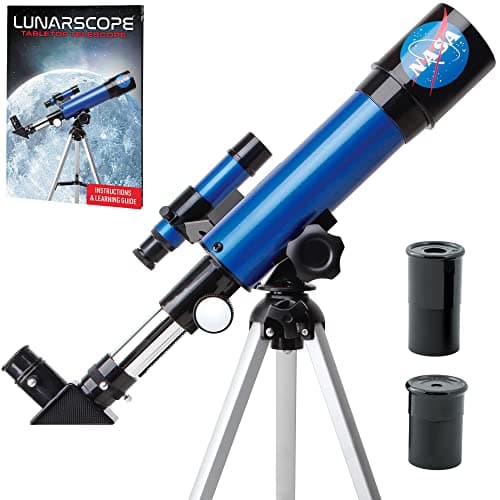
    Blue Marble publishes the NASA Lunar Telescope for ages 8 to 12 with tripod and finder scope. Smaller than the ranked 80mm and easier to aim, which for a child who has never found anything in the sky is the more important specification.

  • ThinkFun ThinkFun Rush Hour Traffic Jam Logic Game

    If the logic game needs to fit in a bag

    ThinkFun Rush Hour Traffic Jam Logic Game

    Age grade 8+

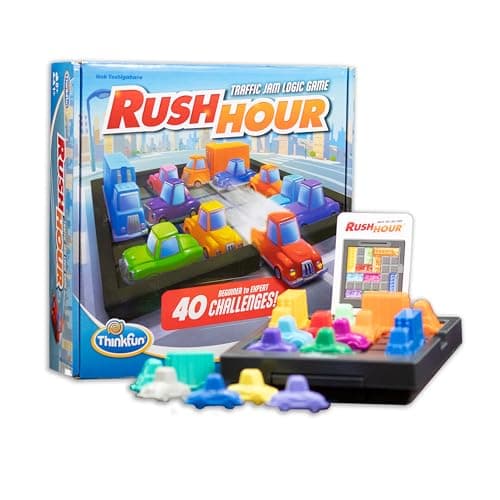
    ThinkFun publishes Rush Hour for kids age 8 and up: a grid, sliding cars and a graded challenge deck. Flatter and more portable than the ranked three-dimensional set, and the better buy for a child who solves things on a plane.

  • Doctor Jupiter Ultimate Science Experiments Kit

    If this is a first science present rather than an upgrade

    Ultimate Science Experiments Kit

    Age grade 8+

    Doctor Jupiter publishes this Ultimate Science Experiments Kit for ages 8+. It is the breadth buy rather than the depth buy — reactions, density, gas, colour and crystals in one box — and it is the right first purchase when nobody can yet say which part of science the child likes. It is consumable, which is why it is listed here rather than ranked.

#ad · As an Amazon Associate we earn from qualifying purchases. How this works.

How we picked

Toys we claim to have played with: 0

Every toy site tells you they tested forty toys with a focus group of real children. We have not played with any of these, and we say so. Here is what we do instead: we read the manufacturer’s own listing and print its published age grade word for word, we record the battery requirement and the assembly note where the maker publishes one and say plainly when it does not, we pull the price live from Amazon so it is never a number we remembered, and we name one thing on every list we would not buy.

The noise and mess ratings are our judgment from what the listing describes — not measurements. Almost no toy manufacturer publishes a decibel figure, which is itself worth knowing. The full method is published, including what disqualifies a toy.

Questions

Questions people actually ask

What are the best STEM toys for a 9-year-old?
Snap Circuits Classic SC-300, graded 8+ with 300 or more projects. At nine a child starts modifying circuits instead of copying them, which is exactly when the smaller hundred-project set runs out — so the larger box is the one with a second year in it.
Is a 9-year-old ready for a chemistry set?
Not for the ones graded 10+, and almost all the chemistry sets worth owning are. The grade is about what is in the tubes rather than how hard the instructions are, so the honest answer is to wait a year, or buy an 8+ general experiment kit in the meantime.
What size telescope should a 9-year-old have?
Aperture is the specification that matters and it cannot be marketed around. An 80mm refractor collects substantially more light than the 50mm starter scopes, which is the difference between the moon being impressive and a usable view of what is behind it. Both are graded 8 to 12.
How is this different from the 8-year-old page?
The shelf is the same — nearly everything here is graded 8+. What changes is which version is right: three hundred projects rather than a hundred, 80mm rather than 50mm, a microscope used for records rather than for surprises. The eight-year-old page ranks the entry versions; this one ranks the upgrades.

Keep reading

Receipts

Sources

We do not run a playroom test lab and we do not pretend to. Age grades, battery requirements and assembly notes are quoted from each manufacturer’s own product listing, read on September 7, 2026; prices come live from Amazon’s API and are stamped with the date they were checked. Where a maker publishes nothing, the page says “manufacturer does not publish this” rather than guessing. Read the full method.