Seven is an awkward year to shop. Half the interesting science kits on the shelf are graded 8+, and the child can now read well enough to be insulted by anything aimed at five. What seven does unlock is the open-ended engineering systems.
We earn a commission if you buy through our links. It does not change the price you pay and it does not decide our picks — our method is published in full, including the part where we say we have not played with these toys. How this works.
Top pick
K'NEX Adventure Wheels Building Set, 480 Pieces
Best overall at seven, and the first system graded exactly here · K'NEX grades it 7+.
#ad · we may earn a commission · prices come live from Amazon and were last checked November 25, 2026. Where we have no verified live price we show none.
#ad · Prices come live from Amazon’s API and were last checked November 25, 2026. Where we have no verified live price we show none — we would rather leave a gap than print a number that has gone stale. Age grades are the manufacturer’s own; noise is our reading, not a measurement.
The verdict: the top pick is the 480-piece K’NEX Adventure Wheels set, published as ideal for ages 7 and above — rods and connectors that have to be braced properly or the model sags, which is the one structural idea a brick set cannot teach. It is for the child who builds things that move. The budget pick is the LEGO Creator 3-in-1 set, graded 7+: the cheapest thing here, and the cheapest way to teach a child that a set is parts rather than a model.
Every age grade is the manufacturer’s own published wording, and every price comes from the price layer with the date it was checked printed under the table. We have not played with these toys and never claim to have — the method is published in full.
Why seven is the awkward year
Shop this category at seven and you will notice the same thing we did: a large share of the science kits worth owning are graded 8+, and there is nothing in between. Electronics sets, rock tumblers, the serious logic games, most decent telescopes — all 8+. The shelf below that is written for five-year-olds, and a seven-year-old knows it on sight.
The answer is not to buy a kit a year early. Age grades on this kind of product are usually a small-parts or a chemical judgment rather than a difficulty estimate, so ignoring one is a safety decision dressed up as a parenting decision. The answer is that seven has its own category, and it is the open-ended construction systems: K’NEX, Quadrilla, fort frames. These are graded at or below seven, they have no ceiling, and they are the only STEM toys that genuinely get better as the child does. If the seven-year-old turns eight within a few months, the 8+ shelf is worth waiting for rather than approximating — Snap Circuits Jr. and the ThinkFun logic games are both graded 8+ and both sit on the eight-year-old page.
The three things we checked
The published grade, printed as the maker wrote it. Nothing is recommended below its own number. Three of the eight picks here are graded exactly 7; the rest carry wider published ranges that include seven. How to read a grade is its own page, because the number means different things on a chemistry set and a card game.
Whether it has a second year in it. This is the question that decides most of the ranking. The systems above are graded to twelve or have no stated ceiling; the marble run listed below the picks is the one whose published range ends at eight, which is why it sits there rather than in the ranking.
Whether a seven-year-old can run it alone. Six of the eight here are hand-it-over toys. The microscope and the telescope are not, and we have said so on each rather than letting the listing imply otherwise.
Matching the pick to the child
Builds things that move: K’NEX, with no real competition at this age. The wheels are the point.
Builds things that stand: the fort kit for a child who wants to be inside it, Quadrilla for a child who wants to watch something travel through it.
Asks how things work: the microscope at seven is a different toy from the microscope at five, because the child now keeps a record of what they looked at.
Likes to win: No Stress Chess. It is the only pick here with an opponent, and the removable card layer is the most honest teaching design in the games aisle.
Wants a computer: the floor robot, not a tablet. The argument in full is on coding toys for kids.
What we would not buy at seven
An 8+ kit bought a year early “because they are advanced”. The grade on an electronics or chemistry set is about contents, not cleverness. A seven-year-old who gets a set they cannot be left alone with ends up with a box an adult has to supervise, which means it gets opened twice.
A single-model licensed building set as the main present. It gets built once, in an evening, and then it is an ornament that cannot be taken apart without a row. The 3-in-1 set above costs a fraction of one and teaches the opposite lesson. The full argument is on what actually gets played with.
And a “STEM” kit whose contents are a plastic tray, three chemicals you already own and a booklet. Seven is old enough to notice. Six science kits ranked by what is actually in the box are on the science kits comparison.
In detail
Every pick, in full
01
Best overall at seven, and the first system graded exactly here
K'NEX Adventure Wheels Building Set, 480 Pieces
K'NEX
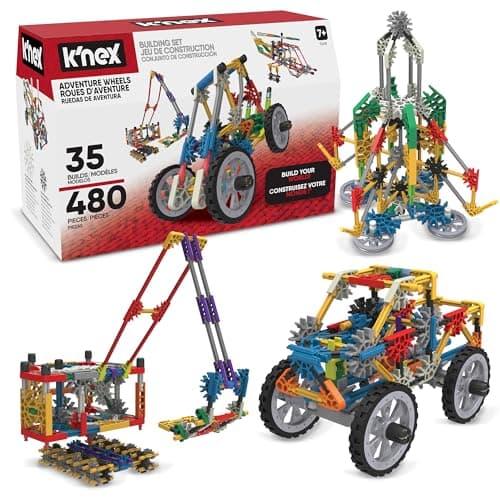
K'NEX publishes this 480-piece Adventure Wheels set as ideal for kids ages 7 and above, and seven is the floor of its own published range rather than a stretch — which is the whole reason it leads. Rods and connectors are a different kind of building from bricks: the pieces have to be put in tension and triangulated or the model sags, so a seven-year-old learns the thing a brick set cannot teach, which is that a structure is only as good as its bracing. 480 pieces is enough for several vehicles at once rather than one model that gets built and shelved, and the wheels mean the finished thing moves, which is what keeps it on the floor rather than on a shelf. Honest limits: separating K'NEX connectors is genuinely hard on seven-year-old fingers for the first week, and the pieces are small, loud in a tub and ruthless underfoot.
Age grade:
7+
Batteries:
manufacturer does not publish a battery requirement
Noise:
Quiet
Mess:
Spreads
Assembly:
manufacturer does not publish an assembly time
Price:
$37.43 as of November 25, 2026
Age grade, battery and assembly wording are quoted from K'NEX’s own product listing, read on September 7, 2026. The manufacturer’s exact words: “ideal for kids ages 7 and above”. Noise and mess are our reading, not a measurement — we have not played with this.
What it gets right
+480 pieces means real builds, not a demonstration model
+Rod-and-connector geometry makes vehicles and structures a brick set genuinely cannot
+Published 7+ grade, and the pieces are big enough that it is an honest 7 rather than a cautious one
What it doesn’t
−Rods under a sofa, forever
−Does not combine with anything else the child owns — it is its own island
How loud
Wheels on a hard floor, and the click of connectors. Nothing electronic.
How much mess
Rods roll. That is the whole problem with rod-and-connector systems and there is no fixing it.
Skip this if…
…storage is already the problem. K'NEX needs a deep bin of its own and does not tidy into a shared toy box in any useful way.
Price checked November 25, 2026. Toy prices move constantly, especially in December — Amazon’s price at checkout is the one that counts.
#ad · we may earn a commission from this link to K'NEX Adventure Wheels Building Set, 480 Pieces
02
Best for biology, and seven is where the manual starts to matter
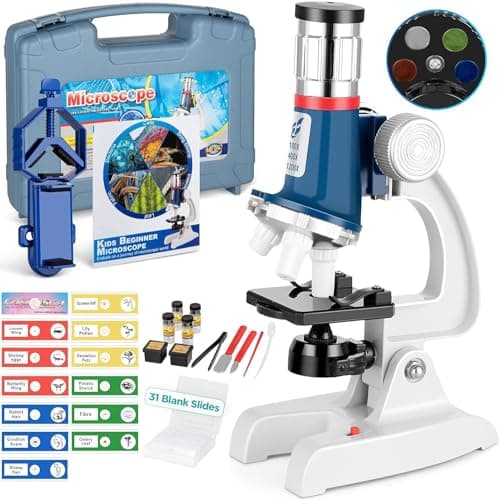
58-Piece Kids Microscope Kit
Uarzt
Uarzt publishes this 58-piece kit for ages 5 to 12. It is on the five-year-old page too, and it belongs on both for different reasons: at five an adult focuses it and the child looks, while at seven the child reads the magnification numbers, prepares a slide and keeps a record of what they saw. That is the year a microscope stops being a surprise and starts being an instrument. 100x to 1200x, metal body, LED stage light, prepared slides included so the first session happens the evening it arrives. Honest limits: it needs 2 AA batteries that are not included, and the highest magnification is the least useful — at 1200x the depth of field is so thin that a seven-year-old sees a grey blur and concludes the microscope is broken rather than that the slide has moved.
Age grade:
5–12
Batteries:
Requires 2 AA batteries (not included)
Noise:
Silent
Mess:
Contained
Assembly:
manufacturer does not publish an assembly time
Price:
$29.87 as of November 25, 2026
Age grade, battery and assembly wording are quoted from Uarzt’s own product listing, read on September 7, 2026. The manufacturer’s exact words: “Ages 5-12”. Noise and mess are our reading, not a measurement — we have not played with this.
What it gets right
+Metal body rather than the plastic toy microscopes at the same price, so focus actually holds
+Prepared slides included, so there is something to look at immediately
+Published 5 to 12 range makes it a genuinely long-lived purchase
What it doesn’t
−Requires 2 AA batteries, not included, for the LED
−Glass slides in a kit graded from five needs an adult present the first few times
How loud
Nothing but an LED.
How much mess
Slides and small tools in a case. The slides are glass, which is the thing to supervise.
Skip this if…
…the child is at the young end and unsupervised. Focusing a microscope is fiddly and glass slides break — five-year-olds need company for this one.
Best logic buy of the year, graded 7+ and designed to be outgrown
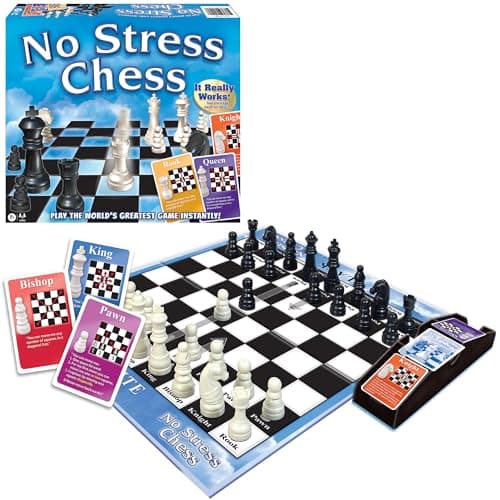
No Stress Chess
Winning Moves
Winning Moves publishes No Stress Chess for ages 7 and up. It is a real chess set with a teaching layer bolted on: the board is printed with the moves, and a deck of cards tells the player which piece to move, so a seven-year-old plays a legal game on day one without memorising anything. Then the cards come out and it is chess. That is a rare and honest design — the training wheels are physically removable rather than a mode you grow out of — and it is the cheapest route from zero to actually playing chess that we know of. Honest limits: the card phase is not chess, and a child who only ever plays with the cards has not learned the game, so somebody has to call time on them; and the pieces and board are the plastic you would expect at this price, not a set anyone keeps for life.
Age grade:
7+
Batteries:
manufacturer does not publish a battery requirement
Noise:
Silent
Mess:
Contained
Assembly:
manufacturer does not publish an assembly time
Price:
$16.99 as of November 25, 2026
Age grade, battery and assembly wording are quoted from Winning Moves’s own product listing, read on September 7, 2026. The manufacturer’s exact words: “Age 7+”. Noise and mess are our reading, not a measurement — we have not played with this.
What it gets right
+Teaches through play rather than through instruction, so no adult has to be a chess coach
+The board itself is a reference card, which is a genuinely good design idea
+Converts into an ordinary chess set once the cards are no longer needed
What it doesn’t
−The card mechanic removes the strategy, so it is training wheels rather than chess
−A child who already knows the moves has no use for the deck
How loud
Chess pieces on cardboard.
How much mess
Thirty-two pieces and a card tray. Chess pieces are famously the thing you find behind a radiator.
Skip this if…
…the child can already play chess. At that point this is an ordinary chess set with an unnecessary deck of cards and a higher price.
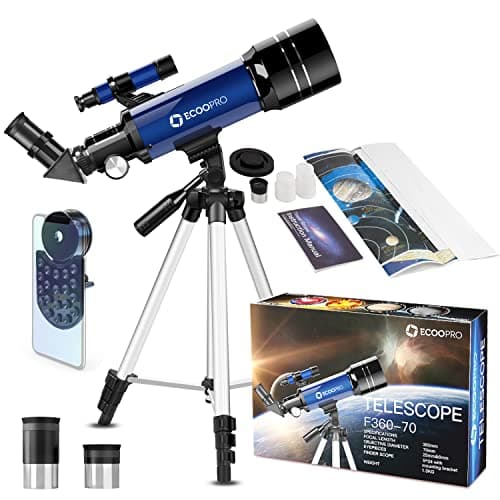
ECOOPRO publishes this 70mm refractor for ages 5 to 12, and seven is the age it stops being a parent's project. A seven-year-old can be taught the finder scope, can hold a target once it is found, and can understand why the image drifts out of the eyepiece — which is the Earth turning, and that is one of the better conversations available for the price of a toy. Seventy millimetres at 15x to 150x shows lunar craters in relief and Jupiter's four big moons in a line. Honest limits: the image is upside-down, which is normal in a refractor and alarming the first time; the tripod is the weak part and every touch wobbles the view for two seconds; and it is useless on a cloudy week, which is more weeks than anyone expects.
Age grade:
5–12
Batteries:
manufacturer does not publish a battery requirement
Noise:
Silent
Mess:
No mess
Assembly:
manufacturer does not publish an assembly time
Price:
$50.86 as of November 25, 2026
Age grade, battery and assembly wording are quoted from ECOOPRO’s own product listing, read on September 7, 2026. The manufacturer’s exact words: “ages 5-12”. Noise and mess are our reading, not a measurement — we have not played with this.
What it gets right
+70mm aperture genuinely gathers enough light for the Moon and the brighter planets
+Wide published 5 to 12 age range, so it stays useful as the child's interest deepens
+Comes with the tripod, which is half of whether a telescope is usable
What it doesn’t
−The 150x maximum magnification is marketing — usable magnification on a 70mm is far lower and the top eyepiece is mush
−A five-year-old cannot aim it alone, whatever the lower bound on the box says
How loud
Nothing.
How much mess
One instrument. Eyepieces are the only losable parts.
Skip this if…
…nobody in the house is willing to stand outside in the cold with the child. A telescope is a two-person hobby at this age and it dies without the adult.
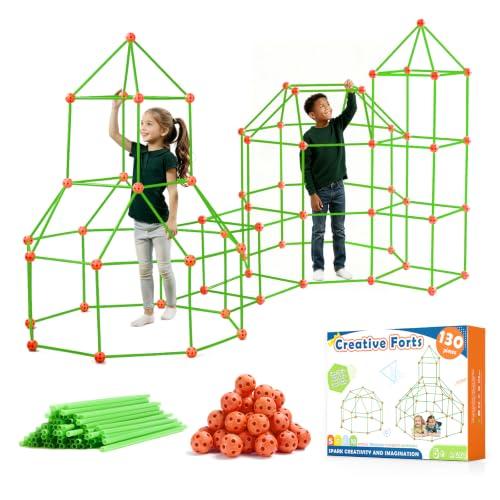
Tiny Land publishes this 69-piece kit for ages 4 to 12, and seven is the age the engineering becomes deliberate. A four-year-old builds whatever stands; a seven-year-old sets out to build a specific shape, discovers the square frame racks sideways, and adds a diagonal. That is statics, learned in an afternoon with no adult involved at all. The finished structure is big enough to sit inside, which is why it holds attention past the build. Honest limits: it is a bag of rods and connectors, and a kit missing four connectors builds a shape the child did not want — so it needs a container with a zip and a rule about it. And the covering is a blanket from the airing cupboard, which looks exactly like a blanket from the airing cupboard.
Age grade:
4–12
Batteries:
manufacturer does not publish a battery requirement
Noise:
Quiet
Mess:
Spreads
Assembly:
manufacturer does not publish an assembly time
Price:
$37.99 as of November 25, 2026
Age grade, battery and assembly wording are quoted from Tiny Land’s own product listing, read on September 7, 2026. The manufacturer’s exact words: “Ages 4-12”. Noise and mess are our reading, not a measurement — we have not played with this.
What it gets right
+The published 4 to 12 range is one of the widest on this site, and it holds up — the toy scales with ambition, not with dexterity
+Uses blankets and sheets you already own, so the kit is the skeleton and the household supplies the rest
+Packs down into a bag between uses, unlike a play tent that is either up or in a cupboard
What it doesn’t
−The finished fort is enormous and there is nowhere polite to put it
−Connectors can crack if a fort is leaned on hard, and they are the part that fails
How loud
Nothing electronic. It is a construction toy made of poles.
How much mess
Not messy so much as territorial. A finished fort occupies a whole room until somebody dismantles it.
Skip this if…
…you do not have a room you can lose for a weekend. This toy's whole value is that it takes over a space, and in a small apartment that is a cost, not a feature.
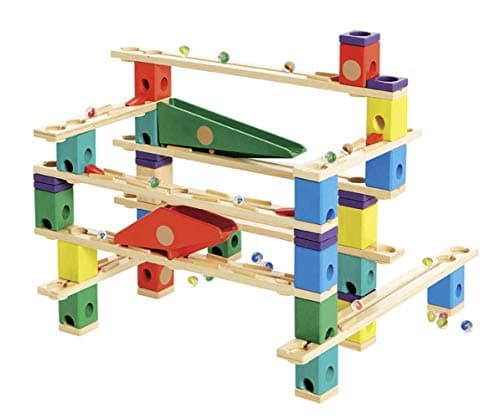
Hape states Quadrilla is best suited to kids 4 and up, and seven is where it finally gets used the way it was designed. The wooden blocks route marbles by internal channels rather than by visible track, so the builder has to predict where a marble will come out of a block before committing to the next one — which is modelling, not assembly, and it is beyond most five-year-olds and exactly right at seven. 134 pieces, wood, and a system Hape designs to be expanded rather than replaced, so money spent at seven is not stranded at nine. Honest limits: a scratch build takes an adult the first few times; the clatter of marbles on wood is pleasant for ten minutes and less so for the ninetieth run; and loose marbles are a flat no in a house with a crawling baby.
Age grade:
4+
Batteries:
manufacturer does not publish a battery requirement
Noise:
Some noise
Mess:
Spreads
Assembly:
manufacturer does not publish an assembly time
Price:
$89.49 as of November 25, 2026
Age grade, battery and assembly wording are quoted from Hape’s own product listing, read on September 7, 2026. The manufacturer’s exact words: “best suited to kids ages 4+”. Noise and mess are our reading, not a measurement — we have not played with this.
What it gets right
+The routing blocks make the run a genuine puzzle rather than a fixed track
+Wood construction, and Hape sets are designed to expand rather than be replaced
+134 pieces is enough for a build with real height, which is the whole appeal
What it doesn’t
−Marbles and a crawling baby are a straightforward no
−Rebuilding from scratch takes an adult the first few times
How loud
Marbles on wood is a constant clattering. Pleasant for ten minutes; less so for the ninetieth run of the afternoon.
How much mess
Marbles escape. They roll under everything, and a lost marble is a set with a hole in it.
Skip this if…
…there is a child under three in the house at all. Loose marbles are the textbook small part, and a marble run cannot be built out of reach.
Price checked November 25, 2026. Toy prices move constantly, especially in December — Amazon’s price at checkout is the one that counts.
#ad · we may earn a commission from this link to Hape Quadrilla Vertigo Wooden Marble Run, 134 Pieces
07
Best screen-free coding, and the pick a seven-year-old debugs properly
Code & Go Robot Mouse, Rechargeable
Learning Resources
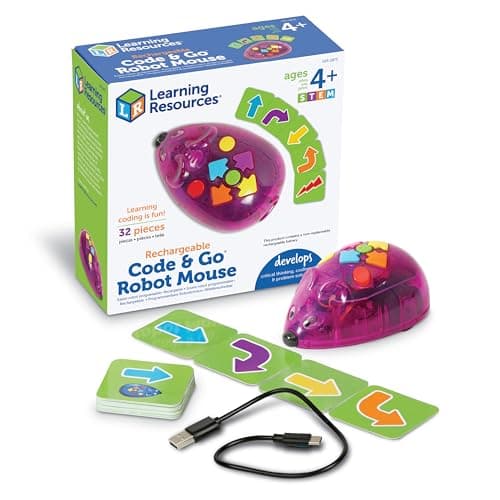
Learning Resources grades this 4+ and states no screens are required. It is graded well below seven and it is ranked anyway for a specific reason: the activity scales with the child rather than the grade. A four-year-old runs three steps and watches. A seven-year-old writes a twelve-step route, runs it, sees it fail at step nine and fixes step nine — which is debugging, and it is the single most useful habit in the whole subject. The physical card sequence makes the program visible on the floor, which no app does. It charges over USB, so there are no batteries to buy. Honest limits: this version is sold as an add-on or replacement, so there are no maze walls in the box and the course gets built from books; and a seven-year-old exhausts the supplied cards faster than the maker seems to expect.
Age grade:
4+
Batteries:
manufacturer does not publish a battery requirement
Noise:
Quiet
Mess:
Contained
Assembly:
manufacturer does not publish an assembly time
Price:
$39.99 as of November 25, 2026
Age grade, battery and assembly wording are quoted from Learning Resources’s own product listing, read on September 7, 2026. The manufacturer’s exact words: “Ages 4+”. Noise and mess are our reading, not a measurement — we have not played with this.
What it gets right
+Rechargeable over a USB cord, so this is a powered toy with no AA batteries to buy, ever
+Learning Resources states “screen-free coding fundamentals” and “no screens required” on the listing — the claim is the maker's, not ours
+Thirty double-sided coding cards and an activity guide are in the box, which is what turns button-pressing into sequencing
What it doesn’t
−No maze walls, tunnels or cheese wedge — the maker lists this version as a replacement or add-on for the Code & Go activity sets
−Graded 4+, but planning a route before running it is the entire activity, so at four an adult is on the floor too
How loud
Learning Resources advertises no sound feature on this listing at all — what it advertises is screen-free coding. The noise is a small motor on a hard floor.
How much mess
One mouse, a charging cord and thirty cards. The cards are the only thing that goes missing.
Skip this if…
…you want the maze. This is the rechargeable mouse plus cards, which Learning Resources sells as an add-on or replacement for the activity sets — buy an activity set if you want walls and tunnels in the box.
Budget pick — cheapest thing here graded exactly 7, and it rebuilds twice
LEGO Creator 3-in-1 Wild Animals
LEGO
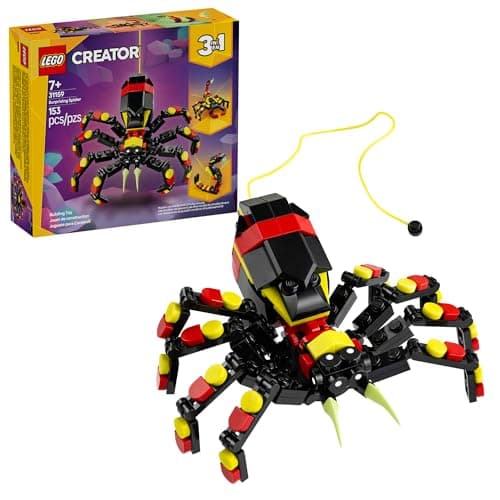
LEGO publishes this Creator 3-in-1 Wild Animals set for ages 7+, and it is the budget pick by a wide margin while still being graded exactly at the age. The 3-in-1 format is the reason it earns the slot rather than just being the cheapest: the same parts build a spider, a scorpion or a snake, and the booklet shows all three, so the child is explicitly taught that a set is parts rather than a model. That is the idea that turns a LEGO owner into a LEGO builder, and this is the cheapest place to buy it. Honest limits: it is small, and a seven-year-old builds all three versions in one afternoon; and once the novelty of the three builds is gone, the part count is too low to do much freestyle with on its own.
Age grade:
7+
Batteries:
manufacturer does not publish a battery requirement
Noise:
Silent
Mess:
Contained
Assembly:
manufacturer does not publish an assembly time
Price:
$6.29 as of November 25, 2026
Age grade, battery and assembly wording are quoted from LEGO’s own product listing, read on September 7, 2026. The manufacturer’s exact words: “Ages 7+”. Noise and mess are our reading, not a measurement — we have not played with this.
What it gets right
+Three published builds from one parts pile, so the box gets opened more than once
+Small enough to be a stocking filler or a party-bag-adjacent gift rather than a main present
+Instructions for all three models are supplied, which matters for a child who does not yet freestyle
What it doesn’t
−Genuinely small — this is a snack, not a meal
−The 7+ grade is about the fiddliness of the pieces, and it is accurate
How loud
Nothing in the box makes a sound.
How much mess
A small set. One bag of pieces, and the rebuild is the point so they stay together.
Skip this if…
…you need this to be the main gift. It is a good extra and a poor centerpiece; buying it as the big present will land flat.
Every one of these carries its manufacturer’s published age grade and a live Amazon price, read November 25, 2026. Full rankings live in the roundups linked above.
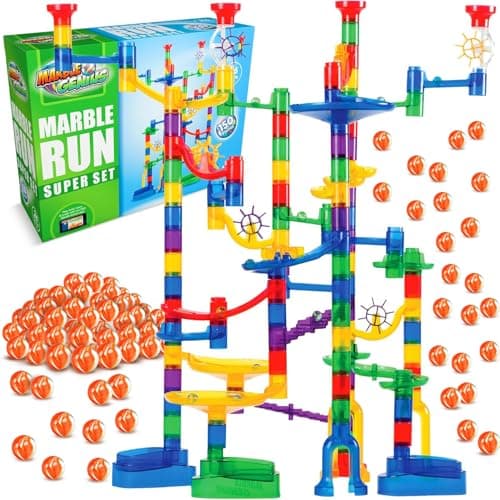
If the house wants a marble run tonight rather than a system
Marble Genius Marble Run Super Set, 150 Pieces
Age grade 4–8
Marble Genius designs this 150-piece translucent set for ages 4 to 8. It is the plastic, fast, build-it-in-ten-minutes answer to the wooden system above — less to learn, less to think about, and a tower that goes high on the first attempt. Seven is the top of its published range, which is the honest reason it is not ranked here.
If the science happens outdoors and at short notice
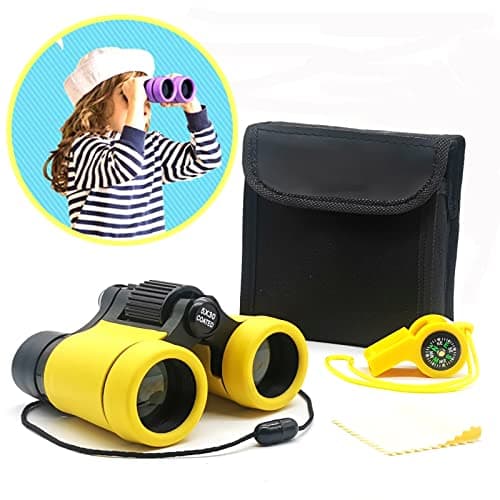
ARTOMIDE Kids Binoculars with Compass
Age grade 3–12
ARTOMIDE publishes these for ages 3 to 12, with a compass and whistle on the strap and a shockproof body. The cheapest real optics we hold, and the pair that actually leaves the house — a seven-year-old can set the barrel spacing without help, which a five-year-old cannot.
If the geometry is more interesting than the machines
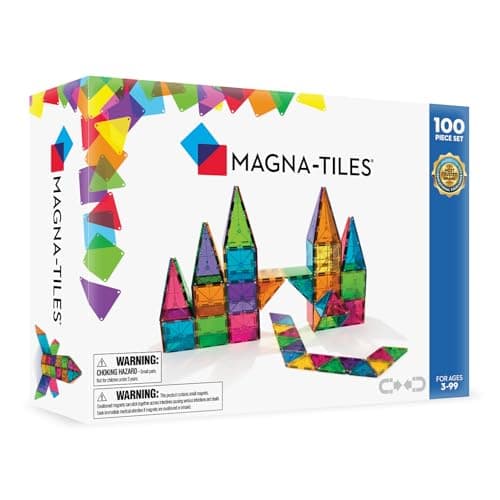
Magna-Tiles Classic 100-Piece Set
Age grade 3+
Magna-Tiles publishes the Classic set for builders aged 3 to 99, and the maker backs it with a lifetime warranty against manufacturing defects. At seven the appeal changes from making shapes to making structures that hold a roof up, which is the same question K'NEX asks with a different material.
If the thinking should happen at a table with other people
CATAN Junior
Age grade 6+
CATAN publishes CATAN Junior for ages 6+, 2 to 4 players, with a stated 30-minute playtime. It is resource trading simplified to a child's scale, and it is the cheapest introduction to the one idea no other pick here teaches: that a plan has to survive somebody else's plan.
#ad · As an Amazon Associate we earn from qualifying purchases. How this works.
How we picked
Toys we claim to have played with: 0
Every toy site tells you they tested forty toys with a focus group of real children. We have not played with any of these, and we say so. Here is what we do instead: we read the manufacturer’s own listing and print its published age grade word for word, we record the battery requirement and the assembly note where the maker publishes one and say plainly when it does not, we pull the price live from Amazon so it is never a number we remembered, and we name one thing on every list we would not buy.
The noise and mess ratings are our judgment from what the listing describes — not measurements. Almost no toy manufacturer publishes a decibel figure, which is itself worth knowing. The full method is published, including what disqualifies a toy.
Questions
Questions people actually ask
What are the best STEM toys for a 7-year-old?+
The 480-piece K’NEX Adventure Wheels set, published as ideal for ages 7 and above. Rods and connectors force a child to brace a structure properly, which is the one idea a brick set cannot teach, and 480 pieces is enough to build several things at once rather than one model that gets shelved.
Why are so many science kits graded 8+?+
Because the grade is usually a small-parts or chemical judgment rather than a difficulty estimate. Electronics sets, chemistry sets and rock tumblers all carry contents the maker will not sign off below eight. Buying one a year early does not make it safe, it makes it a supervised activity.
Is a 7-year-old old enough for chess?+
Yes, with the teaching version above, which its maker grades 7+. The board is printed with the moves and a card deck tells the player which piece to move, so a seven-year-old plays a legal game on day one. Remove the cards and it is ordinary chess on the same set.
What should I buy if they turn 8 soon?+
Wait for the electronics kit. Snap Circuits Jr. is graded 8+ with 100+ projects and is the single strongest STEM purchase on this site; approximating it with something graded lower is a worse gift than a short wait. The eight-year-old page is what opens up.
We do not run a playroom test lab and we do not pretend to. Age grades, battery requirements and assembly notes are quoted from each manufacturer’s own product listing, read on September 7, 2026; prices come live from Amazon’s API and are stamped with the date they were checked. Where a maker publishes nothing, the page says “manufacturer does not publish this” rather than guessing. Read the full method.