Five is the year the pretend science ends. A microscope and a telescope both carry published grades that start at five — so for the first time the honest answer to “something sciencey” is an actual instrument rather than a toy shaped like one.
We earn a commission if you buy through our links. It does not change the price you pay and it does not decide our picks — our method is published in full, including the part where we say we have not played with these toys. How this works.
Top pick
58-Piece Kids Microscope Kit
Best overall at five, and the first real instrument graded for the age · Uarzt grades it 5–12.
#ad · we may earn a commission · prices come live from Amazon and were last checked November 25, 2026. Where we have no verified live price we show none.
#ad · Prices come live from Amazon’s API and were last checked November 25, 2026. Where we have no verified live price we show none — we would rather leave a gap than print a number that has gone stale. Age grades are the manufacturer’s own; noise is our reading, not a measurement.
The verdict: the top pick is the 58-piece microscope kit, published for ages 5 to 12 — a metal-bodied instrument with an LED stage light, and the first piece of real science equipment whose own age grade starts exactly at five. It is for the child who wants to look at things. The budget pick is the kids’ binoculars, graded 3 to 12: the cheapest real optics on this page, and the pair that actually gets carried outside.
Every age grade below is the manufacturer’s own published wording, and every price comes from the price layer with the date it was checked printed under the table. We have not played with these toys and do not say otherwise — the method is published in full.
What actually changes at five
Four is the hardest year in this category, because a four-year-old cannot read and almost every box marked STEM quietly requires it. Five does not fix the reading problem. What it fixes is the grading problem: five is the first year that two genuine scientific instruments — a compound microscope and a refracting telescope — carry published grades that include the child. That is not a marketing distinction. It is the difference between a toy that imitates science and a tool that does it, and a five-year-old can tell.
The second change is patience. A five-year-old will go back and alter one step of something that did not work, rather than knocking it over and starting again. Every pick on this page rewards that: a route that can be re-sequenced, a marble run that can be raised by one level, a fort whose roof fell in for a reason. If the child is not there yet, the four-year-old page is written around materials with a rule in them instead, and nothing on it needs reading either.
The three things we checked
A published age grade that includes five, printed as the maker wrote it. Nothing here is recommended below its printed number. Age accuracy on a toy site is a safety matter rather than a style choice, and the grade is usually a small-parts judgment — loose marbles and 1200x slide covers both qualify. How to read one: age grades explained.
Whether a five-year-old can start it alone. Three picks here need an adult for the first session — focusing the microscope, finding anything at all with the telescope, and setting the binocular spacing. We have said so on each one rather than letting the box imply otherwise. Everything else is hand it over and walk away.
What happens in year two. Five of the eight picks carry published ranges that run to eight, to twelve, or further. A STEM toy that is finished by Christmas is not cheap at any price, which is the argument of toys worth the money.
Matching the pick to the child
The child who asks what things are made of: the microscope, with no real competition. Nothing else on this page produces a surprise that big in the first ten minutes.
The child who asks about space: the 70mm refractor, on the condition that an adult is going outside too. The binoculars are the cheaper version of the same instinct and need nobody’s help after the first lesson.
The child who lines things up and plans: the coding mouse or the cooperative path game. Both are sequencing — one on a floor, one on a table.
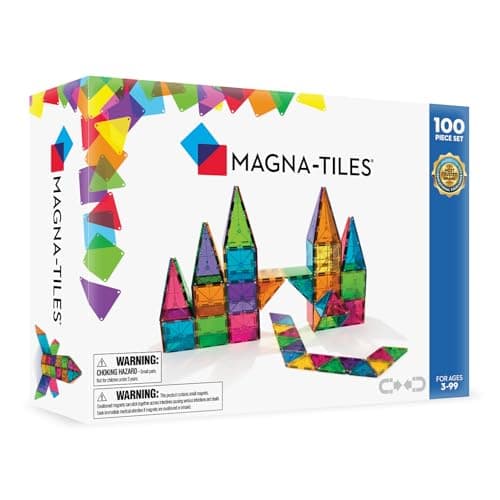
The child who builds: the magnetic tiles or the fort kit. Tiles for a child who builds small and detailed, the fort for a child who wants to be inside the thing. The whole ladder is on toys for the builder.
The child who wants a machine: honestly, wait. The electronics and robot kits that suit that instinct are graded 8 and up almost without exception, and the six-year-old page is the next step rather than a shortcut to them.
What we would not buy for a five-year-old
A chemistry set. The ones worth owning are graded 10 and up for a reason printed on the box that is about the contents rather than the difficulty, and the ones graded for a five-year-old are baking soda and vinegar sold at a chemistry-set price. If the child wants reactions, do them in the kitchen for nothing and spend the money on the microscope.
A tablet-based coding product. At five the screen becomes the activity within a week and the plastic accessory ends up in a drawer; the floor-robot format above survives because there is nothing else to look at. The same argument, at every age, is on tech toys without screens.
And a branded “science lab” play set — the ones with a plastic microscope that does not magnify. A five-year-old who has been given a toy microscope and then meets a real one is not impressed twice. Buy the real one once.
In detail
Every pick, in full
01
Best overall at five, and the first real instrument graded for the age
58-Piece Kids Microscope Kit
Uarzt
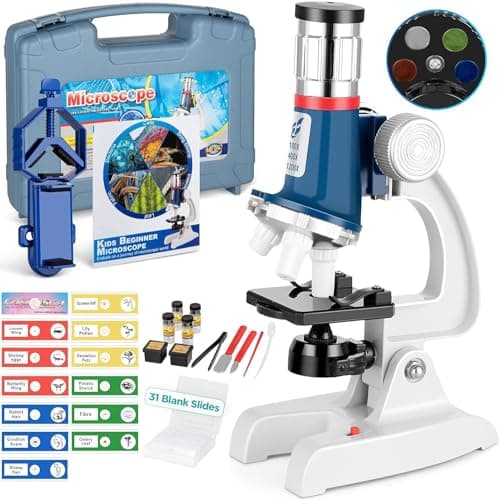
Uarzt publishes this 58-piece kit for ages 5 to 12, which is the fact that puts it first: it is a metal-bodied microscope with an LED stage light and 100x to 1200x magnification, and five is the bottom of its own published range rather than a stretch. A five-year-old cannot read the manual and does not need to — the activity is putting a thing under the lens and looking at it, and a prepared slide of an onion skin or an insect wing is genuinely startling at this age in a way no plastic lab set manages. Slides are included, so the first session happens the evening it arrives rather than after a trip to a shop. Two honest limits. It takes 2 AA batteries, not included, for the stage light, and the light is most of why the cheap end of this category disappoints. And at five an adult focuses it: the fine adjustment is fiddly, and a child who spins the knob to the end of its travel sees a grey blur and decides the thing is broken.
Age grade:
5–12
Batteries:
Requires 2 AA batteries (not included)
Noise:
Silent
Mess:
Contained
Assembly:
manufacturer does not publish an assembly time
Price:
$29.87 as of November 25, 2026
Age grade, battery and assembly wording are quoted from Uarzt’s own product listing, read on September 7, 2026. The manufacturer’s exact words: “Ages 5-12”. Noise and mess are our reading, not a measurement — we have not played with this.
What it gets right
+Metal body rather than the plastic toy microscopes at the same price, so focus actually holds
+Prepared slides included, so there is something to look at immediately
+Published 5 to 12 range makes it a genuinely long-lived purchase
What it doesn’t
−Requires 2 AA batteries, not included, for the LED
−Glass slides in a kit graded from five needs an adult present the first few times
How loud
Nothing but an LED.
How much mess
Slides and small tools in a case. The slides are glass, which is the thing to supervise.
Skip this if…
…the child is at the young end and unsupervised. Focusing a microscope is fiddly and glass slides break — five-year-olds need company for this one.
Best coding toy, and it works with no screen at all
Code & Go Robot Mouse, Rechargeable
Learning Resources
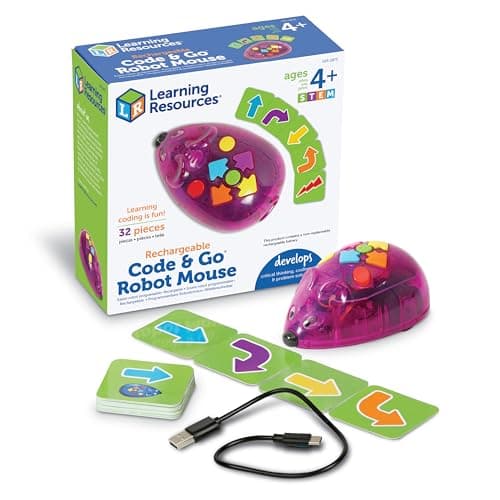
Learning Resources grades this 4+ and states on its own listing that no screens are required, which is why it ranks over every tablet-plus-plastic-accessory product sold as coding for this age. The child presses direction buttons to build a sequence, lays a route on the floor, then runs it and watches it work or fail. At five the failure is the whole lesson and it is a better one than at four, because a five-year-old will now go back and change one step rather than start again — which is debugging, without anybody using the word. It charges over USB, so there are no AA batteries to buy ever. Honest limits: this version is sold as an add-on or replacement for the maker's activity sets, so there are no maze walls or tunnels in the box and you will be building the course out of books; and planning a route before running it is an adult-on-the-floor activity for the first few weeks.
Age grade:
4+
Batteries:
manufacturer does not publish a battery requirement
Noise:
Quiet
Mess:
Contained
Assembly:
manufacturer does not publish an assembly time
Price:
$39.99 as of November 25, 2026
Age grade, battery and assembly wording are quoted from Learning Resources’s own product listing, read on September 7, 2026. The manufacturer’s exact words: “Ages 4+”. Noise and mess are our reading, not a measurement — we have not played with this.
What it gets right
+Rechargeable over a USB cord, so this is a powered toy with no AA batteries to buy, ever
+Learning Resources states “screen-free coding fundamentals” and “no screens required” on the listing — the claim is the maker's, not ours
+Thirty double-sided coding cards and an activity guide are in the box, which is what turns button-pressing into sequencing
What it doesn’t
−No maze walls, tunnels or cheese wedge — the maker lists this version as a replacement or add-on for the Code & Go activity sets
−Graded 4+, but planning a route before running it is the entire activity, so at four an adult is on the floor too
How loud
Learning Resources advertises no sound feature on this listing at all — what it advertises is screen-free coding. The noise is a small motor on a hard floor.
How much mess
One mouse, a charging cord and thirty cards. The cards are the only thing that goes missing.
Skip this if…
…you want the maze. This is the rechargeable mouse plus cards, which Learning Resources sells as an add-on or replacement for the activity sets — buy an activity set if you want walls and tunnels in the box.
Best for the child who asks about the moon, graded 5 to 12
70mm Refractor Telescope for Kids and Adults
ECOOPRO
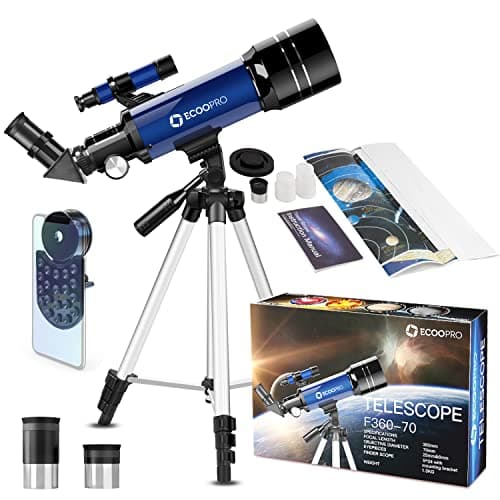
ECOOPRO publishes this 70mm refractor for ages 5 to 12 — the same published floor as the microscope, which is what makes five the year this becomes a real option rather than a gesture. Seventy millimetres of aperture at 15x to 150x is enough to show lunar craters in relief and to put Jupiter's four big moons in a line, and seeing those two things is the difference between a child who owns a telescope and a child who uses one. It stands on its own tripod rather than needing a table. The limits are the ones nobody prints. A five-year-old cannot find anything in the sky alone, so this is a thing you do together or it stays in the box; the image is upside-down, which is normal for a refractor and alarming the first time; and it is useless indoors, so it needs a clear night and somebody willing to stand outside in one.
Age grade:
5–12
Batteries:
manufacturer does not publish a battery requirement
Noise:
Silent
Mess:
No mess
Assembly:
manufacturer does not publish an assembly time
Price:
$50.86 as of November 25, 2026
Age grade, battery and assembly wording are quoted from ECOOPRO’s own product listing, read on September 7, 2026. The manufacturer’s exact words: “ages 5-12”. Noise and mess are our reading, not a measurement — we have not played with this.
What it gets right
+70mm aperture genuinely gathers enough light for the Moon and the brighter planets
+Wide published 5 to 12 age range, so it stays useful as the child's interest deepens
+Comes with the tripod, which is half of whether a telescope is usable
What it doesn’t
−The 150x maximum magnification is marketing — usable magnification on a 70mm is far lower and the top eyepiece is mush
−A five-year-old cannot aim it alone, whatever the lower bound on the box says
How loud
Nothing.
How much mess
One instrument. Eyepieces are the only losable parts.
Skip this if…
…nobody in the house is willing to stand outside in the cold with the child. A telescope is a two-person hobby at this age and it dies without the adult.
Best logic game graded exactly five, and nobody loses
Peaceable Kingdom Race to the Treasure!
Peaceable Kingdom
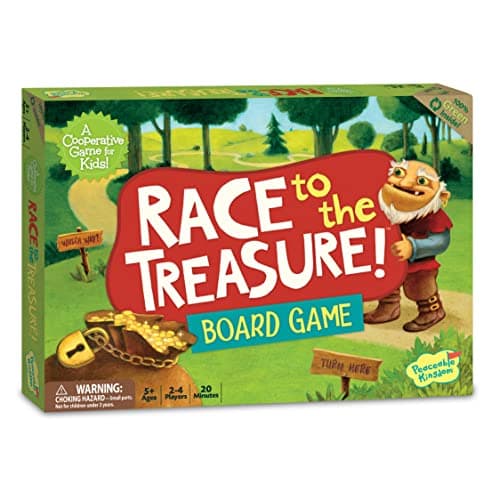
Peaceable Kingdom publishes Race to the Treasure! for ages 5 and up, 2 to 4 players, and it is the only ranked pick here whose grade starts at five rather than below it. The mechanic is a genuine piece of mathematics dressed as a board game: players draw path tiles and lay them to build a continuous route from the start to the treasure before the ogre arrives, which is pathfinding, and a five-year-old plays it as a puzzle rather than a race. It is cooperative, so the table wins or loses together — which at five is the difference between a game played twice and a game played all winter. Honest limits: it is short, around twenty minutes, so it is an after-school game rather than an evening; and the cooperative format means a dominant older sibling can quietly play the whole thing for everyone unless an adult stops it.
Age grade:
5+
Batteries:
manufacturer does not publish a battery requirement
Noise:
Quiet
Mess:
Contained
Assembly:
manufacturer does not publish an assembly time
Price:
$17.99 as of November 25, 2026
Age grade, battery and assembly wording are quoted from Peaceable Kingdom’s own product listing, read on September 7, 2026. The manufacturer’s exact words: “Ages 5+”. Noise and mess are our reading, not a measurement — we have not played with this.
What it gets right
+Bridges the gap between toddler cooperative games and rules-heavy family games
+Path-building introduces genuine spatial planning at five
+Short enough that a five-year-old finishes a whole game in one sitting
What it doesn’t
−Repetitive once the strategy is understood, which happens quickly for an older child
−Small tiles are easy to lose and the game needs all of them
How loud
Cardboard tiles. Nothing electronic.
How much mess
Path tiles and a small board. All of it fits back in the box.
Skip this if…
…the child is seven or older. They will solve it in two plays and want something with real decisions.
Best physics you do not have to explain, graded 4 to 8
Marble Genius Marble Run Super Set, 150 Pieces
Marble Genius
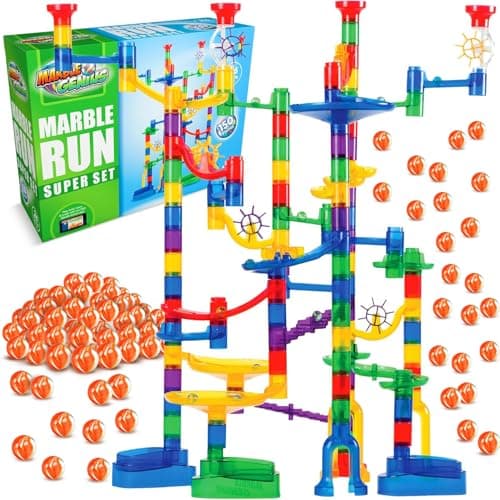
Marble Genius designs this for 4 to 8 and puts 150 translucent pieces in the box, which is the number that matters, because at five the goal is height and 150 pieces builds high enough to be worth the afternoon. Gravity does all the teaching: raise the start and the marble runs faster, leave a gap and the marble is on the carpet, and the child fixes it without anyone using the phrase potential energy. Five is the sweet spot for this set — a four-year-old mostly needs an adult to keep the tower standing, while a five-year-old plans two levels ahead and rebuilds after a collapse instead of giving up. Two warnings that are not on the box: plastic tubes amplify a marble into a rattle you hear through a wall, and loose marbles are a straightforward no in any house with a crawling baby, because a half-built run cannot be put out of reach.
Age grade:
4–8
Batteries:
manufacturer does not publish a battery requirement
Noise:
Some noise
Mess:
Spreads
Assembly:
manufacturer does not publish an assembly time
Price:
$43.99 as of November 25, 2026
Age grade, battery and assembly wording are quoted from Marble Genius’s own product listing, read on September 7, 2026. The manufacturer’s exact words: “designed for kids ages 4-8”. Noise and mess are our reading, not a measurement — we have not played with this.
What it gets right
+150 pieces builds tall, and height is what a four-year-old is actually after
+Translucent pieces make the marble visible through the run, which is most of the fun
+Considerably cheaper per piece than the wooden systems
What it doesn’t
−Plastic joins loosen with repeated rebuilding
−The published 4 to 8 window is honest — a nine-year-old is done with it
How loud
Plastic tubes amplify a marble. It is a rattle you hear from another room.
How much mess
Marbles plus small connectors. Two categories of thing that get lost, in one box.
Skip this if…
…the household includes an under-three. Same rule as every marble toy: the marbles are the hazard, and there is nowhere safe to put a half-built run.
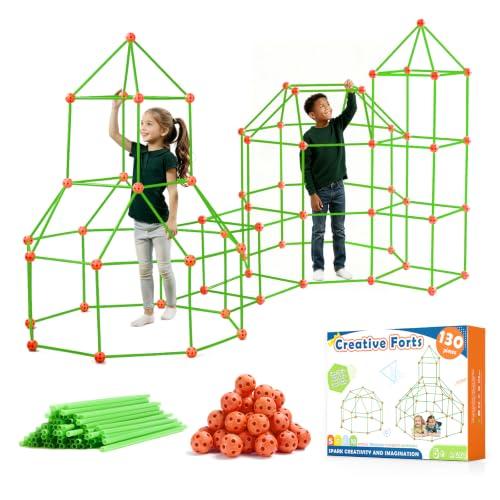
Tiny Land publishes this 69-piece kit for ages 4 to 12 and sells it as a STEM building toy, which for once is accurate rather than marketing: rods and connectors that make a free-standing frame are a lesson in triangles against squares that a five-year-old learns by having the roof fall in. It is the only thing on this page the child can get inside, which is why it holds a five-year-old longer than its parts count suggests, and the published range runs to twelve, so it is not a one-year purchase. Honest limits. The covering is a blanket from the airing cupboard and looks exactly like one, because the kit is a frame rather than a tent. And a 69-piece kit lives in a bag that has to be zipped, because a fort kit with four connectors missing builds a shape the child did not want.
Age grade:
4–12
Batteries:
manufacturer does not publish a battery requirement
Noise:
Quiet
Mess:
Spreads
Assembly:
manufacturer does not publish an assembly time
Price:
$37.99 as of November 25, 2026
Age grade, battery and assembly wording are quoted from Tiny Land’s own product listing, read on September 7, 2026. The manufacturer’s exact words: “Ages 4-12”. Noise and mess are our reading, not a measurement — we have not played with this.
What it gets right
+The published 4 to 12 range is one of the widest on this site, and it holds up — the toy scales with ambition, not with dexterity
+Uses blankets and sheets you already own, so the kit is the skeleton and the household supplies the rest
+Packs down into a bag between uses, unlike a play tent that is either up or in a cupboard
What it doesn’t
−The finished fort is enormous and there is nowhere polite to put it
−Connectors can crack if a fort is leaned on hard, and they are the part that fails
How loud
Nothing electronic. It is a construction toy made of poles.
How much mess
Not messy so much as territorial. A finished fort occupies a whole room until somebody dismantles it.
Skip this if…
…you do not have a room you can lose for a weekend. This toy's whole value is that it takes over a space, and in a small apartment that is a cost, not a feature.
Best magnetic tiles for the money, and the pick with the longest runway
PicassoTiles 100-Piece Clear Magnetic Tiles
PicassoTiles
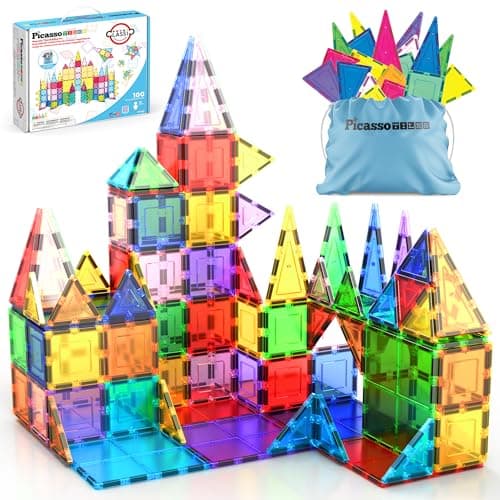
PicassoTiles publishes this 100-piece clear set for kids 3 and up. Magnetic tiles are the one open-ended material that is as interesting at eight as at three, and the reason they belong on a STEM page rather than a blocks page is that the magnets impose a rule — the pieces only join one way round — so the child works inside a constraint rather than stacking. At five the builds change character: flat shapes become boxes, and boxes become buildings with a roof that has to be held up. This is the value brand rather than the original, and that is the whole case for it, because 100 pieces is where magnetic tiles get good and the original costs roughly double for the same count. Honest limits: the magnets are weaker than Magna-Tiles and a tall tower knows it, and the plastic scratches, so a two-year-old set looks its age.
Age grade:
3+
Batteries:
manufacturer does not publish a battery requirement
Noise:
Quiet
Mess:
Contained
Assembly:
manufacturer does not publish an assembly time
Price:
$27.99 as of November 25, 2026
Age grade, battery and assembly wording are quoted from PicassoTiles’s own product listing, read on September 7, 2026. The manufacturer’s exact words: “for Kids 3+”. Noise and mess are our reading, not a measurement — we have not played with this.
What it gets right
+A hundred pieces at a price where the flagship brands sell you thirty-two
+Clear tiles, which is the version that actually does something interesting on a sunny window or a light table
+Compatible with the other magnetic tile systems, so it extends a set you already own
What it doesn’t
−No lifetime warranty published — the value comes from somewhere
−Magnet strength is the usual complaint against the cheaper tiles; tall towers give up sooner
How loud
No electronics. Tiles clicking together is the whole soundtrack.
How much mess
Flat pieces, one bin. Nothing sharp and nothing that rolls under furniture.
Skip this if…
…you are buying the set that gets handed down. If the tiles need to survive two more children, the brands that publish a lifetime defect warranty are the ones making that promise in writing.
Budget pick — the cheapest real instrument here, graded 3 to 12
ARTOMIDE Kids Binoculars with Compass
ARTOMIDE
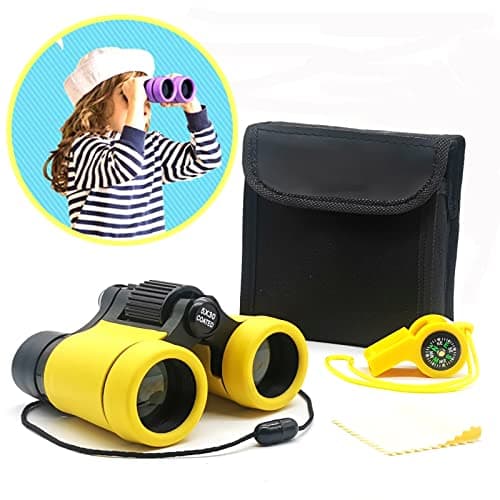
ARTOMIDE publishes these for ages 3 to 12 with a compass and a whistle on the strap, and they are the budget pick by a wide margin while still being a real optical instrument rather than a toy with lenses in it. They earn the slot because of where science actually happens at five, which is outdoors and at short notice: a bird on a far fence, a plane, the top of a tree. The body is shockproof, which on a five-year-old's first optics is not a feature but a requirement. Honest limits, and the first one decides whether they get used: a five-year-old has to be taught to adjust the barrel spacing to their own eyes or they see two circles and give up, and that is a five-minute lesson nobody includes in the box. The compass is a toy compass — accurate enough for which way is roughly north, and no more than that.
Age grade:
3–12
Batteries:
manufacturer does not publish a battery requirement
Noise:
Silent
Mess:
No mess
Assembly:
manufacturer does not publish an assembly time
Price:
$9.99 as of November 25, 2026
Age grade, battery and assembly wording are quoted from ARTOMIDE’s own product listing, read on September 7, 2026. The manufacturer’s exact words: “Ages 3-12”. Noise and mess are our reading, not a measurement — we have not played with this.
What it gets right
+Published from 3 years, which is five years earlier than any telescope here, and the lowest-priced thing in this registry by some distance
+Rubber armor and a stated drop-resistant housing — this is the rare optic designed around being dropped
+Folding barrels adjust to a small child's eye spacing, which is the usual reason kids' binoculars do not work
+Usable in daylight, so it gets used in the hundreds of hours a telescope cannot
What it doesn’t
−5x magnification is modest, and the maker states a furthest usable range of roughly 328 to 492 feet in good conditions
−A toy-grade optic: the view is clear in the center and soft at the edges
−Will not show a single crater on the Moon, which is what a child asking for a telescope is actually asking for
How loud
Optics and a plastic whistle. The whistle is the only thing in the box that makes a sound, and it is the first thing to confiscate.
How much mess
One object on a neck strap.
Skip this if…
…the child specifically asked to look at space. Binoculars are the better optic for a six-year-old in almost every way except the one they care about, and a substitute gift that misses the point lands badly.
Every one of these carries its manufacturer’s published age grade and a live Amazon price, read November 25, 2026. Full rankings live in the roundups linked above.
If the tiles are going to be the household's main toy for five years
Magna-Tiles Classic 100-Piece Set
Age grade 3+
Magna-Tiles publishes the Classic set for builders aged 3 to 99 and backs it with a lifetime warranty against manufacturing defects, which almost nothing else in this bracket will put in writing. It is roughly double the value brands per piece. Worth it only if this is going to be the toy, rather than a toy.
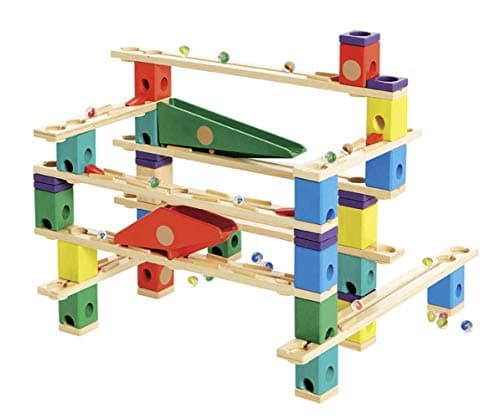
Hape states Quadrilla is best suited to kids 4 and up. The wooden blocks route marbles by internal channels rather than fixed track, so the child designs a path instead of assembling one — harder at five, much more interesting at seven. 134 pieces, wood, and a system Hape designs to be expanded rather than replaced.
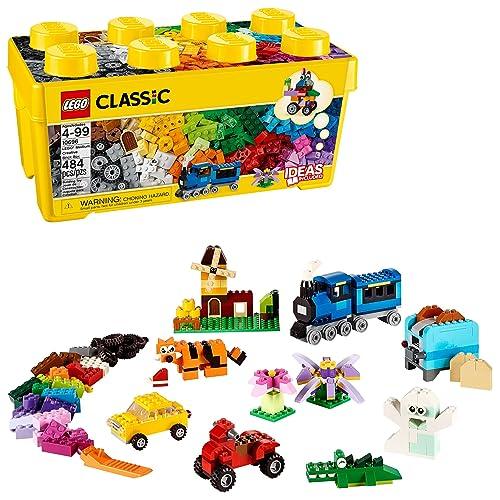
LEGO publishes this box for ages 4 to 99. No theme, no minifigure, no model to rebuild — a box of parts with a lidded storage bin, which is the right first set for a five-year-old and the wrong one for a child who already builds and wants a themed box they chose themselves.
The maker recommends it from 3 and up and states it is 100% kid-powered: no batteries, no cords, no plugs. Jump on the pad and the rocket goes up — a hard stomp higher than a soft one, an angled launcher further than a vertical one. Rockets end up on roofs, and refills are a recurring purchase.
#ad · As an Amazon Associate we earn from qualifying purchases. How this works.
How we picked
Toys we claim to have played with: 0
Every toy site tells you they tested forty toys with a focus group of real children. We have not played with any of these, and we say so. Here is what we do instead: we read the manufacturer’s own listing and print its published age grade word for word, we record the battery requirement and the assembly note where the maker publishes one and say plainly when it does not, we pull the price live from Amazon so it is never a number we remembered, and we name one thing on every list we would not buy.
The noise and mess ratings are our judgment from what the listing describes — not measurements. Almost no toy manufacturer publishes a decibel figure, which is itself worth knowing. The full method is published, including what disqualifies a toy.
Questions
Questions people actually ask
What are the best STEM toys for a 5-year-old?+
The 58-piece microscope kit, published for ages 5 to 12. It is a metal-bodied instrument with an LED stage light and prepared slides in the box, and five is the bottom of its own published range rather than a stretch — so it is real science equipment rather than a toy shaped like it.
Is a 5-year-old too young for a telescope?+
Not for the 70mm refractor above, which its maker publishes for ages 5 to 12. The honest caveat is that a five-year-old cannot find anything in the sky alone and the image is upside-down, so it is a thing you do together. If nobody in the house wants to stand outside on a cold night, buy the binoculars instead.
Can a 5-year-old use a coding toy without a screen?+
Yes. The floor robot above is graded 4+ and its maker states no screens are required: the child presses direction buttons to build a sequence, lays a route and runs it. It charges over USB, so there are no batteries to buy.
How is this different from the 4-year-old page?+
Reading is not the difference — neither page needs it. The difference is that five is the first year a microscope and a telescope carry published grades that include the child, and that a five-year-old will fix one step of something that failed instead of starting over. The four-year-old page is built around materials with a rule in them.
We do not run a playroom test lab and we do not pretend to. Age grades, battery requirements and assembly notes are quoted from each manufacturer’s own product listing, read on September 7, 2026; prices come live from Amazon’s API and are stamped with the date they were checked. Where a maker publishes nothing, the page says “manufacturer does not publish this” rather than guessing. Read the full method.