KiwiCo sells monthly project crates, split into lines by age — Panda, Koala, Kiwi, Atlas, Tinker, Doodle, Eureka, Maker. The question worth asking is not whether the projects are good, it is whether you want one arriving every month forever.
We earn a commission if you buy through our links. It does not change the price you pay and it does not decide our picks — our method is published in full, including the part where we say we have not played with these toys. How this works.
Top pick
Ultimate Science Experiments Kit
Best overall alternative, graded 8+, and a season of crates in one box · Doctor Jupiter grades it 8+.
#ad · we may earn a commission · prices come live from Amazon and were last checked November 25, 2026. Where we have no verified live price we show none.
#ad · Prices come live from Amazon’s API and were last checked November 25, 2026. Where we have no verified live price we show none — we would rather leave a gap than print a number that has gone stale. Age grades are the manufacturer’s own; noise is our reading, not a measurement.
The verdict: the top pick is the Ultimate Science Experiments Kit, graded 8+ — a stack of projects delivered at once rather than one a month, and the right buy when nobody is sure which science the child likes. For the structural answer, the Snap Circuits Jr. electronics set, graded 8+, holds 100 or more projects and consumes nothing. The budget pick is the 4,001-piece fuse bead kit, graded 6 and up: the cheapest thing here and the one that lasts longest.
Every age grade is the manufacturer’s own published wording and every price comes live from the price layer with the date it was checked printed under the table. Our method is published in full.
What KiwiCo sells, and why people look for alternatives
KiwiCo publishes its crates as monthly project boxes split into lines by age: Panda and Koala at the younger end, then Kiwi, Atlas, Tinker, Doodle, Eureka and Maker. Each crate is one project with the exact parts, a printed guide and usually a magazine. They are well designed and this page is not an argument that they are not.
The reason “cheaper alternatives to kiwico” and “companies similar to kiwico” are searched as often as they are comes down to three things, and none of them is about quality. The first is that a subscription is a standing charge that outlives the interest — the crates keep arriving after the child has moved on to something else. The second is pace: one project a month is slow for a child who wants to do three on a wet Sunday, and nothing for a child who forgot about it. The third is that a crate is consumed. When the project is finished, the parts are glued to each other and the box is done, which is a different kind of purchase from a kit that rebuilds.
The maths that decides it
The single most useful way to compare a one-off kit with a subscription is projects per purchase, and once you write it down the comparison stops being close:
Electronics set, graded 8+: 100 or more projects, nothing consumed. At a project a month that is eight years. The larger version of the same system holds 300.
Chemistry set, graded 10+: 125 experiments and an 80-page manual. Ten years at a crate a month, with reagents as a running cost.
Solar robot kit, graded 8 to 13: 12 builds from one parts bin, and the parts come apart again.
Fuse bead kit, graded 6+: 4,001 beads and a pattern book — dozens of projects, and it is the cheapest thing on this page.
What the subscription genuinely buys, and what no kit on this page replaces, is that something turns up. A box in the post is an event, and a kit on a shelf is not — a household that struggles to start things may well get more done with the subscription even though the projects cost several times as much. That is a real argument, and it is the only one we think holds.
Matching the alternative to the crate line
Younger craft lines: the water-fuse bead studio, graded 4 and up — no iron and no adult needed, which is rare at that age.
Middle science and art lines: the fuse bead kit at 6+, and the multi-experiment science kit once the child reaches 8.
The engineering and tinkering lines: the electronics set and the gear book, both graded 8+. These are the closest in spirit and the furthest apart in cost per project.
The older science lines: the chemistry set, graded 10+, and the crystal kit for the slow-project month.
None of the above, because the child likes looking rather than making: the microscope listed below the picks. It is an instrument, and it never runs out. The age-by-age version of all of this is on STEM toys by age.
What we would not buy as a substitute
A cheap multi-kit bundle sold on experiment count. Two hundred experiments usually means two hundred variations on three chemicals, and the child notices by the fourth one. Count the distinct ideas, not the activities — the honest version of that comparison is on the science kits comparison.
A kit graded above the child’s age because the subscription would have sent it eventually. On this shelf the grade is about contents rather than difficulty: 10+ on a chemistry set means the reagents, not the reading level.
And a screen-based project subscription as the replacement for a physical one, for the reason set out on tech toys without screens. If the appeal of a crate was that it is a thing made with hands, an app is not the alternative to it — it is the opposite of it.
In detail
Every pick, in full
01
Best overall alternative, graded 8+, and a season of crates in one box
Ultimate Science Experiments Kit
Doctor Jupiter
Doctor Jupiter publishes this Ultimate Science Experiments Kit for ages 8+, and it leads because it answers the actual complaint behind this search: a subscription delivers one project a month, and this delivers a stack of them at once for roughly what a short subscription costs. Breadth is the point — reactions, density, gas, colour, crystals — which is the same survey approach the science-line crates take, with the difference that the child can do three in an afternoon if they are enjoying themselves instead of waiting for the postman. It is the right buy when nobody is sure which science the child likes, because their reaction tells you what to buy next. Honest limits: it is consumable, so the supplies are finished in a few weekends; and the activities are short, so an eight-year-old can burn through half the booklet in a sitting.
Age grade:
8+
Batteries:
manufacturer does not publish a battery requirement
Noise:
Quiet
Mess:
Spreads
Assembly:
manufacturer does not publish an assembly time
Price:
$16.99 as of November 25, 2026
Age grade, battery and assembly wording are quoted from Doctor Jupiter’s own product listing, read on September 7, 2026. The manufacturer’s exact words: “Ages 8+”. Noise and mess are our reading, not a measurement — we have not played with this.
What it gets right
+Consumables included, so the kit works on day one without a shopping trip
+Multiple short experiments rather than one long one, which suits an eight-year-old's session length
+Published 8+ grade and the chemistry is genuinely age-appropriate
What it doesn’t
−Consumables run out and refills are not sold separately — after that it is a box of empty tubes
−Needs an adult nearby, so it is not an independent activity
How loud
Nothing electronic in the box.
How much mess
Powders, liquids and colored reactions on a kitchen table. Cover the surface first; most of it wipes off, some of it stains.
Skip this if…
…nobody has an hour to supervise. A science kit done alone by an unsupervised eight-year-old is either boring or a problem, and neither is what you paid for.
Best alternative to the engineering line, graded 8+, and nothing is consumed
Snap Circuits Jr. SC-100 Electronics Kit
Snap Circuits
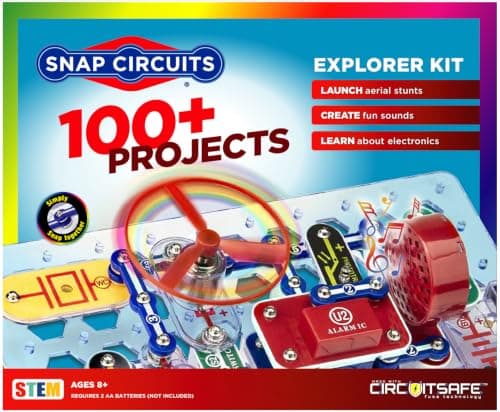
Snap Circuits publishes the Jr. SC-100 for ages 8+ with 100 or more projects. It is the structural answer to a subscription rather than a cheaper version of one: components snap onto a plastic grid, so a working circuit takes about ninety seconds with no tools and no soldering, and because the parts are reusable the hundredth project uses the same components as the first. A hundred projects at one a month is eight years of crates. That maths is the entire argument of this page. Honest limits: it runs on AA batteries that are not included, and a flat set ends a session; and the pieces become a jumble within a month unless somebody insists on the tray, at which point finding the right component becomes the activity instead of building.
Age grade:
8+
Batteries:
manufacturer does not publish a battery requirement
Noise:
Some noise
Mess:
Contained
Assembly:
manufacturer does not publish an assembly time
Price:
$32.99 as of November 25, 2026
Age grade, battery and assembly wording are quoted from Snap Circuits’s own product listing, read on September 7, 2026. The manufacturer’s exact words: “Ages 8+”. Noise and mess are our reading, not a measurement — we have not played with this.
What it gets right
+Over a hundred projects with a real progression, so it is months of activity rather than an afternoon
+No soldering, no exposed wiring — the design removes every reason an adult would say no
+Published 8+ grade, and the projects teach actual circuit concepts rather than dressing them up
What it doesn’t
−Batteries required and not included; check the manual before wrapping it
−The manual is essential, and a lost manual makes the kit nearly useless
How loud
Some projects build a siren or an alarm, and those are as loud as you would expect. Most are silent. No decibel figure is published.
How much mess
Modular parts on a grid base, all of which fit in the tray. The base is the workspace.
Skip this if…
…the child will not follow a diagram. Snap Circuits is a build-from-instructions kit, and freestyling it produces nothing that works.
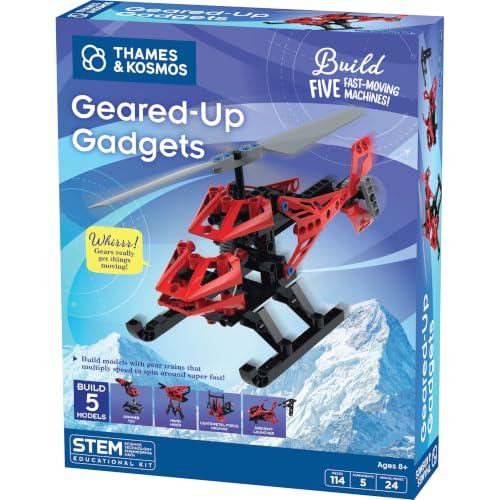
Thames & Kosmos publishes this Geared-Up Gadgets set for Ages 8+, with gears and transmissions as the stated subject: one parts set, five working models — a rescue copter, an aircraft launcher, a hand mixer, a spinner toy and a centripetal force machine — and a 24-page manual that explains the drive behind each one. Of everything on this page it is the nearest in shape to one month's crate: a bound guide, the exact parts needed, a sequence of builds, and an adult-free afternoon at the end of it, with no batteries required anywhere in the box. Honest limits: the parts are the maker's own and nothing on the listing claims LEGO compatibility, so they do not fold into a brick collection once the five builds are done; and five builds is a finite sequence, so it is a few good weekends rather than a year of them.
Age grade:
8+
Batteries:
No batteries required
Noise:
Quiet
Mess:
Contained
Assembly:
manufacturer does not publish an assembly time
Price:
$21.95 as of November 25, 2026
Age grade, battery and assembly wording are quoted from Thames & Kosmos’s own product listing, read on September 7, 2026. The manufacturer’s exact words: “Ages 8+”. Noise and mess are our reading, not a measurement — we have not played with this.
What it gets right
+Gears and transmissions are what the manual teaches, not just what the models happen to contain
+Five models from the same parts set, so finishing the first build does not finish the kit
+The maker publishes no batteries required, which is unusual for a kit whose models move
What it doesn’t
−Five builds is a finite sequence, and the parts are Thames & Kosmos’s own — nothing on the listing claims LEGO compatibility — so they do not fold into a brick collection afterwards
−The maker grades it Ages 8+ in the listing title and “ages 6 and up” in a feature bullet on the same listing; we publish the higher number, but the inconsistency is theirs
How loud
Gears and a hand crank. The maker states no batteries required, so nothing in the box makes a sound on its own.
How much mess
Plastic parts that live in the box they came in. It is published as a 5-in-1, so it is one model at a time out of the same parts — they come apart again rather than accumulating.
Skip this if…
…the household already owns a lot of LEGO Technic. The listing claims no LEGO compatibility, so a Technic bin buys more mechanism per dollar than starting a second, separate parts system does.
Best alternative for an older child, graded 10+, with 125 experiments
Thames & Kosmos Chem C1000 Chemistry Set
Thames & Kosmos
Thames & Kosmos publishes the Chem C1000 V2.1 beginner chemistry set for ages 10+, with 125 hands-on experiments, safety gear and an 80-page manual. It is the serious end of this page and the honest replacement for a year of the older-child crates, because 125 experiments at one a month is longer than most subscriptions survive. An 80-page manual is also a different proposition from a project card: the child is working through a course rather than consuming an activity. Honest limits, and the grade is the first: 10+ is the maker's own published wording and it is about the chemicals, so this is not an eight-year-old's kit however capable they are. The second is that chemistry sets consume reagents, and refills are a real running cost.
Age grade:
10+
Batteries:
manufacturer does not publish a battery requirement
Noise:
Silent
Mess:
Spreads
Assembly:
manufacturer does not publish an assembly time
Price:
$59.95 as of November 25, 2026
Age grade, battery and assembly wording are quoted from Thames & Kosmos’s own product listing, read on September 7, 2026. The manufacturer’s exact words: “Ages 10+”. Noise and mess are our reading, not a measurement — we have not played with this.
What it gets right
+125 experiments and a manual written like a textbook rather than a comic
+Published 10+ grade is honest and should be respected — this is not a seven-year-old's kit
+Genuinely prepares a child for school chemistry rather than just entertaining them
What it doesn’t
−Requires adult supervision throughout, which is a real time commitment
−Chemicals are consumed and replacements have to be sourced individually
How loud
Nothing electronic.
How much mess
Real chemicals on a real surface. This wants a bench, an adult and a wipeable table, in that order.
Skip this if…
…the child is under the published age. A chemistry set below its grade is the one item in this guide where going early is genuinely unsafe, not just disappointing.
Best alternative to the robotics line, graded 8 to 13
12-in-1 Solar Robot Building Kit
Sillbird
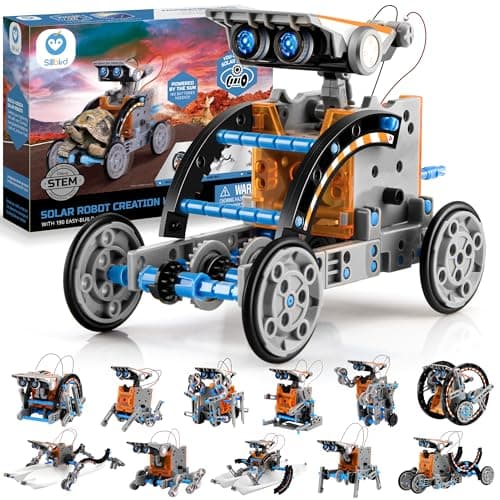
Sillbird publishes this 12-in-1 solar robot building kit for ages 8 to 13 — the widest published range on this page. Twelve machines come out of one parts bin and every one of them runs on a solar cell, so there is no battery, no charging and nothing to replace. Twelve builds is a year of monthly projects in a single box at a fraction of the cost, and the solar drive adds a physics lesson the booklet does not have to teach: the robot stops in shade and restarts in sun, and the child works out why. Honest limits: it genuinely needs direct sun or a bright bulb, so a dark week in winter kills it entirely; and the small plastic tabs are easy to over-tighten and snap, usually on the first build.
Age grade:
8–13
Batteries:
manufacturer does not publish a battery requirement
Noise:
Quiet
Mess:
Contained
Assembly:
manufacturer does not publish an assembly time
Price:
$14.22 as of November 25, 2026
Age grade, battery and assembly wording are quoted from Sillbird’s own product listing, read on September 7, 2026. The manufacturer’s exact words: “Ages 8-13”. Noise and mess are our reading, not a measurement — we have not played with this.
What it gets right
+Solar-powered, so there is no battery cost and nothing to run out on Christmas afternoon
+Twelve published builds from one parts set, which is real rebuild value
+Published 8 to 13 grade with genuine assembly difficulty at the top end
What it doesn’t
−Needs actual direct sunlight; on an overcast January day it does nothing at all
−Small plastic parts that snap off if a build is forced
How loud
Small motor whirring. There is no speaker and no sound feature.
How much mess
Many small plastic parts during assembly. They belong in the box and the box has compartments.
Skip this if…
…you are giving it in midwinter in a dark climate. A solar robot that will not move is a bad first impression that the toy may never recover from.
Best alternative to the one slow project, graded 10 and up
4M Crystal Growing Science Kit
4M
4M recommends this crystal growing kit for ages 10 years and up, with seven crystals and display cases in the box. Every subscription has one month where the project takes weeks rather than an hour, and this is the one-off version of that: crystals form over days, so the child sets something up, leaves it, checks it and leaves it again. Nothing else on this page teaches waiting, and the display cases mean the result gets kept rather than thrown away, which is the difference between a project and an activity. Honest limits: the published grade is 10+ and it is about the chemicals rather than the difficulty, so it is not a younger child's kit; and it is strictly single-use, because once the seven crystals are grown the box is finished.
Age grade:
10+
Batteries:
manufacturer does not publish a battery requirement
Noise:
Silent
Mess:
Contained
Assembly:
manufacturer does not publish an assembly time
Price:
$19.49 as of November 25, 2026
Age grade, battery and assembly wording are quoted from 4M’s own product listing, read on September 7, 2026. The manufacturer’s exact words: “Recommended for ages 10 years and up”. Noise and mess are our reading, not a measurement — we have not played with this.
What it gets right
+The finished crystals are keepable objects and the display cases mean they get kept
+Seven separate growths, so a failure does not end the kit
+Published 10+ grade, and the boiling water step is why
What it doesn’t
−Days of waiting between the setup and the result, which is not obvious from the box
−Requires boiling water and adult involvement at the critical step
How loud
Nothing.
How much mess
Hot water and a chemical powder at the start; after that the crystals just sit there. Contained but not zero.
Skip this if…
…the child needs a result today. Crystal growing is the slowest gift in this guide by an order of magnitude and it disappoints anyone expecting an afternoon.
Best alternative to the younger craft line, graded 4 and up
Aquabeads Deluxe Studio
Aquabeads
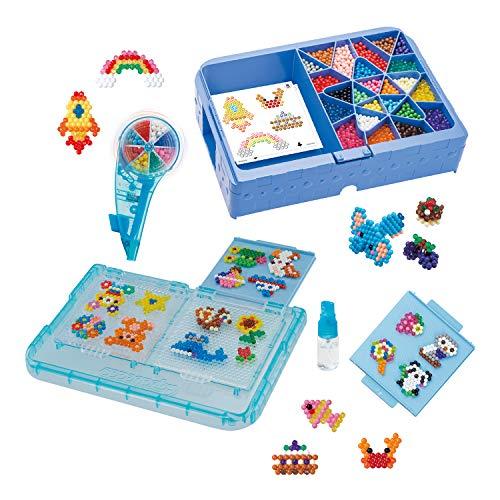
Aquabeads publishes this Deluxe Studio for ages 4 and up — 1,300 water-fuse beads in 24 colours, two flip trays, a bead pen, templates and a sprayer. The younger crate lines are craft rather than science, and this is the strongest one-off answer for that age: the beads fuse with water rather than heat, so a four-year-old can finish a piece alone with no iron and no adult standing over them, which is unusual in this category. Templates mean there is something to make on the first evening and freeform afterwards. Honest limits: loose beads are small, numerous and roll, so this is a tray-and-table activity in a house with a crawling baby or not at all; and the beads are consumable, so refills become a running cost if it takes.
Age grade:
4+
Batteries:
manufacturer does not publish a battery requirement
Noise:
Silent
Mess:
Spreads
Assembly:
manufacturer does not publish an assembly time
Price:
$39.95 as of November 25, 2026
Age grade, battery and assembly wording are quoted from Aquabeads’s own product listing, read on September 7, 2026. The manufacturer’s exact words: “ages 4 and up”. Noise and mess are our reading, not a measurement — we have not played with this.
What it gets right
+No iron, no adult supervision at the dangerous moment — the child can finish a project alone
+Published 4+ grade, two years earlier than fuse beads, because the heat step is removed
+The manufacturer states the under-3 exclusion explicitly, which is the kind of clarity we like to see
What it doesn’t
−Finished pieces are more fragile than ironed fuse beads and come apart if handled hard
−Refill beads are proprietary and the running cost adds up — the theme refill sets are a separate purchase
−Designs have to dry before they can be moved. The maker’s own sequence is spray, flip the tray, then wait — two trays in the box means the next design can start while the first dries, but the object still is not finished when the making is
How loud
Nothing.
How much mess
Small beads, same as fuse beads, but no iron and no scorching. The spill risk is identical; the burn risk is gone.
Skip this if…
…there is a crawling baby. The beads are small, they are designed to be spilled onto a tray, and water makes them stick to floors.
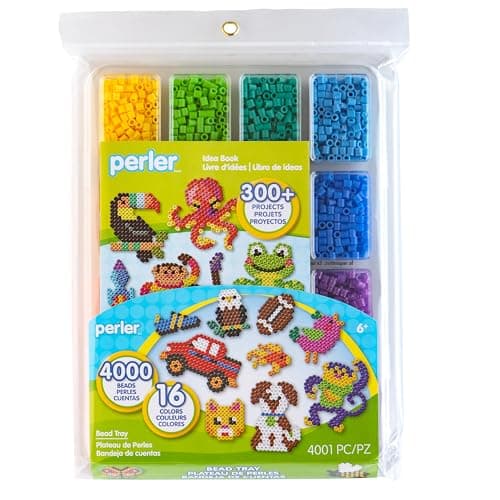
Perler publishes this 4,001-piece fuse bead kit for ages 6 and up, with a storage tray and a pattern book. It is the budget pick and it earns the slot on duration rather than price alone: four thousand beads is dozens of projects, which at one a month outlasts most subscriptions, and the pattern book supplies the ideas a crate would have supplied. The storage tray matters more than it sounds, because a fuse bead kit without compartments is a single colour of bead within a fortnight. Honest limits, and the first is a flat requirement: finishing a Perler piece needs an adult with an iron, every time, which makes it a shared activity rather than a hand-over one; and spilled beads go everywhere and stay there, so a tray is not optional.
Age grade:
6+
Batteries:
manufacturer does not publish a battery requirement
Noise:
Silent
Mess:
Gets everywhere
Assembly:
manufacturer does not publish an assembly time
Price:
$14.59 as of November 25, 2026
Age grade, battery and assembly wording are quoted from Perler’s own product listing, read on September 7, 2026. The manufacturer’s exact words: “for ages 6 and up”. Noise and mess are our reading, not a measurement — we have not played with this.
What it gets right
+The finished pieces are real objects a child can give away, which is unusual for a craft kit
+Storage tray is included, and it is the only thing standing between you and the beads
+Enormously cheap per hour of activity
What it doesn’t
−Requires an adult with an iron for every single project — this is not an independent activity
−Loose beads are the definitive small part and there are thousands of them
How loud
Beads in a tub. Nothing electronic.
How much mess
The worst in this file. Thousands of loose beads with a published 6+ grade — one knocked tray and they are in the floorboards, the vents and the dog.
Skip this if…
…there is a child under three in the house or nobody has time to stand at an ironing board. Both of those disqualify it completely, and the second one is the reason most Perler kits stop being used.
Every one of these carries its manufacturer’s published age grade and a live Amazon price, read November 25, 2026. Full rankings live in the roundups linked above.
If the electronics are going to stick and you want the bigger box
Snap Circuits Classic SC-300 Electronics Kit
Age grade 8+
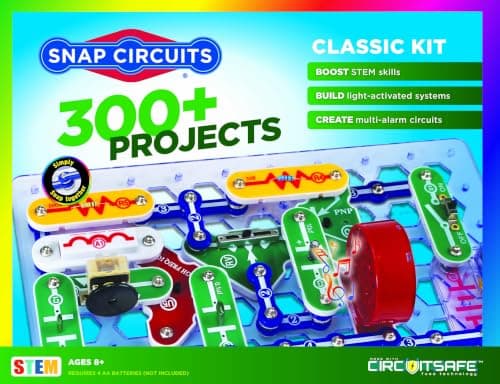
Snap Circuits publishes the Classic SC-300 for ages 8+ with 300+ projects — the same system as the ranked Jr. set with a wider parts bin. Three hundred projects is, at a project a month, longer than any subscription anybody keeps. Buy Jr. first if the interest is a guess.
If the craft line was the reason for the subscription
Friendship Bracelet Making Kit with Loom
Age grade 8–12
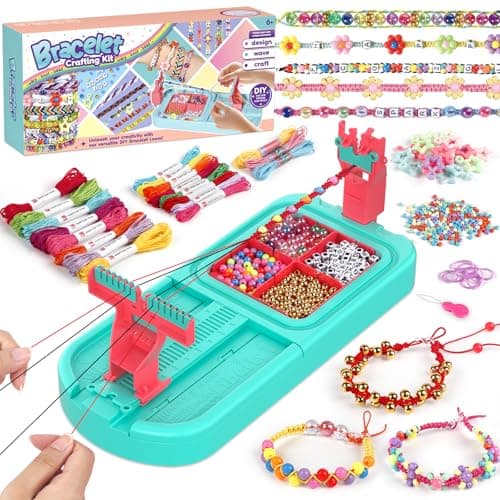
Cmiolacuna publishes this friendship bracelet making kit with a loom for ages 8 to 12. A single skill, practised rather than consumed — which is a different proposition from a monthly project and lasts rather longer than one.
CarlonLin publishes this framed 4-pack of paint-by-number sets for ages 8 to 12, 8 by 8 inches each. Four separate projects, each one producing a framed result — which is the crate experience at its most literal and without the monthly charge.
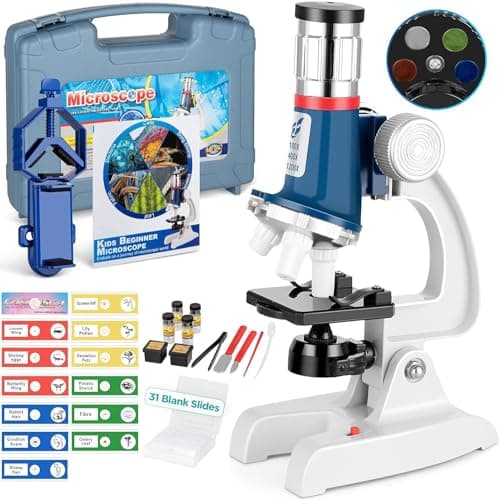
Uarzt publishes this 58-piece microscope kit for ages 5 to 12 — 100x to 1200x, metal body, LED stage light, prepared slides included. An instrument rather than a project: it never runs out, which no crate can say. Needs 2 AA batteries, not included.
#ad · As an Amazon Associate we earn from qualifying purchases. How this works.
How we picked
Toys we claim to have played with: 0
Every toy site tells you they tested forty toys with a focus group of real children. We have not played with any of these, and we say so. Here is what we do instead: we read the manufacturer’s own listing and print its published age grade word for word, we record the battery requirement and the assembly note where the maker publishes one and say plainly when it does not, we pull the price live from Amazon so it is never a number we remembered, and we name one thing on every list we would not buy.
The noise and mess ratings are our judgment from what the listing describes — not measurements. Almost no toy manufacturer publishes a decibel figure, which is itself worth knowing. The full method is published, including what disqualifies a toy.
Questions
Questions people actually ask
What is the best alternative to KiwiCo?+
For a single purchase that covers a season, the Ultimate Science Experiments Kit, graded 8+ — a stack of projects at once rather than one a month. For the best value over years, an electronics kit graded 8+ with 100 or more projects, because nothing in it is consumed.
Is KiwiCo worth the subscription?+
The projects are well designed; what you are really paying for is that one arrives every month without anybody deciding anything. If that regularity is what gets things started in your house, it is worth it. If projects do get started anyway, the same money buys kits with far more projects in them.
What is similar to KiwiCo but cheaper?+
A book-plus-parts activity kit is the closest in shape — a bound guide, the exact parts and a sequence of builds, bought once. The gear kit above, graded 8 to 12, is the clearest example, and its parts are standard LEGO Technic that join the household’s existing bricks afterwards.
What can I buy instead of KiwiCo for a 4-year-old?+
A water-fuse bead studio, graded 4 and up: the beads fuse with water rather than heat, so a four-year-old can finish a piece without an iron or an adult standing over them. Most of the good one-off STEM kits are graded 8+, so the younger end of this category is genuinely thinner.
We do not run a playroom test lab and we do not pretend to. Age grades, battery requirements and assembly notes are quoted from each manufacturer’s own product listing, read on September 7, 2026; prices come live from Amazon’s API and are stamped with the date they were checked. Where a maker publishes nothing, the page says “manufacturer does not publish this” rather than guessing. Read the full method.